Venezuela’s Delcy Rodríguez says oil deal with Trump has ‘endless’ benefits

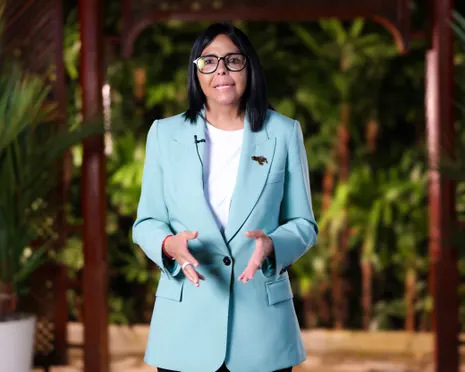
Table of Contents
Venezuela’s Interim Leader Defends Sweeping Oil Pact as Domestic Backlash Intensifies
Wanderstayfinder.com – Delcy Rodríguez, Venezuela’s interim president, stepped onto a television stage on Saturday to stake out a firm defense of what she called an unprecedented energy partnership with the United States. The six-minute broadcast came just hours after Donald Trump publicly unveiled what he branded “the biggest oil deal in world history,” a transaction that would hand Washington operational control over roughly 65 billion barrels of Venezuelan crude reserves. Rodríguez, who has governed since January following the extraordinary seizure of President Nicolás Maduro by American special forces in Caracas, insisted the arrangement would leave ultimate ownership and sovereignty firmly in Venezuelan hands while unlocking billions in development revenue.
“The benefits are endless,” Rodríguez declared, addressing the nation directly.
The former vice-president framed the pact as a necessary step to convert Venezuela’s vast subterranean wealth into tangible economic gains for its citizens. She argued that possessing the world’s largest proven crude oil reserves — an estimated 303 billion barrels, dwarfing Saudi Arabia’s 268 billion and Iran’s 208 billion — is meaningless without the investment, technology, infrastructure, and production capacity to bring that oil to market.
“It’s no use having our oil reserves underground, only to appear in statistics or bookkeeping … and for us not to be able to convert and translate them into development for Venezuela,” she stated.
Trump’s Framing: A “Gift” to American Energy Security
Trump announced the agreement on Friday, describing it as a “historic transaction [that] more than doubles American oil reserves … while helping to continue to set Venezuela on a course toward Tremendous Success and Great Prosperity.” By Sunday, he had taken to his Truth Social platform to elaborate on one particular benefit: replenishing the United States Strategic Petroleum Reserve, which he blamed former president Joe Biden for having “virtually emptied.”
“The ‘topping out’ process will begin very shortly, and is a Gift from Venezuela to the People of the United States,” Trump wrote.
The language of generosity sits in sharp tension with the circumstances under which Rodríguez first assumed power. Hours after Maduro was taken in a special-forces raid on 3 January, Trump issued a pointed warning to his new counterpart: should she fail to align with Washington’s interests, she would face consequences “probably bigger than Maduro.”
What the Agreement Actually Involves
Specifics remain thin, as the pact was negotiated over months of closed-door talks. According to available reporting, the arrangement covers 17 so-called “strategic oilfields” across Venezuela, with a stated ambition of lifting daily output above 1.5 million barrels. Rodríguez projected that the deal would generate more than $209 billion (£154 billion) in revenues and transform the country into what she termed “an energy powerhouse.”
She thanked Trump and US Secretary of State Marco Rubio for brokering the deal, yet appended a clarifying caveat that appeared designed to placate domestic critics:
“There is something that must be made absolutely clear: Venezuela retains the ownership and sovereignty over its resources.”
Opposition and Chavismo Push Back
The reaction inside Venezuela has been swift and bitter. A senior opposition figure, speaking on condition of anonymity on Friday, dismissed the arrangement as “a massive land grab” executed by “a rapacious, mafioso United States.” Rafael Ramírez, the former chief executive of state oil company PDVSA, went further in a written post on X, accusing Rodríguez’s government of “driving a dagger straight into the heart of the homeland” through what he labeled a “neo-colonial” transaction.
“They are handing over 65bn barrels of our reserves to the United States. That has never happened in Venezuela, and I think nowhere else in the world,” Ramírez told the newspaper El Nacional.
On the streets, dozens of left-wing demonstrators marched through Caracas on Saturday carrying placards that read “We are neither a colony, nor a backyard” and “Yankees go home!” Social media users circulated a satirical image proposing that PDVSA be renamed “PDUSA” to reflect the perceived shift in control.
The Irony of Rodríguez’s Political Lineage
The controversy carries a particular sting given Rodríguez’s own background. Daughter of a Marxist guerrilla, she spent years publicly denouncing what she called “imperialist” schemes to seize Venezuela’s hydrocarbons. The socialist, anti-imperialist movement she and Maduro inherited has long positioned itself as a bulwark against foreign extraction of national resources. The current pact, critics argue, represents a dramatic reversal of that founding ethos.
Maduro’s thirteen-year tenure left the country mired in authoritarian governance and one of the most severe peacetime economic collapses in modern history. Rodríguez now claims she is charting a different course — one that trades ideological purity for capital inflows and production scale. Whether Venezuelan voters will accept that trade-off, or whether the sovereignty language in her broadcast will survive contact with the operational realities of American-managed oilfields, remains the central question facing the country in the weeks ahead.
Related Reading
Frequently Asked Questions
What is Venezuela s Delcy Rodríguez says oil deal?
Venezuela s Delcy Rodríguez says oil deal is the main topic of this guide. The article explains the context, practical details, and next steps readers should understand.
Why does Venezuela s Delcy Rodríguez says oil deal matter?
Venezuela s Delcy Rodríguez says oil deal matters because readers are looking for a useful answer, not just a short summary. Good content should match search intent and help them decide what to do next.