Nepal-Tibet deaths from flash flooding rise amid race to free workers in tunnel

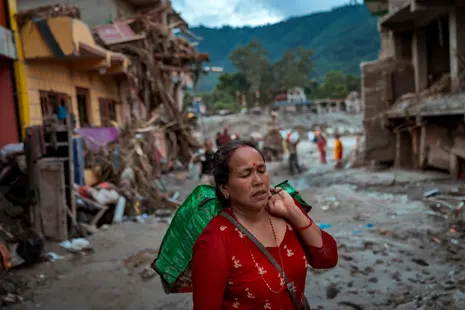
Table of Contents
Nepal Tibet Flood Deaths: Rescue Race in Tunnel
Wanderstayfinder.com – Rescue crews waded through thigh-deep mud under the constant threat of renewed inundation on Sunday, searching for thousands of people whose last known location was inside villages now reduced to rubble along the Nepal-Tibet border. A catastrophic wall of water and debris, triggered by a glacial collapse, tore through the high-altitude corridor on Wednesday morning, swallowing entire settlements in minutes. The Nepal Tibet deaths from flash flooding event has left a landscape of shattered infrastructure and severed lives stretching across both sides of the border.
The combined death toll stood at 797 confirmed fatalities as of the latest updates, while 3,048 individuals remained unaccounted for — a figure that includes hundreds of foreign nationals working or traveling in the region. Some bodies were believed to have been carried downstream by the torrent, potentially as far as Indian territory, complicating recovery efforts already stretched thin by terrain and weather.
Trapped in the Dark: The Trishuli Tunnel Operation
Among the most urgent operations was the effort to reach workers sealed inside the Trishuli 3A hydroelectric complex, where more than 100 personnel were thought to be trapped beneath collapsed tunnel sections. Nepal’s army achieved a critical breakthrough over the weekend by threading a pipe into the buried passage, creating a narrow conduit through which air could be pumped to the workers below.
“We have already started sending air through the small opening, and we will now begin excavation work and send the rescue team inside,” Home Minister Sudan Gurung stated.
Efforts were simultaneously directed at the adjacent Trishuli 3B site. Together, the two locations accounted for a significant share of the 933 hydropower workers listed among the missing by Nepal’s disaster authority. Every hour of delay reduced the odds of finding survivors still breathing in the dark.
Counting the Dead and the Missing
Nepal reported an updated toll of 781 dead within its borders, with 2,502 people — including 592 foreigners — still out of contact. Chinese authorities on the Tibetan side accounted for 16 deaths and 546 missing, among whom 261 were foreign nationals: 104 Nepali, 49 Indian, 33 Latvian, 18 American, and 15 British citizens.
More than 3,700 people had been pulled to safety in Nepal by Sunday. Yet for those whose loved ones remained unaccounted for, the days ahead promised an agonizing limbo. In Kathmandu, relatives and friends gathered outside the main government hospital from before dawn, clutching photographs and scanning patient lists pinned to noticeboards, shuttling between help desks in desperate hope of a single confirming name.
Dil Maya Lama stood weeping near the hospital’s information desk, one of hundreds performing that same futile ritual each morning. The government acknowledged that bodies long submerged in cold mountain water could decompose at an accelerated rate, prompting urgent calls for forensic identification kits and industrial freezer units to preserve remains until families could perform traditional funeral rites. Nepal announced it had begun interring some of the hundreds of recovered bodies only after first collecting DNA samples, so that identification could later allow families to reclaim their dead.
Climate’s Disproportionate Toll
The US Geological Survey attributed the disaster to a glacial collapse that released a massive surge of meltwater and rock debris downstream. Nepal’s foreign minister, Shisir Khanal, used the catastrophe to press for a broader international response to the climate crisis, arguing that the small Himalayan nation was absorbing impacts far beyond its share of global responsibility.
“Despite having only 0.1% contribution to global emissions, people of Nepal have become major victims of climate change,” Khanal said on Saturday.
The remark underscored a recurring tension in climate diplomacy: nations with negligible carbon footprints bear the brunt of glacial instability, intensified monsoon extremes, and accelerating ice loss in the Himalaya — effects that compound existing poverty and limited infrastructure.
Warnings, Exhaustion, and the Long Road to Recovery
Nepal’s National Disaster Risk Reduction and Management Authority issued fresh cautions on Sunday, noting that flood flow in the Bhotekoshi river through Rasuwa district had increased further. Flood alerts were pushed to residents’ mobile phones in the early hours as crews worked to clear a highway linking Kathmandu to one of the hardest-hit zones.
In Dhading, among the most devastated regions, some survivors began returning to the skeletal remains of their homes to salvage what little remained. The nearest intact structures were often kilometers away, and families carried salvaged belongings on their backs through mud-choked paths while search teams continued combing the debris fields above.
Frequently Asked Questions
What caused the Nepal-Tibet border flooding?
According to the US Geological Survey, a glacial collapse released a massive surge of meltwater and rock debris into the Bhotekoshi river system, producing a flash flood that swept through settlements on both sides of the border on Wednesday morning.
How many people are confirmed dead or missing?
As of the latest official updates, 797 fatalities have been confirmed across both countries, and 3,048 people remain missing. Nepal accounts for 781 deaths and 2,502 missing; China’s Tibetan side reports 16 deaths and 546 missing.
Are workers still trapped in the Trishuli tunnels?
More than 100 workers were believed trapped at Trishuli 3A when the collapse occurred. Nepal’s army has threaded an air-supply pipe into the buried section and announced plans to begin excavation and deploy a rescue team. The adjacent Trishuli 3B site is also under active search.
What is being done to identify recovered bodies?
Nepal has begun collecting DNA samples before interring recovered remains so families can later claim their dead. Authorities have also requested forensic identification kits and industrial freezer units to slow decomposition of bodies that spent days submerged in cold mountain water.