Solstice-Aligned 5,000-Year-Old Monument ‘Once in a Lifetime Find’, Say Archaeologists
Wanderstayfinder.com – Archaeologists have uncovered an ancient monument, predating Stonehenge by several centuries, that aligns with both summer and winter solstices. This discovery, made near the iconic Neolithic site in Wiltshire, is being hailed as a groundbreaking find by experts. The structure, located just 5 kilometers from the world heritage site, dates back to around 3000BC, coinciding with the earliest phase of Stonehenge’s construction. More remarkably, it is believed to have served as a precursor to the later solar alignments that define the famous monument. The find has been described as a rare opportunity to glimpse into the spiritual practices of Britain’s early inhabitants.
Unearthing a Hidden Legacy
The Bulford structure, discovered during excavations for new Ministry of Defence housing, consists of two wooden poles spaced 120 meters apart. Unlike Stonehenge’s massive sarsen stones, which have stood for 4,500 years, this early monument left behind only two prominent postholes and a cluster of smaller, scattered pits. The wooden poles, now long decayed, would have been tall enough to reach approximately 3 to 4 meters above the ground, according to the depth of the pits. Their placement suggests a deliberate design, with the alignment of the poles matching the positions of the midsummer sunrise and midwinter sunset in 2950BC.
“What we’re seeing here is the religion of the stone age made manifest in the ground,” said Matt Leivers, the senior research manager at Wessex Archaeology. “Obviously we have no understanding of precisely what any of it meant, but the fact that time and again, over thousands of years, people are coming back to [the Stonehenge landscape] to build and rebuild and mark and remark this set of substantial events – it gives us an indication that this is religion. This is how they are understanding their place in the cosmos, how the universe works, what their deities are.”
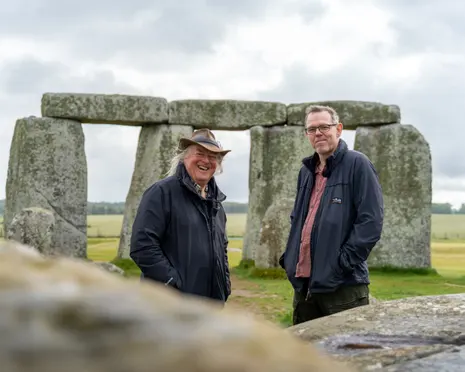
The initial recognition of the monument’s significance was unexpected. Phil Harding, who led the excavation on behalf of Wessex Archaeology, revealed that the team initially overlooked the alignment. His realization came during a later analysis of the site plan, when he connected the anomalous pair of larger postholes with a pencil and ruler. The resulting line, he noted, was strikingly close to the midsummer sunrise direction. “The thing that struck me as soon as I saw that was that [the line was] about 50 degrees off the direct north, which was pretty much the line of the midsummer sunrise,” Harding explained. “And so I got really, really excited about that.”
Skyscape Archaeology and Celestial Precision
Further analysis by Fabio Silva, a specialist in ancient astronomical mapping, confirmed the monument’s alignment with solstices. His findings suggest that the builders of Bulford meticulously planned the structure to track the sun’s movement, creating a natural “gunsight” effect that would have framed the solstice events in the landscape. Silva’s work also highlighted the remarkable accuracy of the alignment, which predates Stonehenge’s solstice-focused design by nearly five centuries. “It’s not just about the physical structure,” Silva added. “This is a reflection of how ancient people conceptualized their relationship with the heavens.”
The discovery raises intriguing questions about the origins of Stonehenge’s design. Harding proposed that the Bulford site could have been the work of the same community that later constructed the iconic monument. “If you had a time machine and went back, I wouldn’t be at all surprised if what we have found is one of the campsites of the builders of the first phase of Stonehenge,” he speculated. “I think that’s entirely plausible.” This theory is supported by the repeated use of solstice alignments in the region, suggesting a shared cultural or spiritual tradition.
The Role of Symbolism in Ancient Rituals
One of the most intriguing artifacts from the site is a disc-shaped flint knife found in a smaller pit aligned with the wooden poles. The knife’s design, experts suggest, may have symbolized the sun itself. This finding adds to the evidence that the Bulford structure was not merely functional but imbued with symbolic meaning. “The amount of effort that’s directed toward marking it and its movements leaves us in no doubt at all that this is a major religious event that’s inscribed over the whole landscape over millennia,” said Leivers.
While the exact purpose of the monument remains a subject of debate, its alignment with solstices implies a deep connection to celestial phenomena. The researchers argue that such precision in design would have required significant planning and communal effort, underscoring the monument’s importance in the lives of its builders. “It’s like a spiritual compass for a civilization that may not have had written records,” Harding remarked. “This structure allows us to see how they interpreted the universe around them.”
Connecting the Past to the Present
Harding, a former presenter on Channel 4’s Time Team, emphasized the rarity of such discoveries. “Sites like this come along once in a lifetime, sometimes they don’t come along at all,” he said. “It doesn’t matter whether you are a resident of Wiltshire or a resident of the Earth – everybody knows about Stonehenge. And to be able to contribute something to expanding our knowledge of Stonehenge is an incredible privilege.”
The Bulford monument also offers a glimpse into the evolution of Neolithic architecture. While the wooden poles have long since rotted away, their placement and the surrounding pits provide a tangible link to the rituals and beliefs of an ancient society. The structure’s alignment with the solstices suggests that it may have functioned as a ceremonial site, possibly used for seasonal festivals or spiritual gatherings. This hypothesis aligns with the broader understanding of Neolithic communities, which often built structures with astronomical significance.
Researchers are now working to piece together the broader context of the site. The presence of the flint knife, combined with the precise alignment of the poles, indicates that the monument was more than just a marker for the sun. It may have been a focal point for rituals, a place where the natural and spiritual worlds intersected. The repeated use of solstice alignments across the Wiltshire landscape, from Bulford to Stonehenge, suggests a continuity of belief that spans thousands of years.
As the team continues to study the site, they hope to uncover more clues about the lives of the people who created it. The discovery has already sparked renewed interest in the prehistoric history of the region, with historians and archaeologists eager to explore its implications. “This is a rare opportunity to connect the dots between early Neolithic practices and the later, more elaborate structures like Stonehenge,” Leivers noted. “It shows how ancient societies built upon their knowledge, refining their understanding of the cosmos over time.”
The Bulford monument’s significance lies not only in its age but also in its role as a bridge between the past and present. It challenges the notion that solstice alignments were a later innovation, instead positioning them as a fundamental aspect of Neolithic culture. As the sun continues to rise and set in the same patterns it did 5,000 years ago, the monument stands as a testament to humanity’s enduring fascination with the heavens. Whether as a prototype for Stonehenge or a standalone ritual site, the discovery is reshaping our understanding of prehistoric Britain’s spiritual landscape.