Trump Faces Fresh Bipartisan Criticism on Iran Deal as Vance Hails Peace Talks
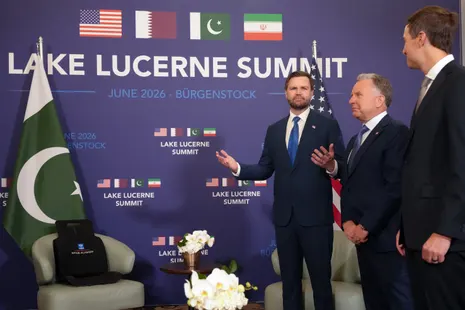
Wanderstayfinder.com – On Sunday, prominent U.S. political figures from both major parties voiced renewed concerns about Donald Trump’s latest agreement with Iran, even as the president emphasized his readiness to escalate tensions. The discussions, held in Lucerne, Switzerland, marked the first direct talks between the two nations since the previous administration’s nuclear deal was abandoned. However, the negotiations faced immediate challenges, as Trump’s public statements reignited scrutiny over the terms of the provisional agreement.
Peace Talks Amid Rising Tensions
Trump’s aggressive rhetoric during the talks underscored the volatile atmosphere. In a post on Truth Social, he declared that “Iran must immediately stop their highly paid PROXIES in Lebanon from causing trouble” and warned that failure to comply would result in “a much harder punch” against Iran than the recent strikes. The remarks prompted Iran’s delegates to walk out of the negotiation venue, according to the state news agency IRNA. The agency reported that “the Islamic Republic of Iran’s delegation, after meeting with the Qatari delegation as a mediating party, vacated the building where the talks were taking place.” This exit followed Trump’s simultaneous declaration of threats on X, where he reiterated his stance on military action against Iran.
Bipartisan Concerns About the MOU
As the talks commenced, bipartisan criticism of the U.S.-Iran memorandum of understanding (MOU) intensified. Senator John Cornyn, a Texas Republican who recently lost his re-election bid, echoed this sentiment on X. He quoted a Wall Street Journal article that highlighted how “rogue regimes evade U.S. economic warfare,” stating:
“Iran’s ability to withstand sanctions so far exposes a hard fact for Washington: economic pressure has largely failed to cow rogue regimes, as they game out more ways to sidestep U.S. restrictions.”
Cornyn’s comments aligned with earlier remarks where he criticized the deal, arguing that the U.S. should have “finished the job” by eliminating Iran’s nuclear threat before releasing restricted funds. He warned that the money would “replace their ballistic missile assets and begin to enrich [uranium] again,” posing a “continuing danger.”
Susan Rice Condemns the Agreement
Susan Rice, a senior Democratic official and former national security adviser under Barack Obama, added her voice to the criticism. In an interview with ABC News This Week, she described the agreement as “flimsy” and “egregious,” citing the “many concessions granted up front” as a significant flaw.
“The concessions to Iran in the MOU, signed by Trump in Paris last Wednesday, wouldn’t normally be, and shouldn’t have been, granted until after there was not only a fully comprehensive deal to address their nuclear program, but also that those provisions had been agreed upon,” Rice stated.
She pointed to a specific clause allowing Iran to “sell all of its oil and oil products unimpeded” and use the proceeds to “rebuild itself” before nuclear terms were finalized. This, she argued, created an imbalance in the agreement, enabling Iran to benefit financially while the U.S. retained limited leverage.
Comparisons to Obama’s Deal
Rice also drew attention to the contrast between Trump’s approach and the earlier deal negotiated by President Barack Obama. She noted that under Obama’s framework, Iran’s access to frozen assets was contingent on their use for humanitarian purposes, whereas Trump’s MOU permits unrestricted spending.
“The previous agreement, which Trump scrapped during his first term, lifted sanctions only after full compliance on nuclear terms. Now, the MOU allows Iran to gain financial advantages before any nuclear pact is finalized,” Rice explained.
This discrepancy has fueled accusations that the current deal represents a more significant concession than its predecessor.
New York Post’s Sharp Take
The New York Post, a prominent Trump-friendly outlet owned by Rupert Murdoch, published a scathing editorial that capitalized on the growing controversy. The headline read:
“With Strait of Hormuz held hostage, Trump’s Iran deal is worse than Obama’s.”
The editorial criticized the agreement for failing to secure the Strait of Hormuz, a critical chokepoint for global oil trade, under U.S. control. It framed the deal as a “surrender” that ceded strategic advantages to Iran, raising questions about its long-term implications.
Cory Booker Rejects Trump’s Credit
Meanwhile, Senator Cory Booker, a Democratic leader from New Jersey, dismissed any attempt to credit Trump for ending the war in the region.
“That’s like literally an arsonist starting a fire and getting credit for running out of the burning building,” Booker said during an interview with NBC’s Meet the Press. “This president has led this nation into a disaster. We have surrendered our power.”
He accused Trump of “capitulating to the enemy” and claimed the memorandum of understanding “gives Iran all the benefits, literally billions and billions of dollars.” Booker’s remarks emphasized the perception that the deal was a strategic loss, undermining U.S. influence in the region.
Broader Implications of the Agreement
Analysts suggest that the MOU could reshape the U.S.-Iran dynamic, prioritizing short-term financial relief over long-term security goals. While Trump framed the deal as a win, critics argue it risks emboldening Iran’s military capabilities and regional influence. The agreement’s lack of comprehensive nuclear commitments has drawn comparisons to previous U.S. concessions, with some accusing the administration of prioritizing political expediency over national interests. As the talks continue, the question remains whether the provisional agreement will hold or if it will become a catalyst for renewed conflict.
With bipartisan leaders united in their disapproval, the U.S. faces mounting pressure to re-evaluate its strategy. The MOU’s provisions, while offering immediate relief, may leave the door open for Iran to advance its nuclear ambitions and strengthen ties with regional adversaries. As the negotiations progress, the challenge for the administration will be to balance diplomatic gains with the assurance that the U.S. has not compromised its strategic objectives.