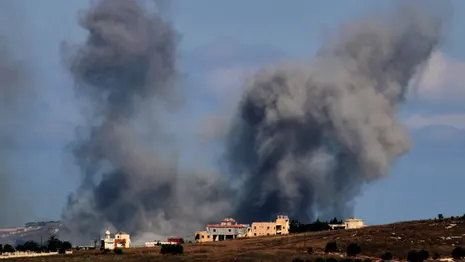
Israel and Hezbollah renew ceasefire after deadly flareup disrupts opening of Iran talks
Wanderstayfinder.com – After a day of intense clashes that threatened to derail the nascent US-Iran agreement, Israel and Hezbollah announced the extension of a fragile ceasefire in Lebanon on Friday. The renewed truce comes amid heightened tensions following Hezbollah’s attacks on Israeli forces and retaliatory airstrikes by Israel, which left dozens of casualties. This development has cast doubt on the prospects of a lasting resolution to the regional conflict, which has already claimed thousands of lives and destabilized key economic corridors.
The planned talks between Washington and Tehran, held in the Swiss village of Obbürgen, were abruptly canceled. The meeting, intended to discuss the implementation of a new deal to curb Iran’s nuclear ambitions and restore oil flow through the Strait of Hormuz, was disrupted when Hezbollah launched a coordinated assault on Israeli troops near Nabatieh. The attack killed four Israeli soldiers, prompting Israel to unleash a series of airstrikes in southern Lebanon and the Bekaa Valley. These strikes reportedly killed at least 47 people and injured dozens, according to Lebanese health officials.
Had the talks proceeded, they would have marked a pivotal step in the US-Iran rapprochement. The memorandum of understanding (MoU) signed earlier this week created a 60-day window for negotiations, aiming to secure a permanent accord on Iran’s nuclear programme. The document also called for a cessation of hostilities across all fronts, including the Lebanon conflict. However, the violence on Friday undercut these aspirations, raising concerns about the agreement’s viability.
Iran’s Chief Negotiator Warns of Consequences
Iran’s top negotiator, Mohammad Bagher Ghalibaf, issued a stern warning on Friday, vowing a “decisive response” to any breach of the ceasefire. His remarks underscored Tehran’s resolve to protect its interests, even as the conflict escalated. The abrupt cancellation of the talks left US officials scrambling, with key staff and journalists already en route to Switzerland. The original lead negotiator, JD Vance, had been expected to spearhead the discussions, but his absence prompted speculation about alternative arrangements.
“We didn’t meet out of desperation, Iran did. They are FINISHED! We’ll play out the 60 days. They get no money, not ten cents!”
Donald Trump, who remains a vocal advocate for the deal, reiterated his support in social media posts, framing the agreement as a victory over Iran. His comments came amid criticism from some Republican lawmakers in Congress, who argued the deal ceded too much to Iran. The White House had deployed dozens of officials and media personnel to Obbürgen in preparation for the talks, but the conflict forced a last-minute shift in strategy.
Trump’s special envoy, Steve Witkoff, was reportedly in Switzerland by Friday evening, with the possibility of opening the negotiations. Axios cited a White House source stating that Witkoff had joined Jared Kushner, the president’s son-in-law, in the country. Meanwhile, Iran’s foreign minister, Abbas Araghchi, was expected to travel to Switzerland on Saturday, though the timeline remained uncertain. The situation highlighted the delicate balance between diplomacy and military action, as both sides sought to assert their positions.
Regional War Intensifies Uncertainty
The flare-up in violence added to the growing uncertainty surrounding the prospects of ending the regional war. At least 7,000 people have been killed in the conflict, with energy prices soaring and global economic stability at risk. Lebanon, already a battleground, has become a critical flashpoint in Trump’s broader strategy to disengage the US from the war. The president has expressed frustration with Israel’s leadership, lashing out at Prime Minister Benjamin Netanyahu and his allies.
Netanyahu, who had promised a joint US-Israeli campaign to topple Iran’s regime, faces mounting domestic pressure. His office issued a statement condemning Hezbollah’s attacks, vowing to “exact a very heavy price” from the group. “Israel will remain in the security zone in southern Lebanon for as long as necessary to protect the communities of the north,” the statement emphasized. With elections looming within months, Netanyahu’s government is under scrutiny for its handling of the crisis, particularly its reliance on military force.
The latest confrontations between Israel and Hezbollah, which share a strategic alliance, were the most severe since the initial ceasefire was brokered. Hezbollah’s overnight barrage of rocket fire and drone strikes targeted Israeli positions near Nabatieh, while Israeli shelling had continued throughout Thursday. The retaliatory airstrikes by Israel, targeting what it claimed were Hezbollah strongholds, resulted in 18 deaths and 33 injuries, according to Lebanese health authorities. By Friday evening, the immediate hostilities appeared to have subsided, though the threat of renewed violence loomed large.
Israeli commentators have mixed reactions to the deal. While some acknowledge its potential to stabilize the region, others argue it empowers Iran by reducing direct military confrontation. The killing of Israeli soldiers by Hezbollah has fueled public anger, with critics accusing the government of being too lenient in its approach to negotiations. Meanwhile, the Iranian side has framed the conflict as a test of its resolve, insisting that any concession to Israel would weaken its global standing.
As the ceasefire takes hold, the focus shifts to the next phase of negotiations. The 60-day period offers a window for both sides to demonstrate their commitment to peace, but the recent violence has sown doubt. The US and Iran must navigate not only the immediate fallout but also the broader geopolitical implications of their agreement. For Lebanon, the country remains caught in the crossfire, with its government struggling to mediate between the warring factions.
Analysts suggest the conflict could see renewed escalation if the ceasefire proves temporary. The death toll and displacement of civilians continue to rise, with the humanitarian crisis deepening. As the talks resume, the success of the new deal will hinge on the ability of both parties to prioritize diplomacy over military action, a challenge that has tested their resolve at every turn.
Political Dynamics and Strategic Shifts
Trump’s involvement in the talks has drawn attention to the political stakes. His special envoy, Steve Witkoff, and Jared Kushner have taken the lead, reflecting the president’s desire to maintain control over the negotiations. The presence of these figures in Switzerland signals a strategic shift, with the US seeking to bypass traditional diplomatic channels and engage directly with Iran’s leadership. However, the success of this approach remains uncertain amid the ongoing violence.
Netanyahu’s position is also under pressure from within his own party. His far-right national security minister, Itamar Ben-Gvir, has called for a complete military solution, declaring that “all of Lebanon must burn.” This hardline stance contrasts with the more measured approach of other Israeli officials, who recognize the need for a sustainable peace. The internal debate within Israel’s government highlights the complexity of the situation, as leaders balance national security concerns with the desire for political stability.
The ceasefire’s extension offers a brief respite, but it is not a guarantee of lasting peace. Both Israel and Hezbollah are likely to test the agreement, with the potential for renewed clashes in the coming days. The international community, including the US and Iran, will closely monitor the situation, as the outcome of these negotiations could reshape the region’s future. For now, the fragile truce remains in place, but the path to a permanent solution is far from clear.