Climate Crisis Intensifies as Himalayan Communities Face Unprecedented Floods
Wanderstayfinder.com – Mountain settlements across the western Himalayas are confronting a new reality where weather patterns once considered predictable have become sources of devastation. From the remote valleys of Kashmir to the high-altitude regions of Ladakh, communities are witnessing increasingly violent cloudbursts that threaten lives, destroy homes, and disrupt centuries-old livelihoods.
The phenomenon is particularly acute in Indian-administered Kashmir, where a series of intense rainfall events this month has claimed at least 28 lives and left hundreds of families displaced. Scientists attribute this escalation to rising temperatures that are fundamentally altering precipitation patterns across the region.
A Village Swallowed by Water
Before dawn on July 19, Haji Mohammad Latief emerged from his home in Murrah, a village nestled high within the Pir Panjal range. The rain had been falling steadily, but his daughter’s urgent request to relocate their car suggested something more was coming. “I had only just parked it,” Latief remembered. “When I turned around, I saw the water coming.”
Within moments, the sky released its burden in a violent cloudburst. Mud, massive boulders, and churning water cascaded down the mountainside, obliterating the structure Latief had spent years constructing for five generations of his Gujjar family. Eight relatives found themselves trapped beneath the torrent. Latief owed his survival to a simple act of stepping outside.
“I built that house for my family,” Latief said, holding up pictures of his 16-year-old son Sajjad Ahmed, an aspiring cricketer, whose body was still missing.
By morning, everything Latief had worked to create lay in ruins. The village, situated approximately 125 miles southwest of Srinagar, Kashmir’s principal city, became isolated as floodwaters demolished roads and footbridges. Access required a grueling 90-minute trek through rain-soaked terrain littered with landslide debris.
Searching for the Lost
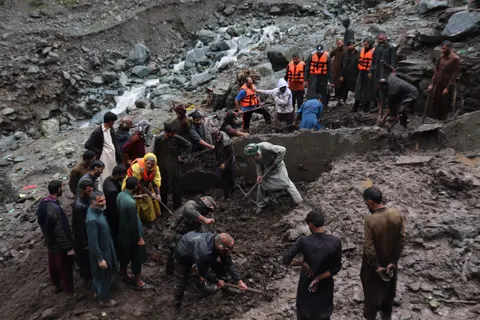
Days after the disaster, Murrah remained cut off from basic services. Electricity, roads, and mobile connectivity had vanished. Residents carried essential supplies—sacks of flour, cooking gas cylinders, and medicines—across makeshift crossings. The hillside proved too treacherous for heavy machinery, forcing soldiers, disaster responders, and local volunteers to search through rubble by hand.
Meanwhile, others combed the swollen Suran River for those swept away. Mohammad Razak, 45, dedicated four days to this effort alongside fellow volunteers. “We’ve been searching every bend of the river,” he explained. “We’re still hoping we’ll find them.”
Latief now resides in his brother Mohd Bashir’s house, positioned above the landslide zone. Inside, women gathered in mourning while men received visitors offering condolences. Verses from the Qur’an filled the air. When news arrived that another body had been recovered miles downstream, the room fell silent as yet another funeral procession moved through the village.
A Region Under Siege
The devastation extended well beyond Murrah. Approximately 30 miles away in Rajouri, the Manawar Tawi River overflowed its banks, destroying roads, dozens of vehicles, and the town’s primary bus station. Low-lying settlements along the riverbank became submerged in mud and debris. Across the Pir Panjal mountains, multiple houses collapsed, livestock disappeared, and hundreds of families lost their homes.
Further north, roughly 180 miles from Murrah in the Gurez Valley near the line of control with Pakistan-administered Kashmir, residents observed identical patterns. A cloudburst on July 20 in Achoora village damaged crops belonging to 11 families and blocked the valley’s sole road.
“People knew when the snow would come and when to plant crops,” said Aamir Asghar Khan, 26, a resident of Achoora. “Nothing seems predictable any more. The rain is getting more intense every year, and the frequent cloudbursts are threatening our livelihoods.”
The Gujjars, one of the Himalayas’ largest pastoralist communities, have traditionally relied on livestock, farming, and seasonal mountain migration. These foundations are now crumbling under the weight of erratic weather. Similar cloudbursts over the past month have damaged homes, farmland, bridges, and roads throughout Gurez and the neighboring Tulail region.
Broader Implications
Heavy rainfall triggered equally devastating floods and landslides in Ladakh and across the border in Pakistan-administered Gilgit-Baltistan. These events reinforce growing concerns that increasingly unpredictable weather is reshaping life across the western Himalayas.
For mountain communities, the climate crisis compounds existing geographical and social vulnerabilities. Steep terrain amplifies the impact of intense rainfall, transforming what might be manageable precipitation into rapid flooding and catastrophic landslides. Remote settlements, often lacking robust infrastructure, face disproportionate risks.
The International Centre for Integrated Mountain Development has documented similar trends across the broader Himalayan region, noting that warming temperatures are increasing the frequency and intensity of short, concentrated rainfall events. As these patterns continue to evolve, communities like Murrah must adapt to a world where the sky no longer behaves as it once did.
Related Reading
Frequently Asked Questions
What is I just want to find them?
I just want to find them is the main topic of this guide. The article explains the context, practical details, and next steps readers should understand.
Why does I just want to find them matter?
I just want to find them matters because readers are looking for a useful answer, not just a short summary. Good content should match search intent and help them decide what to do next.