US deports 20 people to Liberia, the first of 1,200 migrants under Trump deal

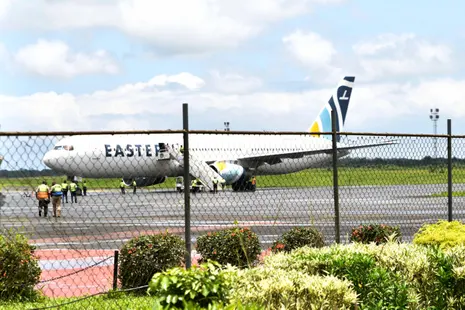
Table of Contents
A New Chapter in Third-Country Deportation: Liberia Receives First Group Under a 1,200-Person Compact
Wanderstayfinder.com – Twenty migrants flown out of the United States landed at Roberts International Airport near Monrovia on Thursday, marking the operational start of what officials describe as the single largest bilateral deportation compact the Trump administration has negotiated since returning to power. Under the deal, Liberia is positioned to receive up to 1,200 individuals over the coming months — a figure that dwarfs every other third-country arrangement the White House has finalized to date.
The compact sits within a broader strategy in which Washington has, according to advocacy groups, quietly negotiated removal agreements with nearly two dozen nations that are not the migrants’ countries of origin. Roughly ten of those destinations fall on the African continent. The Liberia pact, however, stands apart in scale: it represents the biggest single-country commitment in what has become a sprawling network of deportation channels.
What the Compact Provides
In exchange for accepting the deportees, the United States has committed $124 million in development assistance to Liberia. The agreement also extends visitor visas available to Liberian nationals from twelve months to thirty-six months, a concession that opens a longer window for travel, study, and short-term work in the U.S.
Liberia’s information minister, Jerolinmek Piah, outlined the expected composition of the incoming population during a public briefing on Tuesday. He stated that the 1,200 individuals will include African nationals alongside people from North America, South America, and the Caribbean — a mix that underscores how the arrangement functions less as a repatriation pipeline and more as a general overflow mechanism for the administration’s immigration enforcement apparatus.
Liberia’s Stated Conditions
Justice minister Natu Oswald Tweh addressed reporters the same day, offering two points of note. First, he characterized the majority of the deportees as having committed “migration-related violations and offenses,” a framing that distinguishes them from asylum seekers seeking protection. Second, he confirmed that any individual arriving under the compact retains the right to apply for asylum within Liberia itself, should they wish to do so.
“The majority of the deportees had committed migration-related violations and offenses, and they could seek asylum in the west African country if they wished.” — Natu Oswald Tweh, Liberia’s justice minister
That asylum provision is significant. It means Liberia is not simply a holding pen from which migrants will be onward-transferred; it is, at least in principle, a destination where a person can settle. Whether that option will be exercised in practice depends on local conditions, language access, and the willingness of Liberian authorities to process claims.
Placing the Liberia Deal in Context
A joint report published in early August by Refugees International and Human Rights First tallied the administration’s third-country deportation activity across at least 35 partner nations. By that count, roughly 23,000 people had been sent to 26 of those countries. The Liberia compact, at its full 1,200-person capacity, eclipses every other single arrangement in the tally.
Immigration attorneys have long argued that routing migrants through a third country operates as a legal workaround. Rather than adjudicating an asylum claim on its merits in a U.S. courtroom, the administration removes the individual to a nation where no such claim is pending, effectively nullifying the protection without a formal denial. In numerous documented cases, the destination country is one the migrant has never visited, speaks no language of, and faces genuine safety risks upon arrival. The practical effect, critics contend, is to push the person back toward the home country they were fleeing in the first place.
Cost, Oversight, and the Senate Findings
A February report produced by Democrats on the Senate Foreign Relations Committee examined the financial dimensions of the policy. It found that the administration had paid more than $32 million to five foreign governments to accept approximately 300 third-country deportees. The per-person costs varied dramatically: Rwanda received $1.1 million for each of seven individuals, while Equatorial Guinea was paid $7.5 million for twenty-nine — a sum that exceeded all U.S. bilateral aid to that country over the preceding eight years.
The committee also tracked outcomes after removal. More than 80 percent of those sent to third countries had, by the time of the report, returned to their original home countries anyway, often at additional taxpayer expense. The report cited specific instances in which deportees carrying active U.S. court-ordered protections were transported to Ghana or Equatorial Guinea and then forwarded onward within days, raising questions about whether judicial orders were being honored in practice.
The State Department pushed back against the committee’s characterization of its enforcement record, disputing the framing without, according to the report’s authors, providing itemized counter-evidence for each cited case.
What Comes Next
The arrival of twenty individuals on Thursday is a procedural milestone rather than a policy turning point. The real test lies in whether the remaining slots under the 1,200-person cap will be filled, whether Liberian authorities will process asylum applications in good faith, and whether the $124 million in pledged assistance translates into tangible infrastructure for the receiving communities. For the migrants themselves, the question is simpler and more immediate: they have been moved to a country where they have no established ties, and their next steps depend on how quickly local systems can absorb them.
The broader pattern — dozens of quiet agreements, tens of thousands of people relocated, and a legal architecture that treats third-country removal as a substitute for adjudication — continues to expand. Liberia’s compact is its largest expression yet, and its implementation will be watched closely by courts, advocacy organizations, and the families of those already in transit.
Related Reading
Frequently Asked Questions
What is US deports 20 people to Liberia?
US deports 20 people to Liberia is the main topic of this guide. The article explains the context, practical details, and next steps readers should understand.
Why does US deports 20 people to Liberia matter?
US deports 20 people to Liberia matters because readers are looking for a useful answer, not just a short summary. Good content should match search intent and help them decide what to do next.