Jamaica’s beach access crisis: ‘We shouldn’t be forced to fight for what is already ours’
Wanderstayfinder.com – For decades, the shores of St Ann, Jamaica, have been a haven for locals, where children played in the waves, fishers bartered over daily catches, and artisans crafted souvenirs beneath the shade of almond trees. Devon Taylor, a lifelong resident of the area, recalls those days vividly. “I grew up on Mammee Bay,” he says, emphasizing how the beach was not just a place of recreation but a lifeline for the community. It was here that he learned to swim, watched generations of fishers cast their nets, and collected seawater for his grandmother when she could no longer walk to the water’s edge. “That beach raised us. It fed us.”
Today, Mammee Bay stands as a battleground in Taylor’s fight against a tourism model he calls “plantation tourism.” While the government touts this system as the engine of Jamaica’s economy, activists like Taylor argue it perpetuates old inequalities, favoring wealthy visitors and the elite while marginalizing everyday Jamaicans. In 2019, the community’s protest against a fence erected by investors building luxury hotels turned violent when state and private security forces moved in. “We ripped down the fence and reoccupied the beach,” Taylor explains, but the pandemic’s movement restrictions left them vulnerable. “When they came back, they met concrete walls.” The incident marked the start of a “violent displacement,” he says, with gunshots used to disperse protesters. For Taylor, the struggle is not just about access to the sea but about survival.
Across the country, similar conflicts are unfolding. Mammee Bay, Little Dunn’s River, the Blue Lagoon, Bob Marley beach, and Flankers/Providence beach are now the focus of five court cases, with the first trial set for later this month. Each location has its own story, yet they share a common thread: communities denied access to spaces that hold deep social, economic, and spiritual value. Taylor points to the legal systems inherited from colonial rule as a key factor. Although Jamaica gained independence in 1962, much of its legal framework, including the 1956 Beach Control Act, remains intact. This law granted the state ownership of the island’s foreshore and seabed, requiring permits for any use or development. Taylor sees this as the foundation of a tourism model that systematically disadvantages locals.
“We call it plantation tourism because it has all the characteristics of a plantation,” Taylor says. “Exploitation of a poorly treated labor force, and wealth that either doesn’t stay in our country or is only in the hands of the elite.” The model, he argues, prioritizes private profit over public benefit, locking communities out of resources they’ve long relied on. For Taylor, the fight is a continuation of a historical struggle. “When you cut us off from the sea, you are actually setting us up to starve,” he adds, highlighting the economic stakes of the dispute.
Blue Lagoon: A Treasure Under Threat
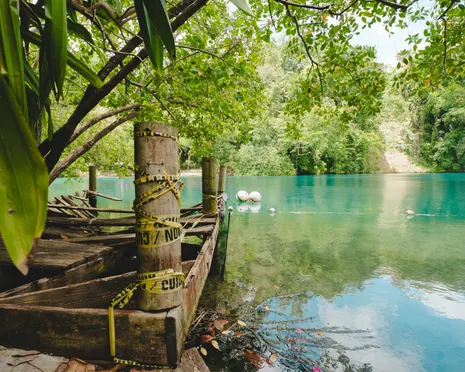
Farther north, in the parish of Portland, the Blue Lagoon has become a symbol of betrayal. Campaigners say local authorities misled them in 2022 by closing the lagoon with promises of reopening within 90 days. The idea was to improve facilities and create more opportunities for guides and vendors. However, the reality was a permanent closure of public access roads, allowing developers to build private villas. “This is an infringement on our rights,” says Colin Beckford, president of the Blue Lagoon Alliance. The lagoon, surrounded by lush greenery and known for its mesmerizing, ever-changing colors—turquoise, sapphire, or azure—has long been a source of life for nearby communities. Its mineral springs, fed by mountain water, are believed to have healing properties, drawing generations of locals for relaxation and respite.
Wilbourn Carr, 73, who has swum in the lagoon since he was 14, describes it as more than just a place for recreation. “This space is not just for fun,” he says. “It’s where our elderly come to heal, where children learn to float, and where the rhythm of our lives is connected to the land.” The closure threatens not only economic livelihoods but also cultural practices tied to the site. For Carr, the lagoon is a shared inheritance, a natural asset that should not be privatized. “Why take away this beautiful gem from the people instead of trying to protect it?” he questions, echoing the sentiment of many who feel the state has failed to uphold its duty.
Flankers Beach: A Forgotten Land
Over 100 miles away, the situation at Flankers Beach in Montego Bay mirrors the broader crisis. Campaigners there have filed an injunction to block developers from encroaching on the shoreline, which has been neglected by the government for decades. “Our foreparents shed blood for this land,” says Olando Brown, a local activist. “We shouldn’t be forced to fight for what is already ours.” Brown, who identifies as a Rastafarian, emphasizes the spiritual significance of the beach. “It provides a space for meditation, for connecting with the earth and the divine,” he says. “Taking it away feels like stealing a piece of our identity.”
The conflict in Flankers Beach underscores the emotional toll of these disputes. For many, the ocean is not just a resource but a part of their heritage. The struggle to reclaim access has sparked a movement across Jamaica, with activists demanding accountability and fair treatment. Taylor’s Jamaica Beach Birthright Environmental Movement (Jabbem) has become a rallying point, uniting voices from different regions to challenge the status quo. “We’re not asking for special privileges,” he insists. “We just want the right to use the beaches we’ve always known.”
As the first trial approaches, the question remains: can the legal system, which once protected colonial interests, now be reformed to serve the people? The beaches, with their rich history and cultural importance, are more than just tourist attractions—they are the heart of Jamaica’s communities. For locals like Taylor, Carr, and Brown, the fight is not only about preserving their access but also about reclaiming their dignity. “When we are cut off from the sea, it’s like being cut off from our roots,” Taylor says. “This is a battle for our future.”
The crisis has sparked a broader conversation about economic development and social equity. While the all-inclusive tourism model brings revenue and international attention, it also raises concerns about who benefits and who is left behind. Critics argue that the system’s structure—where private companies control land and resources—resembles the exploitative practices of the past. The government, they say, has failed to balance growth with the needs of the people. As the court cases progress, the outcome may determine whether Jamaica’s beaches remain a shared space or become the exclusive domain of the few.
Devon Taylor’s journey from a child playing in the waves to a leader demanding justice is a testament to the deep connection between Jamaicans and their shores. His words carry the weight of generations, a reminder that the sea is not just a place of leisure but a symbol of resilience and community. “We shouldn’t have to fight for what is already ours,” he reiterates. “It’s our birthright, and it’s time to claim it.”
“When you cut us off from the sea … you are actually setting us up to starve.”
With the legal battles intensifying, the hope is that these cases will catalyze a shift in policy. For now, the activists continue their fight, driven by the belief that the ocean belongs to all. Their struggle is a call to action, urging the nation to reflect on the legacy of colonial rule and the future of its natural treasures.