A Bizarre Premise Meets Familiar Romcom Formula in ‘One Night Only’
Wanderstayfinder.com – Universal Pictures has delivered what might be the most peculiar romantic comedy to hit theaters in recent memory. One Night Only arrives as the first wide-release romantic comedy since April, bringing with it a concept that is simultaneously charming and bewildering. The film envisions a world where single individuals are legally restricted to intimate encounters for just twelve hours annually. This high-concept setup has earned the movie an unofficial nickname: the “Sex Purge.”
At face value, the premise suggests something far darker. One might expect a dystopian nightmare reminiscent of The Handmaid’s Tale, where an authoritarian government exerts crushing control over citizens’ bodies. Instead, the film uses this authoritarian backdrop as a springboard for lighthearted romantic entanglements. The screams of political dissent are effectively muffled by an upbeat Top 40 soundtrack that keeps the mood buoyant throughout.
The World-Building and Its Flaws
Introductory exposition establishes that premarital intercourse has been outlawed across the United States. Citizens must now wait for their designated twelve-hour window, which has become a “government decreed sexual climate.” In this new reality, remaining celibate has transformed into a “badge of honour,” with incels finding unexpected social validation. The legislation arrived following what the film describes as an “ideological grenade” launched by Congress at the American public.
Pre-marital sex has been outlawed in the US and is now only legal for 12 hours on one night of the year.
Technology plays a crucial role in enforcement. Citizens wear biosensors capable of detecting chemical markers released during sexual activity. These devices shift from red to green upon marriage or when the annual sex purge commences. That single night of debauchery sees desperate singles scrambling to find partners, raising the obvious question of why the remaining three hundred and sixty-four days of the year cannot be utilized for planning.
Compliance is strictly monitored. Condom prices experience dramatic surge pricing, reaching as high as two thousand dollars per unit. Violations carry serious consequences, as demonstrated when an elderly man is forcibly removed to a police station for the offense of being sexually aroused in public.
Cast and Creative Team
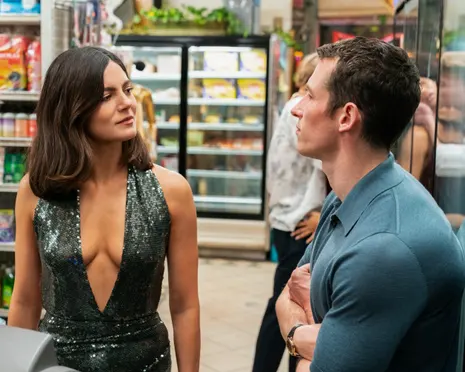
The narrative unfolds across New York City, a fitting location for a story exploring both romantic isolation and sexual liberation. Callum Turner portrays Owen, who arrives with plans to spend the night with his girlfriend, played by Maya Hawke. However, she seizes the opportunity to connect with a neighbor instead. Monica Barbaro stars as Allie, who receives encouragement from her queer roommate to embrace the evening, which the roommate characterizes as a night “for the straights.”
Both characters don revealing attire and venture into the city. Their trajectories cross, yet for unexplained reasons, they decline to consummate their attraction. Instead, they become each other’s wingmen, navigating from Manhattan through Brooklyn and back again.
Director Will Gluck brings commercial sensibility to the project. Having achieved unexpected success with Anyone But You, Gluck demonstrates mastery of the sleek aesthetic that defined early twenty-first-century romantic comedies. His visual approach benefits from immersive on-location shooting, avoiding the pitfalls that plagued last week’s Spider-Man sequel, which awkwardly substituted Glasgow for New York City.
Strengths and Weaknesses
The performances represent a notable improvement over Gluck’s previous collaboration with Sydney Sweeney and Glen Powell, who were among the most vacant pairings in the genre’s recent history. However, the screenplay by Travis Braun, a writer primarily known for children’s television, lacks the sharp specificity needed to justify the characters’ unusual choices. Viewers are asked to accept that Owen and Allie would forego intimacy despite the urgency of the situation, even when Owen has recently vomited near Allie’s feet after consuming omakase.
The film leans more heavily into raunchy adventure than traditional romantic comedy, featuring a series of near-misses and cameos that range from effective to forgettable. Julia Fox, Pete Davidson, Molly Ringwald, Nicholas Braun, and Roma Maffia all appear in brief roles, though their contributions lack comedic impact.
Perhaps the most defining characteristic of One Night Only is its frenetic, attention-deficit energy. The movie bombards viewers with pop culture references, seemingly designed to keep a younger generation engaged and away from their mobile devices. This approach extends to the production design, where nearly every scene incorporates some form of visual gimmick.
Ultimately, One Night Only functions as an overstuffed yet undercooked soufflé. It possesses the ingredients for success but struggles to achieve the necessary rise. The concept is ambitious, the execution is uneven, and the result is a film that is more interesting than it is satisfying—a breezy summer diversion that cannot quite commit to either its romantic or comedic ambitions with complete conviction.
Related Reading
Frequently Asked Questions
What is One Night Only review?
One Night Only review is the main topic of this guide. The article explains the context, practical details, and next steps readers should understand.
Why does One Night Only review matter?
One Night Only review matters because readers are looking for a useful answer, not just a short summary. Good content should match search intent and help them decide what to do next.