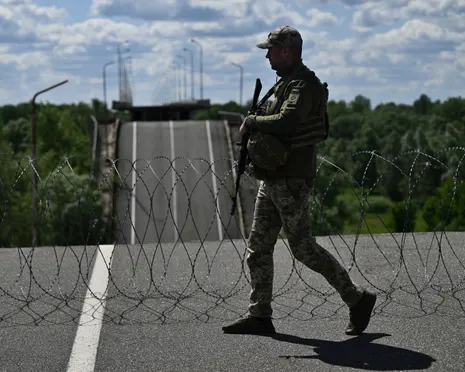
Ukrainian President Sets Deadline for Belarus
Wanderstayfinder.com – Volodymyr Zelenskyy has given Belarus’s leader, Alexander Lukashenko, a week to dismantle the Russian relay stations operating within his country, or risk facing direct action from Ukraine. The Ukrainian president made the statement during a press briefing, emphasizing that the equipment in question was being used to support attacks on Ukrainian civilians. “If he fails to act, we will take matters into our own hands,” Zelenskyy asserted, though he provided no further details on how Ukraine would proceed.
These relay stations, strategically positioned in two Belarusian regions near the Ukraine border, are believed to be critical for Russian forces in coordinating strikes. Zelenskyy’s warning comes as Ukraine intensifies its military preparations along the northern frontier, responding to reports that Vladimir Putin may be increasing Belarus’s role in the conflict. Recent tensions between Kyiv and Minsk reached a peak when Lukashenko formally apologized for earlier remarks that had incited Ukrainian anger, claiming Belarus seeks no involvement in the war.
“What’s the point of saying he doesn’t want to be in the war? Let him remove this equipment, let him switch it off. I think a week will be enough for him to do that,” Zelenskyy said on Friday.
The Ukrainian leader also highlighted Belarus’s contribution to Russia’s war efforts, specifically its oil refining sector. He pointed out that Lukashenko’s regime had become a key supplier for Moscow, asserting that the Belarusian leader could halt this flow if he chose. “Today he is the main supplier, or one of the main suppliers, for the Russian army. Specifically, Lukashenko, specifically Belarus,” Zelenskyy remarked, suggesting the removal of such support could be achieved through Lukashenko’s authority.
EU Diplomatic Outreach and Russian Response
Meanwhile, the European Union has maintained its focus on engaging with Russia through direct dialogue, despite internal resistance from some member states. António Costa, the EU chief, defended the bloc’s approach during a summit, stating that maintaining a diplomatic channel with Moscow was essential to support Ukraine’s cause. “It is precisely because we need also to support Ukraine through diplomatic means that we need to have a direct diplomatic channel with Russia,” Costa explained, while noting there were no “credible signs” of Russia’s willingness to negotiate.
Russia, in turn, has expressed openness to talks with European countries but rejected any form of ultimatum. Kremlin spokesperson Dmitry Peskov highlighted the necessity of dialogue, citing the “enormous number” of complex issues requiring attention. However, he urged Europeans to adopt a more flexible stance toward Russia, stating that their current approach was too rigid.
Poland’s Diplomatic Reckoning with Ukraine
Poland has also taken a firm stance, threatening to revoke its highest honor from Zelenskyy after the Ukrainian president sparked controversy by renaming an army unit after the Ukrainian Insurgent Army (UPA). The nationalist group, responsible for massacring Poles during World War II, has become a symbol of resistance for Ukraine. Poland’s president, Karol Nawrocki, announced plans to strip Zelenskyy of the title of Commander of the Order of the White Eagle, a move that could escalate tensions between the neighboring nations ahead of a reconstruction conference in Gdansk.
Andriy Sybiha, Ukraine’s foreign minister, criticized Poland’s decision, calling it a “strategic error” that benefits Moscow. The incident underscores the delicate balance between historical grievances and current alliances in the region. Zelenskyy’s actions have not only stirred Polish nationalist sentiments but also raised questions about the EU’s unity in its response to the war.
Recent Civilian Casualties and French Spy Arrest
Amid these political developments, a fresh wave of violence struck Ukraine’s eastern Donetsk region. In Kramatorsk, a frontline city, Russian shelling killed three civilians and injured six others. The attacks targeted a high-rise apartment building and a car park, according to Vadym Filashkin, the regional governor. This incident reinforces the urgency of Zelenskyy’s demands, as the war continues to exact a heavy toll on Ukrainian communities.
In a separate development, French authorities detained a man of Belarusian origin on charges of spying for Russia. The Paris prosecutor’s office revealed the individual was apprehended while filming a drone prototype for a company that supplies both French and Ukrainian armed forces. Intelligence officials alleged the man transmitted a video to a Russian contact, potentially revealing sensitive operational data. This arrest adds to the growing list of individuals linked to Belarus’s role in supporting Moscow’s military campaigns.
French President Emmanuel Macron reiterated the EU’s position on Friday, stating that European leaders would be ready to participate in peace talks when the time comes. “Europeans will be at the table when and if there are discussions about Ukraine’s future,” he emphasized, clarifying that the bloc is not acting as a mediator but as a staunch ally of Ukraine. Macron also noted that the priority was to unify the EU’s stance before engaging in negotiations, a step he believes is crucial for effective diplomacy.
As the conflict enters its fifth year, the interplay between military strategy, diplomatic maneuvering, and regional alliances remains pivotal. Zelenskyy’s challenge to Lukashenko reflects Ukraine’s determination to limit Russian leverage, while the EU’s efforts to bridge with Moscow highlight the complexity of maintaining support for Kyiv without alienating Russia. Meanwhile, Poland’s response to Ukraine’s symbolic gestures and France’s intelligence operations demonstrate the broader geopolitical landscape in which the war is unfolding.
The pressure on Belarus to distance itself from Russia is intensifying. With relay stations and oil supplies serving as key points of contention, Lukashenko’s next move could determine the trajectory of the conflict. Zelenskyy’s threats to act unilaterally underscore Ukraine’s readiness to escalate if necessary, ensuring that Belarus’s role in the war remains under scrutiny. As the situation evolves, the focus remains on reducing the flow of resources and support to Russia, while safeguarding the interests of Ukraine and its allies in the region.