Wildfires Rage Across Southern Europe, Forcing Thousands to Flee Homes
Wildfires rage across southern Europe forcing – Amid a relentless heatwave that shattered temperature records earlier this summer, wildfires have spread rapidly across southern Europe, displacing thousands of residents and prompting emergency measures in multiple countries. The crisis has disrupted daily life, with officials in France, Spain, Portugal, and Greece declaring areas unsafe and imposing restrictions on public activities, including a temporary ban on spectators at a key stage of the Tour de France. As conditions worsen, experts warn that the region is facing a severe test of its emergency response systems.
Firefighters Battle Blazes in Five Countries
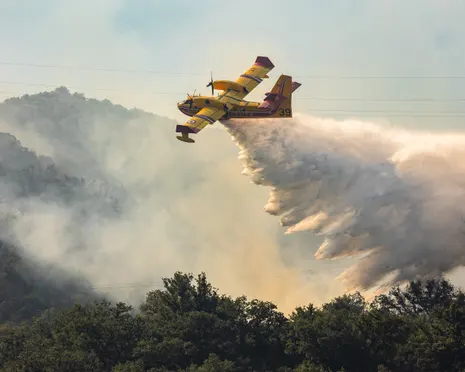
Across the Iberian Peninsula and the Mediterranean, hundreds of firefighters are working tirelessly to contain wildfires that have scorched nearly 20,000 hectares of land. In Portugal, over 1,200 personnel, supported by nearly 400 vehicles and 15 aircraft, are combating a fire that erupted in the Vouzela area and has since burned through 13,000 hectares. Spain and Italy have contributed additional resources, with emergency services reporting that 80% of the blaze is now under control. However, challenges remain, as rising temperatures and scattered “smoking hotspots” within the affected zones complicate efforts.
France’s Pyrenees Fire Threatens Thousands
One of the most intense fires is unfolding in the French Pyrenees, near the Spanish border. Over 700 firefighters are battling an out-of-control blaze that has consumed 5,000 hectares of land, forcing the evacuation of more than 10,000 people from the region. The fire has even come within 300 metres of residential areas, according to Patrice, a resident of Trévillach village. “We were shocked by how fast it spread, it was staggering—bordering on panic,” he told Agence France-Presse, highlighting the urgency of the situation.
“We were shocked by how fast it spread, it was staggering—bordering on panic.”
The French interior minister, Laurent Nuñez, reported that conditions in the area had deteriorated further on Monday, with the fire now affecting five departments. This has led to a doubling of the land burned compared to the same period last year. The European Commission has responded by deploying four waterbombing aircraft from Cyprus and Sweden to assist in extinguishing the flames around Perpignan, a city in the south of France. “Europe stands with France,” said European Commission president Ursula von der Leyen, emphasizing the bloc’s commitment to combating the crisis.
Climate Crisis Accelerates Wildfire Risk
Scientists from the World Weather Attribution group have linked the extreme temperatures recorded in June to the ongoing climate crisis, stating that such conditions would have been “virtually impossible” without global warming. The heatwave, which arrived earlier than usual, has left vast regions of southern Europe particularly vulnerable to wildfires. Chantal Mauchet, the prefect of the Hérault department, noted that the wildfire season in southern France had essentially started three or more weeks early, with several fires burning through at least 300 hectares of land.
“This season is going to be a long one for the soldiers fighting fires. You have to help us.”
Temperatures are expected to climb again this week, reaching up to 40°C in certain areas. Eric Belgioino, the fire chief for Pyrénées-Orientales, described the situation as a critical phase, with the Pyrenees fire nearly tripling in size since Sunday. “Climate change is here, we are living the consequences and it is only the start of July,” he warned, underscoring the severity of the environmental impact. The region’s firefighters are now preparing for a prolonged battle, as the heatwave continues to fuel the blazes.
Spain’s Evacuations and Fire Perimeter Challenges
On the Spanish side of the border, the situation remains dire. Fire has devastated 2,200 hectares of land in the Les Gavarres protected natural area, with a perimeter of 40km stretching across the region. The Catalan fire service’s head of operations, Eduard Martinez, stated that the blaze is currently stable but remains a significant threat due to its size and the difficult terrain. Meanwhile, in the eastern Castellón province of Spain, more than 500 residents were evacuated after a wildfire spread into the Sierra de Espadán national park, raising concerns about the spread of the flames.
Global Impact and Evacuation Alerts
The wildfires are not confined to France and Spain. In Croatia, the island of Hvar has seen large-scale destruction, with hundreds of hectares of forest and scrubland consumed by flames. Similarly, in Albania, a fire at Tale has damaged extensive areas of land. Greece, which was largely spared during the recent heatwave, has now experienced its own set of challenges, as a forest fire tore through two factories in the northern city of Thessaloniki. Authorities issued evacuation alerts for three suburbs, urging residents to stay indoors and close windows and doors to avoid toxic smoke from the recycling plant.
Emergency Measures and Regional Collaboration
As the crisis deepens, regional collaboration has become essential. In the eastern Pyrenees, the prefect Pierre Regnault de la Mothe ordered restrictions on Tour de France spectators for Monday’s third stage, directing them to stay away from the race route and finish area. The decision ensures that the event remains safe for participants and viewers, while also protecting critical infrastructure. Meanwhile, the EU’s rapid response with the deployment of waterbombing aircraft reflects the urgency of the situation and the interconnected nature of the region’s environmental challenges.
Despite the challenges, officials remain optimistic that the worst of the heatwave may be over. However, the scale of the wildfires and the prolonged impact of climate change suggest that the region may face a protracted period of high-risk conditions. With temperatures forecast to rise further, the battle against the flames is far from complete. The combination of extreme weather and human activity continues to strain emergency resources, prompting calls for increased preparedness and international support.
The wildfires serve as a stark reminder of the increasing frequency and intensity of climate-related disasters. As southern Europe grapples with this crisis, the need for coordinated efforts between governments, emergency services, and scientific communities has never been more urgent. The situation in the Pyrenees, where the fire has grown to a critical size, highlights the delicate balance between natural resilience and the escalating threat posed by global warming. For the thousands of residents displaced, the focus remains on finding temporary shelter and ensuring safety until the flames are brought under control.