Trump threatens further action as US and Iran exchange fire in new flare-up

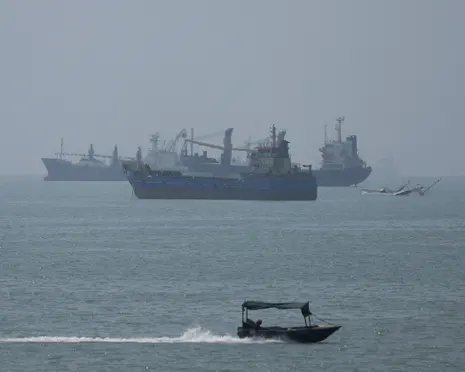
Table of Contents
Missiles and Drones Cross the Strait of Hormuz Again as Washington and Tehran Trade Blows
Wanderstayfinder.com – For the first time since late July, American and Iranian forces exchanged live fire across the narrow waterway that carries roughly one-fifth of the world’s seaborne energy supply. US missiles and drones struck rocket launchers positioned on Larak Island, while Tehran answered with ballistic missiles aimed at American-operated airfields in Jordan and a drone push toward the United Arab Emirates. The flare-up, which began late Sunday and spilled into Monday, marks a sharp escalation in a conflict that has been simmering since February 28.
The US Strike on Larak Island
Washington said it acted after intelligence indicated Iranian forces were preparing to lay a fresh batch of sea mines in the strait. US Central Command confirmed the operation, describing it as the first direct strike on Iranian territory since July. A US official stated plainly: “I can confirm that earlier today US forces struck two Iranian launchers on Larak Island. Islamic Revolutionary Guard Corps forces were observed preparing to launch rockets with sea mines into the strait of Hormuz.”
The move followed a week in which President Donald Trump declared the American navy had swept the waterway of mines for the first time since the conflict began on February 28. Tehran dismissed that claim as outright fabrication. Washington’s stated objective has been to pry open what it views as Tehran’s chokehold on commercial shipping, a grip that has tightened since hostilities commenced and has kept global energy markets on edge.
Tehran’s Retaliation
The Islamic Revolutionary Guard Corps responded swiftly. In a statement, the IRGC said it had “targeted technical infrastructure, maintenance facilities and enemy fighter jet positions at the US-operated King Hussein and al-Azraq airbases in Jordan” with ballistic missiles, claiming “heavy damage” to both installations. The UAE defence ministry separately announced that it intercepted a drone over its territorial waters.
The IRGC also reported that three of its soldiers were killed and two civilians wounded in the American strike on Larak Island. Iran’s Mehr news agency quoted the guard corps as saying its air-defence units shot down a US MQ-9 drone over the strait, sending it crashing into Gulf waters. Washington, for its part, said every missile fired toward US forces in Jordan was intercepted and produced no significant impact.
Trump’s Response and Broader Strategy
Speaking to Fox News on Monday, the president did not mince words about what comes next:
“We’re going to hit them hard. There will be a response.”
He went further, branding Iran “officially a failed nation without an airforce, a navy or a currency,” and asserting that inflation there had reached 300 percent while its leadership proved incapable of representing the country. Those remarks land against a backdrop in which the White House signalled last week that Trump was shelving further military action in favour of an economic strangulation campaign built on enforced sanctions. The administration’s theory of pressure, in short, has shifted from kinetic strikes to financial suffocation.
The Tanker Incident and Shipping Disputes
Iranian state television offered a different account of what triggered Sunday’s escalation. It claimed a tanker caught fire after striking two Iranian naval mines while attempting to transit the southern side of the strait near Oman. Officials subsequently said Tehran had targeted three vessels trying to use what it calls an unauthorised southern route. The IRGC warned that any other ship violating its passage rules would meet the same fate and declared compliance with its regulations mandatory for transit.
The White House maintains that the strait is now under American control and that ships may navigate freely. That assertion is heavily contested. Tanker Trackers, an independent maritime monitoring agency, reported on Sunday that the daily average of crude oil exports via the strait over the preceding seven days stood at 3.8 million barrels per day — a figure that underscores how constrained the flow remains despite Washington’s claims of restored freedom of navigation.
Diplomatic Channels and Economic Pressure
Even as missiles flew, a quieter diplomatic track continued. Iranian President Masoud Pezeshkian met Pakistan’s Prime Minister Shehbaz Sharif on the margins of the Shanghai Cooperation Organisation summit in Kyrgyzstan on Monday. He told Sharif that continuing the war was not in Iran’s interest and that he remained prepared to implement the memorandum of understanding with the United States that Pakistan had brokered in June.
That willingness to negotiate sits in tension with the currency crisis at home. The rial was under renewed pressure on Monday, and parliamentarians are growing alarmed by the inflationary cascade triggered by its rapid depreciation. For ordinary Iranians, the economic toll of the standoff is becoming harder to ignore.
The Oman Factor and What Comes Next
Last week, Iran and Oman reached a verbal understanding on a new single temporary shipping route through the strait, under which Oman retains control over vessels in Omani waters. A Western diplomat familiar with the negotiations said the message had reached Washington that this bilateral arrangement alone would not be sufficient for Tehran to reopen the waterway. In the diplomat’s view, at minimum the United States would need to lift its blockade of Iranian oil exports — a concession Trump is not currently prepared to make.
“There are many in Iran determined to torment Trump right up to the end of his presidency. We are stuck.”
The diplomat added that some oil was getting through, but not in meaningful volumes. The strait, which before the war carried roughly one-fifth of global seaborne energy, remains a pressure point where military posturing, economic coercion, and fragile diplomacy collide. For now, the exchanges of fire have resumed, and the question of who controls the waterway — and on what terms — remains unanswered.
Related Reading
Frequently Asked Questions
What is Trump threatens further action as US?
Trump threatens further action as US is the main topic of this guide. The article explains the context, practical details, and next steps readers should understand.
Why does Trump threatens further action as US matter?
Trump threatens further action as US matters because readers are looking for a useful answer, not just a short summary. Good content should match search intent and help them decide what to do next.