How intense rains in the Grand Canyon turned into a deadly disaster

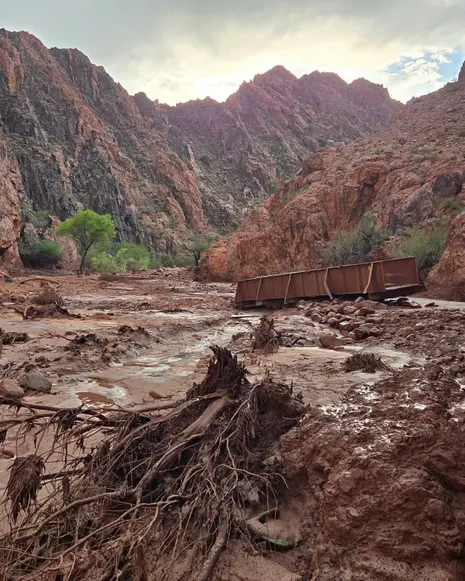
Table of Contents
When the Canyon Fills: Anatomy of a Grand Canyon Flash Flood Disaster
Wanderstayfinder.com – A wall of black water and debris tore through one of America’s most visited natural landmarks on Saturday, killing at least two people, sweeping away bridges and trail infrastructure, and forcing helicopter evacuations for nearly 80 visitors trapped along Bright Angel Creek. One person remained missing as rescue crews worked through the night. The event, which struck the lower reaches of the Grand Canyon in Arizona, was not simply a bad-weather accident. It was the product of multiple climate stressors converging on a landscape already weakened by drought, scarred by wildfire, and saturated by an unusually powerful El Niño signal in the Pacific.
The Immediate Sequence
What began as a clear summer afternoon in the canyon quickly turned violent. Torrential rain hammered the Bright Angel Creek corridor, a narrow slot between sheer rock walls where water has nowhere to spread and no time to soak into the ground. Within minutes, what meteorologists call a downpour became a fast-moving surge carrying rocks, timber, and sediment. Visitors caught on trails and at the historic Grand Canyon Lodge area were pulled from the water by search-and-rescue teams and airlifted out by helicopter after the creek swallowed footbridges and other structures.
Flash flooding in this part of the Southwest is a seasonal reality. From June through September, the monsoon season delivers intense, localized storms to terrain that has spent months baking in drought. The canyon’s steep, rocky geometry acts as a natural funnel: rain that falls on the rim or mid-slope arrives at the creek floor as a concentrated, high-velocity flow. Park rangers have long warned summer visitors that a cloudless sky can give way to a life-threatening deluge within minutes.
Wildfire Scarring Multiplies the Threat
What made Saturday’s event especially lethal was the condition of the ground above the creek. In July 2025, the Dragon Bravo wildfire raced across nearly 150,000 acres (60,700 hectares) of canyon rim and slope, consuming vegetation, charring soil, and destroying the Grand Canyon Lodge itself. In the aftermath of such a fire, the landscape loses its capacity to slow and absorb rainfall. Bare, hydrophobic soil sheds water almost instantly, sending runoff racing downhill at speeds far exceeding pre-fire norms.
Federal teams from the Department of Interior, tasked with evaluating post-fire threats to “life, property, and critical natural and cultural resources,” assessed the situation upstream of Phantom Creek and concluded that runoff hazards would be between two and eight times greater than before the blaze.
“Hikers on the trails within or downslope from the burned area will experience frequent stabilization issues, especially hazardous rockfall for at least the first year,” the assessment team wrote in its report on post-fire conditions.
Park officials had flagged the elevated risk at the start of summer, anticipating that stronger-than-average storms would find a landscape primed for rapid water movement. Hikers evacuated by helicopter later described the creek turning black as it filled with mineral-laden runoff from the burn scar.
Drought, El Niño, and the Compound Extreme
The Grand Canyon region and the broader Colorado River basin have endured a prolonged, severe drought that has desiccated soils and stripped vegetation across millions of acres. Hardened, sparsely vegetated terrain cannot absorb or contain the sudden influx of moisture that a monsoon storm delivers. The result is a landscape primed to convert rainfall into flash runoff with minimal delay.
Layered on top of that drought was a historic El Niño event, which has pushed Pacific sea-surface temperatures to record-breaking levels. El Niño is a natural oscillation, but climate models indicate a strong likelihood that the current episode will rank among the most intense on record. In the American Southwest, the extra water vapor loaded into the atmosphere by warmer ocean surfaces is wrung out as extreme rainfall.
“The higher amount of water vapor in the atmosphere due to El Niño is wrung out in the form of rainfall,” explained Park Williams, a hydroclimatologist at the University of California, Los Angeles, speaking to the Associated Press.
Daniel Swain, a climate scientist at the California Institute for Water Resources, assessed the link between human-caused warming and the heavy Arizona rain as “moderately strong.” His recent work with colleagues underscores a broader pattern: as global temperatures climb, extreme events do not merely grow more frequent — they begin to overlap. Drought weakens the land. Wildfire strips what remains. El Niño supercharges the storm. The convergence of these factors, what researchers term a “compound extreme,” produces disasters far more destructive than any single factor alone.
What Comes Next
The Grand Canyon remains one of the crown jewels of the U.S. national park system, drawing millions of visitors each year. The loss of the Grand Canyon Lodge to the 2025 fire already represented a blow to the site’s historic infrastructure. Saturday’s flood adds a human toll and a renewed urgency to questions about trail management, early-warning systems, and visitor education in monsoon season.
For the region, the event is a preview of what climate scientists expect to become routine: overlapping extremes that test the limits of infrastructure, emergency response, and public resilience. The canyon’s geology will not change. What changes is the frequency and intensity of the storms that meet it, and the condition of the ground they strike. Each summer, the margin between a scenic hike and a fatal surge narrows further.
Related Reading
Frequently Asked Questions
What is How intense rains in the Grand?
How intense rains in the Grand is the main topic of this guide. The article explains the context, practical details, and next steps readers should understand.
Why does How intense rains in the Grand matter?
How intense rains in the Grand matters because readers are looking for a useful answer, not just a short summary. Good content should match search intent and help them decide what to do next.