Race Against Time: Japan Earthquake Death Toll Rises
Wanderstayfinder.com – Race against time – At least 13 people lost their lives when a powerful 6.8 magnitude earthquake struck southern Japan on Tuesday, leaving hundreds injured and tens of thousands without power and water. “There are people who are still waiting to be rescued, and it’s a race against time,” Prime Minister Sanae Takaichi declared on Wednesday. “We will go all out to find and rescue as many people as we can.” The seismic event registered a maximum intensity of 7 on Japan’s shindo scale when it hit Kumamoto prefecture on the southern island of Kyushu on Tuesday afternoon.
Rescue Operations Underway
The government reported that more than 9,000 people were sheltering in evacuation centres across the country early Wednesday. “We have received reports of seven people with serious injuries and 29 with minor injuries. Furthermore, as of 7:00 am today (2200 GMT Tuesday), 9,186 people have sought refuge in 506 evacuation centres across five prefectures, including Kumamoto and Fukuoka,” government spokesman Minoru Kihara stated a day after the devastating quake.
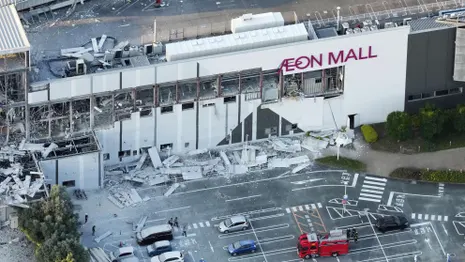
Rescue crews were meticulously sifting through wreckage at critical locations, including a paper mill in Yatsushiro where a chimney collapsed. Two workers were discovered and transported to hospital in cardiac arrest, while nine others remained missing. An explosion was reported at an Aeon shopping mall housing approximately 200 outlets in the prefecture shortly after the earthquake, with footage showing the upper section of the main building torn away and partially collapsed.
“We have already been informed that people have been injured. Power outages and fires have occurred in some areas, and there has also been damage to roads and bridges and the collapse of buildings,” Takaichi said. “I ask everyone to take action to protect themselves, including evacuating to a safe location.”
Two women in their 20s were confirmed dead, and another person reportedly suffered cardiac arrest. An Aeon spokesperson confirmed that customers and employees were evacuated following the initial quake, with the cause of the explosion remaining unclear. A government official told reporters that Aeon Kumamoto reported a gas leak, though the exact cause had not yet been determined.
Aftershocks and Infrastructure Impact
The Japanese military mobilised 3,600 personnel for disaster relief operations and deployed 20 aircraft to assess aerial damage, according to the defence minister. Hundreds of first responders from neighbouring prefectures arrived in the affected areas on Tuesday evening. The Japan Meteorological Agency (JMA) warned that regions experiencing the strongest tremors would remain vulnerable to further powerful quakes and landslides for approximately a week due to the shallow earthquake triggering ongoing seismic activity.
By Wednesday morning, more than 60 aftershocks had been recorded, ranging in magnitude from 1 to 4, the agency reported. A tsunami warning was issued immediately following the earthquake but was lifted within two hours. Nearly 50,000 households were without power late on Tuesday, along with 140,000 without water.
Temperatures in the region were forecast to exceed 35°C on Wednesday, with high humidity increasing the risk of heatstroke for those lacking access to air conditioning and water. Large numbers of people slept in their vehicles overnight out of fear of aftershocks. Despite the earthquake’s intensity, relatively few buildings collapsed, which helped reduce the number of fatalities and injuries.
Japan maintains strict construction standards, and earthquake resistance requirements for new buildings have been elevated multiple times over recent decades. Technology such as apartment blocks with foundations laid on rollers that can sway enables newer structures to withstand intense shaking. Takaichi noted on Tuesday evening that authorities were still evaluating the extent of damage in the area, which had been devastated by another deadly quake a decade ago.
More than 350 people had been treated at local hospitals, many of which were affected by power and water outages and damage to medical equipment. “People are coming in with burns and fractures from being trapped under objects due to the earthquake, and ambulances are constantly bringing in injured people,” NHK quoted one hospital employee as saying. “Inside the hospital there are water leaks and electrical system failures.” About 300,000 people were instructed to go to evacuation centres, the disaster management agency said.
JR Kyushu, the regional railway company, suspended services on Tuesday, including its high-speed bullet trains. Kumamoto airport also shut its runway as airlines diverted and cancelled flights. Telecoms operators KDDI and NTT Docomo reported disruption to their mobile phone services owing to power shortages and transmission-line failures.
There were no irregularities reported at the nuclear power stations in the area, Japan’s nuclear regulation authority confirmed. Footage from NHK on Tuesday showed the extent of the damage across the region.
Frequently Asked Questions
What is the current death toll from the Japan earthquake? At least 13 people have been confirmed dead following the 6.8 magnitude earthquake that struck Kumamoto prefecture on Tuesday.
How many people are in evacuation centres? More than 9,000 people were sheltering in 506 evacuation centres across five prefectures as of early Wednesday morning.
Are there risks of further earthquakes? Yes, the Japan Meteorological Agency warned that areas with the biggest tremors would remain at risk of further strong quakes and landslides for about a week.
What services have been disrupted? JR Kyushu suspended bullet train services, Kumamoto airport closed its runway, and telecoms operators KDDI and NTT Docomo reported mobile phone service disruptions.
Are nuclear power stations safe? Japan’s nuclear regulation authority reported no irregularities at the nuclear power stations in the affected area.