Japan enlists 1,800 people to drag a 360-tonne castle keep using ropes and rollers

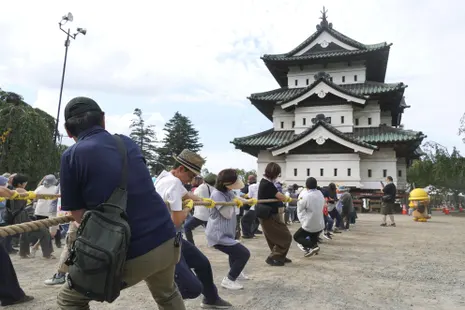
Table of Contents
Thousands Gather in Aomori to Haul a 360-Tonne Castle Tower Back Into Place
Wanderstayfinder.com – Chanting in unison, roughly 1,800 volunteers converged on a northern Japanese castle grounds over a single weekend to drag a massive fortified tower a combined distance of just over two metres toward its rightful foundation. The operation, part of a multi-year restoration at Hirosaki Castle in Aomori prefecture, required the keep to be shifted because a critical wall had been compromised by seismic activity and needed full reconstruction beneath it.
Working in rotating shifts of 80, participants gripped 30-metre ropes and pulled in coordinated bursts, their voices rising in the traditional call of “so-re, so-re.” Saturday’s effort advanced the structure 1.13 metres along its rail-mounted track; Sunday added another 1.09 metres. Each increment was small, but the cumulative effect over the coming weeks will return the tower to its original footprint.
The Ancient Art of Hikiya
Because the keep holds the status of a nationally designated important cultural property, officials ruled out dismantling it piece by piece. Instead they turned to hikiya, a centuries-old Japanese building-relocation method in which a structure is placed on rollers or rails and physically towed to a new position. The technique predates modern construction machinery and has been employed across Japan since antiquity for temples, shrines, and other timber-and-stone edifices.
In 2015 the city first invited ordinary residents to take part in the hauling process. That initiative marked the inaugural citizen-driven hikiya in recorded history and represented the first occasion in roughly a century that the method had been applied, in any capacity, to relocate a castle structure.
“Because the keep is a nationally designated important cultural property, we didn’t take it apart. We’re using hikiya, a building-relocation method that has existed in Japan since ancient times.” — Kensuke Hayasaka, head of the parks and green spaces division at Hirosaki City
Overwhelming Public Demand
Interest in joining the pull far exceeded available slots. Hayasaka noted that approximately 8,000 people applied for the 1,800 positions offered across the two-day weekend — a ratio of roughly four to one. Applicants came not only from Aomori but from every corner of Japan and from abroad, with a notable contingent arriving from south-east Asia, Europe, and North America.
Motoharu Nakata, 61, made the journey from Hiroshima, at the opposite end of the main island, to take part once again. He had helped pull the keep during the 2015 operation.
“I pulled it 11 years ago too. It’s very moving to be able to participate again. There’s absolutely no other opportunity to pull a castle — it was fantastic.” — Motoharu Nakata
What Came Before: Repairing the Damaged Wall
The reason for the relocation was structural. A major earthquake had fractured a load-bearing wall of the keep, making it impossible to continue preservation work until the tower was moved aside. Engineers and masons spent months rebuilding that wall, completing the task in December 2024. All 2,185 stones were carefully catalogued, removed, and restacked in their precise original positions before the keep could be shifted back over the repaired section.
Timeline and Scale of the Remaining Work
Manual pulling will continue through the end of August. Officials have scheduled approximately 4,100 participants in total to move the keep a cumulative five metres by hand. The remaining distance — roughly 73 metres — will be covered by heavy machinery before the year closes. The human element, while symbolically vital, accounts for only a small fraction of the total displacement.
Once the structure sits atop its restored foundation, comprehensive preservation work on the keep itself will commence. The entire tower will be enclosed in protective covering during that phase.
“Once it’s back on the original base, the preservation work on the keep begins and the whole structure will be covered over. As things stand, we expect it to reopen to visitors in 2033.” — Kensuke Hayasaka
A Rare Survivor of Japan’s Castle Age
Hirosaki’s keep is one of only twelve original castle towers remaining anywhere in Japan, and the sole example located in the north-eastern Tohoku region. The fortress was completed in 1611 as the seat of the Tsugaru clan, a powerful regional lord. The original keep perished in 1627 when a lightning strike ignited a gunpowder magazine, sending flames through the timber-and-stone structure. The present building dates from an 1810 reconstruction.
Today the castle grounds function as a major public park. During the annual cherry-blossom season the site attracts approximately two million visitors, making the multi-year closure for renovation a significant loss for local tourism and civic pride. The community-driven hauling effort thus serves a dual purpose: it advances a technically necessary restoration while reinforcing a shared sense of stewardship over a structure that has stood, in one form or another, for over four centuries.
Related Reading
Frequently Asked Questions
What is Japan enlists 1 800 people to drag?
Japan enlists 1 800 people to drag is the main topic of this guide. The article explains the context, practical details, and next steps readers should understand.
Why does Japan enlists 1 800 people to drag matter?
Japan enlists 1 800 people to drag matters because readers are looking for a useful answer, not just a short summary. Good content should match search intent and help them decide what to do next.