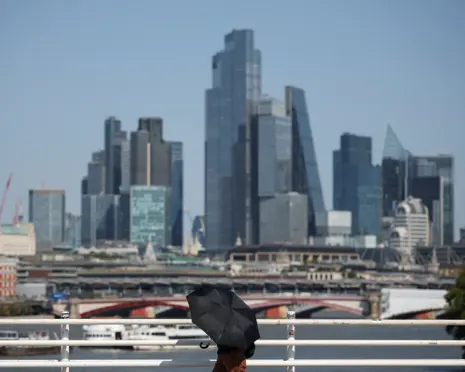
At least 35,000 excess deaths recorded in Europe’s back-to-back heatwaves


Table of Contents
Europe’s Deadliest Heat Season: Over 35,000 Excess Deaths Across Four Consecutive Heatwaves
Wanderstayfinder.com – Four successive heatwaves, stretching from May through August, have pushed Europe past a grim threshold: at least 35,000 more people died than statistical models would predict for a typical summer. The figure, drawn from provisional data covering barely half the continent’s nations, is expected to climb sharply once August mortality tallies are finalized. Three of the bloc’s largest economies — Germany, France, and Spain — have already surpassed 25,000 excess deaths between them, and public-health analysts caution that the true toll will be considerably higher.
The atmospheric conditions behind the toll were unprecedented. Western European weather stations shattered all-time temperature records across hundreds of monitoring sites. France logged its warmest national mean daily temperature ever recorded. In late June, German stations broke records for three consecutive days, with 46 locations exceeding 40 °C (104 °F). Spanish towns endured sustained readings above 42 °C. Climate scientists attribute the increased frequency and severity of such episodes to anthropogenic warming, noting that what was once a once-in-a-century event is now recurring within a single season.
Germany: A Record-Breaking Toll
No European nation has been hit harder than Germany. The Robert Koch Institute (RKI), the country’s public-health authority, estimated roughly 14,000 heat-attributable deaths between 6 April and 9 August. Within that window, a single week — 22 to 28 June — accounted for an estimated 9,600 of those deaths. For context, RKI notes that heat-related fatalities in an ordinary summer typically remain below 2,000. The prior national peak stood at 8,900, recorded in 2018.
EU-wide excess-mortality tracking, maintained since 2008, reveals that only one other summer week has shown a comparable spike: July 2022, when pandemic-era mortality was still distorting baselines. This summer’s German figures dwarf every other entry in the dataset.
“Figures released so far would probably prove to be underestimates,” said Karl Lauterbach, former German health minister, commenting last week on the preliminary data.
Spain: Worst Year on Record
Spain’s Carlos III Institute mortality-monitoring system attributes approximately 4,947 deaths to heat between May and the week of reporting. That figure makes 2026 the worst year on record for heat-attributable mortality in the country, surpassing the 4,520 deaths logged in 2022. Spanish authorities, like their German counterparts, run real-time modelling that cross-references daily temperature readings against mortality rates to isolate heat’s contribution — a necessary step because heat is seldom listed as a primary cause of death on a certificate. More often, extreme warmth exacerbates underlying respiratory, cardiovascular, or renal conditions, and the victim dies of a heart attack, stroke, or kidney failure. Formal attribution can take weeks or months, and several countries have yet to publish even early-August numbers.
France: Scale of the Alert
More than 500 French weather stations recorded temperatures above 40 °C during the episode, and at one point 98 percent of the country sat under official heat alerts. France’s national health agency reported an initial “all-cause” excess-death figure of 7,300 for the period spanning late May through 22 July. August data had not yet been compiled. The agency noted that its early calculations relied on electronic death certificates, which capture roughly 80 percent of total mortality, meaning the final number will be revised upward once paper-based records are integrated.
Italy, the UK, and Smaller Neighbouring States
Italy’s municipal-level heat-surveillance system, which depends on local data feeds and is prone to reporting delays, had released only incomplete real-time indicators rather than a consolidated national toll. Modelling nonetheless suggested that 2,700 more people died than expected during the week of 22–28 June alone. Epidemiologists projected the country’s eventual heat-attributable total would land between 5,000 and 8,000 once formally recorded.
Elsewhere, the United Kingdom’s health-security agency told officials in July that its modelling placed heat-associated fatalities in England at 2,877 for the May–June heatwaves. Belgium’s preliminary data showed a 39 percent mortality increase between 18 and 29 June, equating to 1,222 additional deaths. The Netherlands reported at least 900 excess deaths between 22 June and 5 July. A rapid modelling study cited by the European Commission estimated 1,070 excess deaths in Poland during the late-June episode, while Swiss public-health data indicated 220 excess heat-related deaths in the same week.
Why the Numbers Keep Rising
The methodology behind these figures deserves explanation for readers unfamiliar with mortality surveillance. Because heat rarely appears as a standalone cause on death certificates, national agencies employ statistical models that compare observed daily death counts against expected baselines derived from historical temperature-mortality relationships. Germany and Spain run such models in real time; France publishes an initial all-cause excess figure and follows with definitive attribution later; Italy’s municipal architecture introduces longer lags. The result is a patchwork of estimates released at different speeds, which is why the continental total of 35,000 remains provisional and will almost certainly be revised upward.
The broader implication is stark. Four record-breaking heatwaves in a single summer, each capable of killing thousands within days, signal that Europe’s infrastructure, public-health preparedness, and urban design were calibrated for a climate that no longer exists. As warming continues to compress the interval between extreme-heat events, the question for policymakers is no longer whether such seasons will recur, but how quickly the continent can adapt its hospitals, cooling centres, early-warning systems, and building codes to a new normal in which 40-degree days arrive not once a decade, but several times in a single summer.
Related Reading
Frequently Asked Questions
What is At least 35 000 excess deaths?
At least 35 000 excess deaths is the main topic of this guide. The article explains the context, practical details, and next steps readers should understand.
Why does At least 35 000 excess deaths matter?
At least 35 000 excess deaths matters because readers are looking for a useful answer, not just a short summary. Good content should match search intent and help them decide what to do next.