UK to use Ukraine battlefield data to train AI to protect sensitive sites


Table of Contents
London Turns to Four Years of Ukrainian War Data to Build AI Shields Around Its Own Infrastructure
Wanderstayfinder.com – The British government has agreed to feed operational military data gathered during Ukraine’s war into artificial-intelligence systems designed to guard domestic defence installations, rail networks, and energy facilities. The arrangement, struck between London and Kyiv, marks the first time the UK has formally imported a foreign conflict’s sensor and strike records to train home-grown security algorithms. Private firms will also receive curated slices of the dataset through a Ministry of Defence–managed platform, opening what privacy advocates are expected to challenge as an unprecedented cross-border data flow.
What the Data Actually Contains
The Ukrainian contribution comes from the country’s Avengers AI laboratory, which has accumulated roughly four years of wartime records. Those records span drone flight profiles, strike-mission video, and sensor feeds captured during Russian attempts to sabotage Ukrainian critical infrastructure. Officials in London describe the archive as substantially richer than anything previously available to Western model builders, who had largely relied on open-source imagery and publicly released footage. The depth of labelled, real-combat data — including close-range movement signatures of personnel and vehicles near hardened targets — is what makes the dataset attractive for domestic defence applications.
The Pilot: Buried Fibre-Optic Cables and Movement Detection
The initial trial will take place at a single UK defence site. Engineers will lay fibre-optic cables beneath the perimeter and use AI-optimised processing to distinguish the unique vibration and acoustic signatures of different kinds of movement — a person walking, a scooter idling, a convoy of trucks, or a drone hovering overhead. If the pilot proves workable, the government has indicated the same architecture could be extended to airports, prisons, railway corridors, and power-generation facilities.
Ministry of Defence sources clarified that the system is intended to flag not only state-level threats but also organised protest activity. That framing arrived in the wake of a June incident at RAF Brize Norton, where members of the activist group Palestine Action rode scooters onto the airfield, spray-painted two Voyager transport-and-refuelling aircraft, and left the site without being stopped. The episode prompted the government to proscribe the organisation — a step that drew sharp criticism from civil-liberties groups — and it has now become a frequently cited example of why perimeter-detection technology needs to account for small, fast, low-technology incursions as well as conventional military strikes.
Private-Sector Access and the Companies Involved
Three British AI firms have already received approval to participate in pilot projects: Sintela, Mind Foundry, and Skyral. Sintela, headquartered in Bristol and specialising in fibre-optic sensing, recently signed a $35 million (£26 million) contract with the Trump administration to supply surveillance technology along the US–Mexico border. Under the Ukraine arrangement, approved companies will access the battlefield archive through a secure MoD platform; the exact scope of what each firm may download, store, and reuse remains subject to ongoing data-protection review.
Privacy campaigners have signalled that they intend to scrutinise the deal closely. The question of whether wartime sensor data — potentially containing geolocation metadata, imagery of civilian areas, and identifiable personnel — can be shared with commercial entities without explicit consent has not yet been fully addressed in public consultation.
Expert Skepticism and the Drone Question
Not every academic in the field is convinced the Ukrainian data will produce a step-change in perimeter-detection capability. Steven Murdoch, professor of computer science at University College London, noted that fibre-optic vibration sensing has existed in some form for decades and that the incremental gain from wartime labelling is uncertain.
“I haven’t heard anything that is very convincing, but there is a plausible scenario where they could see something that could be predicted easily and isn’t in any publicly known dataset,” Murdoch said.
He added, however, that Ukraine’s value may lie less in refining existing sensor algorithms and more in exposing Western planners to threat patterns they have not yet encountered.
“What’s valuable is something we’re seeing today which other countries will be worrying about in the future. Anything to do with drones, for example.”
That observation points to a secondary use the government has outlined: training predictive models that can forecast when a railway junction, a substation, or a military base is likely to come under stress from hostile actors, giving operators lead time to harden or reroute before an incident occurs.
Political Framing and Longer-Term Ambitions
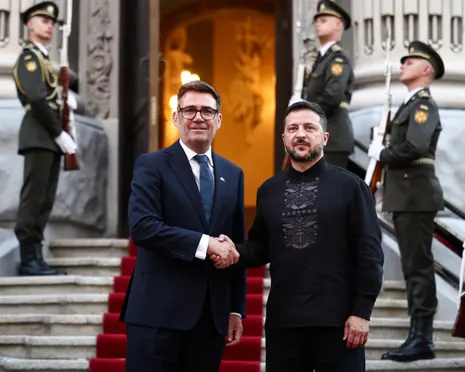
Prime Minister Andy Burnham framed the deal as a chance for British technology firms to pair their engineering talent with real-world combat data.
“Accelerate the development of capabilities that not only strengthen our national security but better protect our critical infrastructure and growth in every postcode here at home,” he said.
Defence Secretary Wes Streeting emphasised the reciprocal nature of the partnership.
“By combining the UK’s world-leading scientists, engineers and tech companies with Ukraine’s unique battlefield experience and data, we will strengthen both of our nations’ defence and security,” Streeting said, adding that Ukraine was “pushing the frontier of defence innovation as they bravely resist Putin’s illegal invasion.”
Beyond perimeter sensing, officials have hinted at follow-on projects that could include purpose-built AI accelerators for autonomous drones, robotic sentries, and semi-automated weapons platforms. Whether those ambitions will materialise depends on the pilot’s results and on whether parliamentary scrutiny of the data-sharing terms produces conditions acceptable to both governments.
For now, the buried cables at the trial site are being laid, the sensor arrays are being calibrated, and the first labelled datasets are being ingested. What emerges from that process — a more responsive perimeter defence, a new class of predictive threat model, or simply a confirmation that existing open-source training already covers most realistic scenarios — will become clear over the coming months.
Related Reading
Frequently Asked Questions
What is UK to use Ukraine battlefield data?
UK to use Ukraine battlefield data is the main topic of this guide. The article explains the context, practical details, and next steps readers should understand.
Why does UK to use Ukraine battlefield data matter?
UK to use Ukraine battlefield data matters because readers are looking for a useful answer, not just a short summary. Good content should match search intent and help them decide what to do next.