Jared Kushner meets with Hamas ahead of talks with Netanyahu on Gaza


Table of Contents
Diplomatic Gamble in Cairo: Kushner Seeks Hamas Buy-In Before Confronting Netanyahu Over Gaza Roadmap
Wanderstayfinder.com – The stalled ceasefire governing Gaza’s fate took a sharp turn on Sunday when Jared Kushner, Donald Trump’s son-in-law and senior White House envoy, sat down across the table from Khalil al-Hayya, Hamas’s political chief, in a closed-door session in Egypt lasting more than two hours. The encounter marked one of the few direct contacts between the two sides since the truce took hold, and it carried an explicit purpose: locking in Hamas’s commitment to a US-drafted disarmament and withdrawal framework before Kushner turned his attention to Jerusalem.
On Monday, Kushner is scheduled to sit down with Israeli Prime Minister Benjamin Netanyahu alongside former British Prime Minister Tony Blair and Nickolay Mladenov, the director of the US-created Board of Peace that now oversees the ceasefire. A source familiar with the itinerary and a separate diplomatic source confirmed the arrangement, both speaking anonymously because the session was to remain behind closed doors.
A Roadmap Netanyahu Has Already Rejected
The 15-point plan at the center of these talks was put forward with full American backing and calls for a phased process: Hamas progressively surrenders its arsenal to a Palestinian technocratic committee tasked with managing daily governance in the territory, while Israeli forces cease operations and pull back from areas they currently occupy. Netanyahu, however, publicly dismissed the document last week in what observers described as an unusually blunt act of defiance against Washington, Israel’s closest strategic partner.
His position is categorical: Israel will not relinquish any ground in Gaza until Hamas has been entirely disarmed. That stance effectively freezes every other pillar of the ceasefire architecture, including reconstruction of the devastated enclave and the planned deployment of international peacekeeping forces to buffer Israeli positions from committee-administered zones.
The Mechanics of Disarmament — and the Sticking Points
Under the roadmap’s design, weapons would be transferred to a Palestinian technocratic committee intended to oversee civilian operations across Gaza. That committee has not yet entered the territory. Complicating matters further, Hamas has tied the surrender of its heaviest ordnance to the eventual establishment of a Palestinian state — a prospect Israel’s current government flatly rejects. The result is a circular impasse: Israel will not withdraw until disarmament is complete; Hamas will not fully disarm until statehood is on the table.
The Hamas official present in Cairo said the group remained committed to the framework and was awaiting the mediators’ signal to open a 14-day negotiation window during which a concrete implementation timetable would be negotiated. That window cannot open until every party formally approves the roadmap. The same official added that al-Hayya demanded Israel halt its ongoing strikes and pull its forces back to the so-called “yellow line” — a boundary dividing the territory — before any implementation phase could begin. The yellow line was never precisely mapped, and Israeli troops have long since moved past it, now controlling roughly 60 percent of Gaza’s area.
In May, Netanyahu declared the next objective was expanding Israeli control to 70 percent of the enclave, describing the strategy as “tightening the grip” on Hamas “from every direction.”
Regional and International Pressure Builds
The rejection of the roadmap triggered an immediate diplomatic backlash. Foreign ministers from Saudi Arabia, the United Arab Emirates, Jordan, Pakistan, Indonesia, and the ceasefire mediators issued a joint statement condemning Israel’s move:
“Israel now bears responsibility for obstructing the efforts to bring peace in Gaza.”
The communiqué urged the Board of Peace and the United States to take “immediate and concrete measures” to prevent any single party from derailing the plan’s execution.
Hamas, in its own statement following the Cairo session, called on the mediators and the Board of Peace to “compel” Israel to approve the roadmap and move to the next phase.
Human Cost and Political Clock
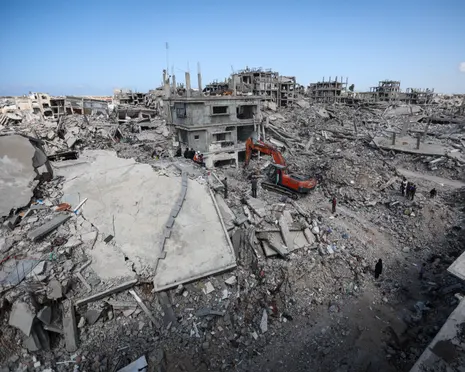
More than 10 months have passed since the ceasefire, agreed on 10 October 2025, ended large-scale military operations. In that interval, Gaza’s health ministry tallies more than 1,200 Palestinians killed and over 4,100 wounded. The territory, home to approximately two million residents, remains largely under Israeli military control, and reconstruction has barely begun.
Netanyahu enters Monday’s meeting under domestic pressure as well. A general election is set for 27 October, and his coalition includes ministers who advocate an even harder line on Gaza. Whether he will accept any compromise on sequencing — allowing partial withdrawal alongside phased disarmament rather than demanding total disarmament first — remains the central question of the talks.
Precedent and Process
The Cairo format is not new. Last year, a similar gathering in Egypt involving Kushner, fellow envoy Steve Witkoff, and Hamas leadership helped seal the original ceasefire. At that point, progress had been frozen over the same core issue: how and when Hamas would lay down its arms. The current round of talks represents an attempt to break that deadlock through direct, high-level engagement rather than through intermediaries alone.
The White House directed questions about the meetings to the Board of Peace, which did not respond immediately. The Tony Blair Institute also declined to comment.
What emerges from Monday’s session in Jerusalem will determine whether the 15-point roadmap survives as a living document or becomes another diplomatic artifact filed away while two million people wait in a territory that has not known sustained peace in over a decade.
Related Reading
Frequently Asked Questions
What is Jared Kushner meets with Hamas ahead?
Jared Kushner meets with Hamas ahead is the main topic of this guide. The article explains the context, practical details, and next steps readers should understand.
Why does Jared Kushner meets with Hamas ahead matter?
Jared Kushner meets with Hamas ahead matters because readers are looking for a useful answer, not just a short summary. Good content should match search intent and help them decide what to do next.