Is the US actually too chicken to take on China for trade?

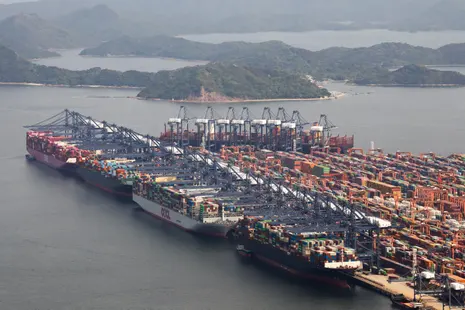
Table of Contents
The White House’s New AI Border Detective Won’t Fix What Tariffs Couldn’t
Wanderstayfinder.com – Washington unveiled a new artificial-intelligence system last week designed to scan every bill of lading and shipping manifest crossing American borders, flagging goods that have been rerouted through third countries to dodge tariffs. The administration’s pitch is dramatic: a digital sleuth that “never sleeps, never tires, and never forgets,” hunting down Chinese-made components smuggled into Mexican trucks, Vietnamese freighters, or Indian container ships. The tool was announced alongside a White House report titled The Great Transhipment Scam, which catalogues the scale of the problem and names the American communities it claims are being hollowed out.
The report’s language is blunt:
“When power supplies, control panels, aluminum sheet, valves, plastics, or furniture components are rerouted from China through Mexico, Vietnam, Malaysia, Poland, or the UAE, they destroy or reduce jobs in Milwaukee, Cleveland, Toledo, Hickory, Phoenix, Youngstown, and dozens of other American manufacturing communities.”
The commerce department’s underlying analysis puts a dollar figure on the phenomenon: roughly $67 billion worth of Chinese-origin goods passed through Mexico, India, and Vietnam in 2025 before reaching American buyers. Trade adviser Peter Navarro made his displeasure no secret on Thursday, singling out Chinese electric motors bolted onto reclining chairs that arrived stamped “Made in Vietnam.” The optics, he argued, are intolerable.
A Truce Built on Rare-Earth Leverage
The broader context matters. In October of last year, Beijing threatened to cut off American access to rare-earth magnets — the tiny but indispensable components inside everything from fighter jets to wind turbines. Washington blinked first. A trade truce was struck, and the administration has since preferred to declare victory rather than reopen the confrontation. The numbers flatter that narrative: Chinese imports into the United States fell by 40 percent in the twelve months through June compared with the same window in 2024. On the surface, the tariff campaign appears to have worked.
But the share of total value added embedded in US imports has not declined in any meaningful way. In other words, Americans are still buying Chinese-made content; they are simply buying it with a different country of origin stamped on the box. The White House’s own acceptance of this reality — that not purchasing Chinese goods from China is not the same as not purchasing Chinese goods at all — undercuts the triumphalist framing.
What the Crackdown Will Not Achieve
Three sobering facts temper the excitement around the new border-scanning system. First, American manufacturing employment has barely moved despite two and a half administrations spanning roughly a decade of policy interventions aimed at reviving factory work. The employment figure sits close to where it stood when Donald Trump first took office in 2017. Second, the total US import bill is running higher than it was in 2024, notwithstanding the layered tariffs imposed since. Third, Chinese export volumes have continued to grow even as Washington has tried to squeeze them out of American markets.
The AI detective, for all its computational horsepower, will not reverse any of these trends. It may slow the flow of mislabeled goods, but it will not put a lathe back in Youngstown or a stamping press back in Toledo.
The Yuan Question Nobody Wants to Answer
The more consequential lever remains untouched: the exchange rate. The Chinese yuan has been trading at levels that economists widely regard as undervalued relative to fundamentals, and that undervaluation functions as a permanent export subsidy. Every dollar of Chinese goods sold abroad is effectively discounted by the currency’s weakness, making Chinese factories more competitive in every market simultaneously — not just the American one, but also the markets of Southeast Asia, Africa, Latin America, and Europe.
Addressing the yuan’s mispricing would strike at a critical structural driver of China’s enormous export surplus, which is not merely swamping US import markets but also threatening industrial development across the rest of the globe. China’s share of world manufacturing exports has climbed from roughly 3 percent in 1995 to about 20 percent today. It now accounts for more than half of global exports in hundreds of individual product categories. Its current-account surplus, estimated at around 5 percent of GDP, represents a massive continuous drain on aggregate demand elsewhere.
“A Symptom, Not the Disease”
Monetary economists will object. The standard textbook reply is that exchange rates reflect deeper imbalances: China’s depressed household consumption rate forces it to rely on foreign demand to sustain growth, while America’s outsized federal budget deficit must be financed by foreign savings — savings that flow in from Beijing and other surplus economies. In that framing, the weak yuan and the comparatively strong dollar are merely reflections of those structural forces. “The exchange rate is a symptom, not the disease,” the argument runs. If Beijing simply forced the yuan higher by fiat without changing anything else, growth would slow, import prices would fall, inflation would ease (perhaps into deflation), and the real exchange rate would drift back down.
That logic is tidy, but it carries the same flavor as the old Western exhortation to simply wait for China’s multiparty democracy to mature. On the American side of the ledger, the last time Washington made a serious, sustained effort to shrink its budget deficit was in the twentieth century. Waiting for Beijing to expand pension benefits or otherwise stimulate household spending, without external pressure, amounts to waiting indefinitely.
Exchange-rate pressure — whether through coordinated intervention, targeted tariffs calibrated to currency effects, or multilateral negotiation — can supply the incentive that domestic politics alone will not. The new border-scanning tool is a reasonable administrative step. But it is a scalpel where the situation calls for surgery, and the White House appears content to settle for the former.
Related Reading
Frequently Asked Questions
What is Is the US actually too chicken?
Is the US actually too chicken is the main topic of this guide. The article explains the context, practical details, and next steps readers should understand.
Why does Is the US actually too chicken matter?
Is the US actually too chicken matters because readers are looking for a useful answer, not just a short summary. Good content should match search intent and help them decide what to do next.