Sheikh Hasina Declares Return to Bangladesh Despite Capital Punishment Looming
Wanderstayfinder.com – Bangladesh’s former prime minister has announced she intends to travel back to her homeland before the year concludes, fully aware that authorities have sentenced her to death. The decision comes two years after a wave of student demonstrations successfully removed her from power. “I may end up in a prison cell. They might execute me. Whatever occurs, I must return,” Hasina stated during a virtual address to journalists in the Indian capital. At seventy-eight years old, she has resided in India under heavy protection since escaping Dhaka in a dramatic departure. The timing of her planned arrival holds particular significance for Bangladesh. December marks what the nation calls its “month of victory,” commemorating the triumph over Pakistani military forces during the 1971 struggle for independence.
“Whatever fate awaits me, I will return to my people,” the former Awami League leader told attendees at the Foreign Correspondents’ Club of South Asia in Delhi.
Her son, Sajeeb Wazed Joy, provided updates on his mother’s condition during the same news conference. He emphasized that she receives treatment befitting a sitting head of state, surrounded by comprehensive security and diplomatic services.
“Prime minister Narendra Modi’s government has shown her the utmost respect, and for that I am eternally grateful,” Joy explained.
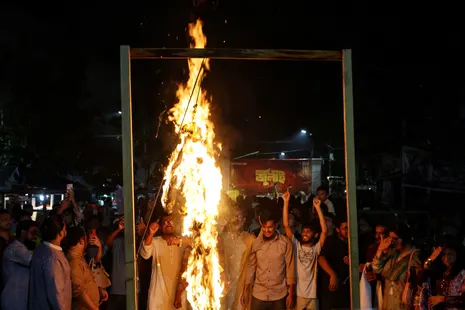
New Delhi moved quickly to clarify its position regarding the event. Officials stated India neither organized the conference nor endorsed any political positions articulated by Hasina during her address. This careful distancing reflects the delicate nature of India-Bangladesh relations following Hasina’s departure. Once considered one of India’s most reliable regional partners, bilateral connections have weakened considerably. Indian diplomats are now navigating competing pressures: maintaining constructive ties with Bangladesh’s new leadership while simultaneously resisting calls to hand Hasina over to Dhaka authorities. Her dramatic exit concluded more than fifteen years of Awami League governance, which gradually became more centralized and authoritarian. The Bangladesh Nationalist party, headed by Tarique Rahman—son of former prime minister Khaleda Zia—captured power in an election that excluded the Awami League from participation. Bangladesh’s current administration has indicated Hasina would likely face immediate detention upon crossing into the country. Last November, an international crimes tribunal convicted her in absentia of crimes against humanity related to the violent crackdown on protesters. The unrest originated from demands for expanded government employment quotas but rapidly evolved into a nationwide movement challenging Hasina’s leadership. United Nations assessments suggest as many as 1,400 individuals lost their lives during the demonstrations, though Hasina’s allies maintain the figure closer to 800.
“She has rejected the court’s verdict as politically motivated and said the execution threat would not change her plans,” observers noted.
Hasina’s political journey has been marked by intense competition with Khaleda Zia, who passed away in 2025. The two women engaged in what became known as the “Battle of the Begums,” exchanging accusations involving corruption prosecutions and strategic arrests. Within Bangladesh, domestic broadcasters and newspapers face restrictions on covering Hasina’s public statements. She continues to press for the removal of the Awami League ban, the liberation of political detainees, and the dismissal of what she characterizes as fabricated legal cases against party members.
Claiming Bangladesh is sinking into lawlessness and economic ruin, she accuses the new government of trying to erase the country’s secular character.
The current administration faces mounting challenges including elevated inflation rates and weak economic expansion. Officials attribute numerous difficulties to alleged corruption and administrative failures during Hasina’s tenure. Her return would test whether Bangladesh’s political climate has stabilized enough to accommodate a figure who remains deeply polarizing. International observers will watch closely to see if her presence triggers renewed tensions or signals a potential path toward reconciliation. The outcome of her journey could reshape Bangladesh’s domestic politics and influence how regional powers engage with the South Asian nation moving forward.
Related Reading
Frequently Asked Questions
What is Exiled PM vows to return to Bangladesh?
Exiled PM vows to return to Bangladesh is the main topic of this guide. The article explains the context, practical details, and next steps readers should understand.
Why does Exiled PM vows to return to Bangladesh matter?
Exiled PM vows to return to Bangladesh matters because readers are looking for a useful answer, not just a short summary. Good content should match search intent and help them decide what to do next.