Security Alert at Leipzig Airport: Drone with Explosives Triggers Investigation and Flight Diversions
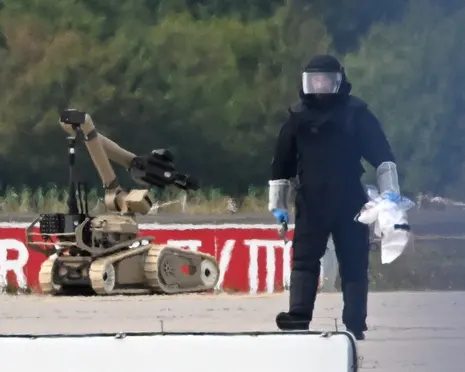
Wanderstayfinder.com – German authorities have launched a comprehensive investigation after security personnel discovered a drone equipped with an explosive device at Leipzig airport, one of the nation’s most critical transportation hubs. The incident prompted the deployment of a specialized bomb disposal robot and led to the temporary closure of the southern runway, causing several commercial flights to be rerouted to alternative destinations.
Compounding the security concern, a DHL cargo aircraft that had been forced to abort its landing attempt subsequently encountered an unidentified object while ascending from the airport. The cargo plane, which sustained only minor damage during the mid-air encounter, eventually touched down safely in Hanover. This dual incident has raised serious questions among security analysts about potential coordinated threats targeting German infrastructure.
Timeline of Events and Initial Response
According to official statements, airport staff identified the suspicious drone during overnight operations on Wednesday. The device was located within the security perimeter of the cargo operations zone, positioned near the south runway. The drone, identified as a quadcopter configuration, carried what investigators described as an unknown explosive mechanism. Security personnel immediately initiated containment protocols and deployed remote-controlled equipment to examine the device without risking human safety.
The cargo aircraft collision occurred after the plane had successfully taken off following the initial runway closure. Investigators confirmed that the aircraft experienced contact with a second unidentified flying object during its climb. Post-landing inspection in Hanover revealed only superficial damage to the aircraft structure, allowing normal operations to resume with minimal disruption.
Strategic Importance of Leipzig Airport
Leipzig airport holds particular significance in European logistics and defense supply chains. The facility serves as a major distribution center for military equipment transported by both the German armed forces and NATO member nations. Additionally, the airport functions as a critical base for Ukraine’s Antonov Airlines, which operates several cargo aircraft bearing patriotic inscriptions such as “Be Brave Like Kherson” and “Be Brave Like Bucha”—references to locations that experienced significant civilian casualties during Russia’s full-scale invasion of Ukraine.
A representative from NATO confirmed awareness of the situation, stating that German authorities are conducting a thorough examination of all circumstances surrounding the incidents. The presence of Ukrainian military equipment at the facility has made it a potential target for various actors with interests in the ongoing conflict.
Explosive Device Analysis and Chemical Composition
Media reports have provided varying details regarding the explosive mechanism found on the drone. Some publications suggested the device may have been constructed using a combination of fertilizer and petrol, materials commonly available and relatively simple to assemble. However, a collaborative investigation by public broadcasters NDR and WDR, along with the Süddeutsche newspaper, identified the presence of pentaerythritol tetranitrate, commonly known as PETN.
PETN represents a powerful high explosive belonging to the same chemical family as nitroglycerin. It serves as a primary component in semtex, a versatile explosive material widely used in both military applications and terrorist incidents throughout history. The sophistication of the device suggests deliberate preparation rather than a hasty assembly.
Political Response and Investigation Directions
Interior Minister Alexander Dobrindt, who was vacationing in Italy when news of the incident broke, announced his intention to travel immediately to Leipzig. He plans to convene meetings with both federal and state authorities to coordinate the response and ensure comprehensive coverage of all investigative angles.
Investigators are currently evaluating multiple scenarios, with particular attention focused on potential Russian involvement. One theory suggests Moscow may have attempted to target Ukrainian military equipment stationed in Germany. Another possibility involves broader efforts to escalate tensions between Russia and Western nations through coordinated attacks on critical infrastructure.
Who else could it be but Russia?
Ukraine’s ambassador to Germany, Oleksii Makeiev, expressed confidence that Moscow was responsible for the incident. He made his comments to the commercial broadcaster Welt TV, noting that Moscow had not yet issued any official response to the allegations.
German political figures have called for urgent action. Konstantin von Notz, the Green party’s spokesperson on intelligence oversight, emphasized the need for rapid investigation. He warned that if a foreign state is found responsible, the incident would represent more than ordinary terrorism—it would constitute state terrorism directed against Germany and its citizens.
Should it transpire that a state is behind this action, this would constitute not merely terrorism but state terrorism directed against the federal republic of Germany and its citizens.
Marc Henrichmann, who chairs the German parliament’s intelligence oversight committee for the CDU party, suggested the attack appeared designed to target a company of particular importance to Ukraine. He told the Rheinische Post newspaper that confirmation of these details would mark a significant escalation in the pattern of attacks against Western targets.
Broader Context of European Security Concerns
This incident does not exist in isolation. Germany and several other European nations have experienced a series of suspicious unauthorized drone overflights targeting airports, military installations, ports, and major logistics companies in recent months. While Moscow has consistently denied involvement in these incidents, European security agencies have increasingly pointed to Russian agents as potential perpetrators.
Earlier in 2024, European intelligence services investigated a series of incendiary devices concealed within parcels that spontaneously caught fire during transit. These devices, some discovered at a DHL warehouse in Leipzig and others found in freight shipments moving across Europe, raised serious concerns about coordinated sabotage efforts targeting air cargo operators. The chemical composition of these devices bore similarities to the explosive found on the drone at Leipzig airport.
Operations at the northern section of Leipzig airport resumed approximately two hours after the initial incident, while the southern runway remained closed for extended examination. Police and prosecutors confirmed that there was no ongoing threat to passenger safety or airport personnel, and commercial air traffic continued without significant disruption.
Tobias Meyer, chief executive of DHL, addressed the situation during a quarterly earnings conference call. He noted that the company had contingency plans in place for incidents of this nature, emphasizing the organization’s preparedness for security challenges in its global logistics network.
We’ve got plans for cases like this.
As the investigation continues, security experts warn that the Leipzig incident could represent a new phase in European security dynamics, particularly if evidence emerges linking the attack to state-sponsored actors seeking to influence the outcome of the conflict in Ukraine through direct action on European soil.
Related Reading
Frequently Asked Questions
What is Bomb disposal robot deployed after drone?
Bomb disposal robot deployed after drone is the main topic of this guide. The article explains the context, practical details, and next steps readers should understand.
Why does Bomb disposal robot deployed after drone matter?
Bomb disposal robot deployed after drone matters because readers are looking for a useful answer, not just a short summary. Good content should match search intent and help them decide what to do next.