Keir Starmer Likely to Declare Resignation as Prime Minister on Monday
Labour MPs Push for Andy Burnham to Assume Leadership Amid Political Turmoil
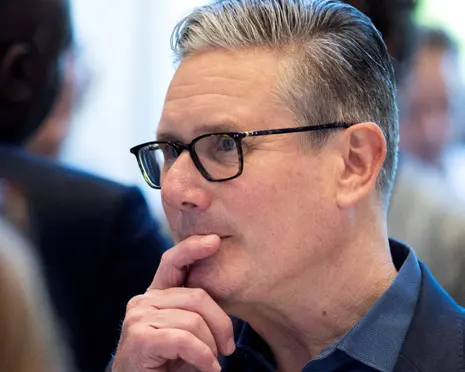
Wanderstayfinder.com – On Monday, Prime Minister Keir Starmer is anticipated to formally announce his intention to step down, a move driven by mounting pressure from within his own party. This decision comes after weeks of speculation and internal conflict, with Andy Burnham emerging as the frontrunner to replace him as Labour leader. The announcement is expected to signal the end of Starmer’s tenure, which has seen the government navigate a series of challenges since his election victory in the general election last year.
Labour’s business secretary, Peter Kyle, addressed the situation during a Sunday interview with the BBC’s *Sunday with Laura Kuenssberg* programme, emphasizing the political dynamics at play. While Kyle declined to speculate on Starmer’s exact plans, he acknowledged the “political realities” that the prime minister is currently facing. “There is no doubt that a leadership challenge is brewing,” Kyle stated, highlighting the growing consensus among MPs that Starmer’s leadership might be untenable in the short term. He noted that Starmer has been “very mindful of the country’s interests” and has been weighing the implications of his next steps.
“I don’t want to come on here and be delusional that there is no process, no forces at work challenging the prime minister as leader – that is clearly the case,” Kyle said, underscoring the inevitability of the leadership transition. His remarks reflect the internal strain within Labour, where the party’s future appears to hinge on the outcome of a potential contest.
The pressure on Starmer intensified following his victory in the Makerfield byelection, where Andy Burnham secured a decisive win. Burnham’s success, marked by a 9,000-plus majority and over 50% of the vote, bolstered his credibility as a candidate for the party’s leadership. His team now believes they have garnered support from approximately 200 Labour MPs, a number that could justify a formal leadership challenge under the party’s rules. Kyle confirmed that Burnham’s position has grown stronger, with the prime minister’s allies urging him to finalize a timetable for his exit by the weekend or risk being forced out.
Despite Starmer’s initial resolve to defend his leadership, the government has been under scrutiny since the byelection. Kyle pointed to Starmer’s Friday comments, in which the prime minister vowed to resist any leadership challenge, as a testament to his determination. However, the business secretary also suggested that Starmer is preparing for a relatively smooth transition, with the timetable for his departure set to be announced soon. “He was very focused on the country’s needs and repeatedly asked my opinion on what the public might expect,” Kyle explained, though he withheld specific details of the advice he provided.
The Labour leadership race has become a focal point of national attention, with Burnham positioned to take the helm without a contested election. Kyle’s comments hint at a potential “coronation” for Burnham, where he would ascend as leader and, by extension, prime minister, following Starmer’s formal resignation. This scenario, while not certain, has gained traction as Burnham’s influence within the party grows. Kyle urged unity, stating that Labour must “find a way to get through this that puts the country first,” a sentiment echoed by many MPs who see the need for stability amid ongoing uncertainty.
Labour’s internal dynamics have been further complicated by the potential candidacy of Wes Streeting, the former health secretary. Although Streeting has pledged to challenge for the top job, his prospects remain uncertain. Kyle noted that Streeting’s bid could face challenges if wavering backbenchers align with Burnham, who is seen as a more likely winner. “The key will be whether the party can consolidate support behind a clear candidate,” Kyle added, acknowledging the fragility of the current political landscape.
Starmer’s leadership has been marked by a series of controversies and strategic shifts, which have eroded public confidence. Notably, his decision to appoint Peter Mandelson as UK ambassador to Washington and his handling of winter fuel payment policies have drawn criticism. These issues, combined with Labour’s declining poll ratings, have left Starmer in a precarious position. Reform UK, a far-right party, has maintained a lead in national polls for over 300 consecutive days, further weakening Labour’s position.
With Starmer’s departure imminent, the UK could face its seventh prime minister in a decade. This would follow his dramatic rise to power, which saw Labour win a majority of 174 seats in the 2024 general election. However, the past two years have been a rollercoaster for the government, as Starmer attempted to stabilize the party amid rising public discontent. The impending leadership change may be a necessary step to restore momentum, but it also raises questions about the long-term viability of Labour’s strategy.
Kyle’s interview provided insight into the behind-the-scenes negotiations shaping the transition. He revealed that Starmer had engaged in lengthy discussions with him on Friday, reflecting on the challenges ahead. “He was very thoughtful about how to minimize disruption to the national interest,” Kyle said, suggesting that Starmer’s decision is not merely a reaction to pressure but a calculated effort to ensure a smooth handover. This approach, however, has been met with mixed reactions, as some MPs remain loyal to Starmer while others push for Burnham’s leadership.
Burnham’s campaign has focused on rejuvenating Labour’s image, with his victory in Makerfield seen as a symbolic triumph. Yet, his path to the top job is not without obstacles. Kyle noted that Burnham’s team is optimistic about their support base, but the final tally of MPs backing his candidacy could influence the outcome. “The challenge is to ensure that any change is done in a functional way,” Kyle emphasized, echoing the need for a pragmatic solution that avoids further destabilizing the government.
As the clock ticks toward Monday, the political stakes are high. Starmer’s resignation would mark the end of an era, but it could also pave the way for a new chapter in Labour’s history. The decision will be scrutinized not only for its immediate implications but also for how it reflects the broader challenges facing the party. With public opinion increasingly critical and internal divisions unresolved, the transition to Burnham’s leadership may prove to be a critical test for Labour’s ability to adapt and recover.
The government’s ability to maintain focus on national priorities will be paramount in the coming days. Kyle highlighted that Starmer’s approach to leadership has been characterized by a balance between authority and responsiveness, a tightrope that has been difficult to walk. “The challenge is to ensure that any leadership change keeps the people at the center of our efforts,” he said, a message that resonates with both supporters and critics of the current administration.
Starmer’s departure may also have lasting effects on the political landscape. With a new leader taking charge, the focus will shift to how Labour can regain public trust and rebuild its electoral base. The upcoming leadership contest will serve as a litmus test for the party’s cohesion, with Kyle’s remarks suggesting that the outcome will be shaped by the broader political forces at play. As the UK prepares for this transition, the nation watches closely to see whether the new leader can steer Labour back to success or if the party will continue to struggle in the face of rising challenges.