How the world’s voracious appetite for shrimp is destroying Ecuador’s mangroves
Wanderstayfinder.com – At the edge of the Pacific Ocean, in the low-lying mudflats of Isla Costa Rica, 32-year-old Johana Carolina Cruz Potes trudges through the sludge with a bucket and a small metal hook. Her task is to extract concha negra, black-shelled cockles, from the tangled roots of a mangrove forest. This routine, which she has performed since childhood, has become increasingly difficult as the habitat shrinks and the catch dwindles. Cruz Potes attributes the decline to the arrival of shrimp farms, which have carved deep scars into the landscape. “They cut down all the trees for their ponds,” she says, pointing to a nearby tank. “But the conchas depend on the roots. When the trees disappear, so do the cockles.”
The Growth of Shrimp Production
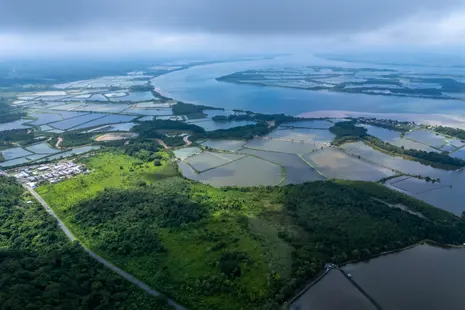
Ecuador’s shrimp industry has expanded rapidly over the past decade, with output nearly doubling. This surge has outpaced the country’s oil exports, making shrimp its largest economic export. Most of these shrimp end up in markets across China, the United States, and Europe, where demand has grown exponentially since trade barriers were lifted. The industry’s rise has pushed operations deeper into ecosystems already weakened by previous deforestation efforts. Between 1969 and 1999, the nation lost nearly half its mangrove forests, and shrimp farms now occupy an area 1.5 times larger than what remains.
Despite regulations banning the conversion of mangroves, the industry claims its footprint has shrunk to nearly zero as production has surged. However, local residents and environmental scientists dispute this, citing evidence that deforestation continues. “People believe the destruction stopped years ago,” says Eduardo Rebolledo Monsalve, a researcher at the Catholic University in Esmeraldas. “But that’s not the case.” Data from Trase, a global supply-chain transparency project, reveals that 427 hectares of mangroves were transformed into shrimp ponds between 2014 and 2018, primarily in Guayas province, Ecuador’s primary shrimp-farming region. A subsequent study using satellite imagery found an additional 2,900 hectares lost in the following four years, with nearly half of this loss occurring within protected zones.
Shrimp Farming’s Hidden Costs
In January 2024, a naval operation uncovered a 10-hectare mangrove clearing within Manglares Don Goyo, a critical wetland in the Gulf of Guayaquil. Recognized as an international conservation site under the Ramsar Convention, the area’s destruction highlights the ongoing threat to these vital ecosystems. Luis Ángel Flores Ramírez, a crab harvester in El Oro province, where shrimp farming began decades ago, describes a pattern of incremental expansion. “Farmers now clear small patches under the excuse that they’re just pruning or building canals,” he explains. “But the damage accumulates over time.” Residents often notice the toll only after inspectors find widened dikes or fresh deforestation sites.
Shrimp farms disrupt more than just the physical landscape. By constructing walls and canals, they block tidal flows that sustain mangrove soil health. “When these barriers cut off the water exchange, the mud dries out, salinity rises, and trees that remain can wither slowly,” says Rebolledo Monsalve. This process not only reduces biodiversity but also weakens the natural defenses of coastal regions against erosion and storm surges. Additionally, the industry’s waste discharge practices have intensified. Ecuadorian law mandates that untreated waste from shrimp farms must not be released directly into estuaries, yet a 2023 study found mangrove waters near these farms in Esmeraldas contained two and a half times more ammonium and phosphorus than unpolluted counterparts.
The waste often escapes through canals or drainage systems, with over half of it entering the environment, according to a Seafood Watch assessment. A former shrimp worker from La Libertad recalls being instructed to release pond water directly into the estuary. “Everything goes straight into the estuary,” he says. “It all turns white with foam.” This runoff carries organic matter, nutrients, and chemical additives like sodium metabisulfite, which is used to preserve shrimp during transport. For Mauricio Cruz, a crab harvester in Huaquillas, these chemicals compound the environmental toll, particularly during water exchanges. “We see dead fish floating in the water,” he says. “It’s not uncommon.”
Community and Conservation Concerns
Residents like Máximo Jordán, president of an artisanal crabbers’ association in Puerto Roma, describe a growing sense of urgency. His village is encircled by over 150 shrimp ponds, and he claims farmers have installed hidden pipes to channel dredged sediment into mangrove areas. “Why don’t they dispose of it in their own canals?” he questions. “They push it 300 metres into the forest. It contaminates the trees and kills the crabs.” Such practices underscore the tension between economic gains and ecological preservation.
While shrimp farms claim to operate sustainably, critics argue that the scale of the industry’s impact is undeniable. The expansion into protected zones has sparked debates about the balance between livelihoods and conservation. For families reliant on shellfish gathering, the loss of mangroves means fewer resources and uncertain futures. Cruz Potes, whose work has defined her life, feels the weight of these changes acutely. “We’ve always lived here, but now the land is changing,” she says. “It’s hard to find the same things we used to.”
Environmental advocates warn that the destruction of mangroves poses a broader crisis. These forests act as natural buffers against climate change, absorbing carbon dioxide and stabilizing coastlines. Their loss accelerates soil degradation and threatens marine life that depends on their roots for shelter. Scientists emphasize that even with regulations in place, the cumulative effect of shrimp farming remains significant. “It’s not just about the trees,” says Rebolledo Monsalve. “It’s about the entire ecosystem that relies on them.”
As global demand for shrimp continues to rise, the pressure on Ecuador’s coastal ecosystems grows. The industry’s growth has created economic opportunities, but at what cost? For Cruz Potes and others, the answer is clear: the mangroves are vanishing, and with them, a vital part of their heritage and survival. “We need to protect what’s left before it’s too late,” she insists. “Otherwise, we’ll lose everything.”
Meanwhile, activists and researchers urge stricter oversight and sustainable practices. They argue that the current pace of expansion is unsustainable and call for investment in eco-friendly alternatives. Yet, without immediate action, the damage will continue. The once-thriving mangroves, which have supported local communities and global biodiversity for centuries, now face an uncertain future. As the world’s appetite for shrimp grows, so does the footprint of its production—a quiet but relentless threat to the delicate balance of nature.