Homes damaged as storms follow heatwaves in England and Wales

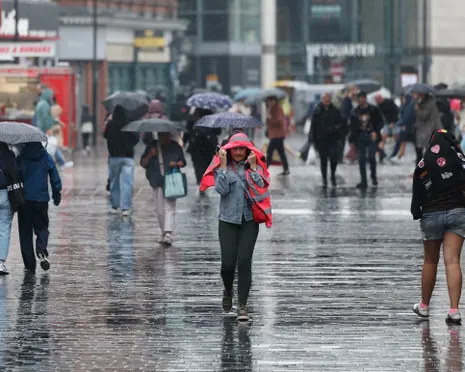
Table of Contents
Simultaneous Drought and Flooding: England and Wales Face a Weather Paradox
Wanderstayfinder.com – The same soil that cracked under weeks of relentless sun was, within hours, overwhelmed by a torrent of rain. Dozens of properties across England and Wales sustained flood damage on Wednesday night and into Thursday as violent thunderstorms swept through regions still locked in drought — a scenario climate scientists have long predicted would become routine as global heating destabilises British weather patterns.
The Met Office warned that thundery showers could dump as much as 75 mm of rain within a single 12-hour window in parts of England and Wales. Two separate yellow thunderstorm warnings were active: the first covering sections of the Midlands, eastern England, southern England, the north-west, Yorkshire and Humber, and Wales, running until 10 pm on Thursday; the second targeting Lincolnshire, further eastern areas, parts of Yorkshire, Kent, and the Medway basin from 5 pm Thursday through 7 am Friday.
Birmingham’s Perry Barr Floods
Nowhere was the damage more acute than in Birmingham, where the Environment Agency had issued a full flood warning for the Perry Barr district. West Midlands fire service responded to 32 properties near the Tame Valley canal on Wednesday evening, dispatching seven fire engines to the scene. Residents described water rising rapidly through streets that had been bone-dry for months.
Ryan Goodwin, who lives on one of the affected streets near the M6 motorway, was driving home with his children around 7:30 pm when he noticed the streets already pooling.
“I was in the car with the kids and I thought I don’t want to get out yet, there’s too many puddles here. Then in a matter of about half an hour it was just a river coming round the corner, all the way down the road.”
By the time he reached his front door, the conservatory was submerged under roughly three feet (one metre) of water, and the laminate flooring in the front room had been compromised. Electrical systems tripped as water reached the wiring. Neighbours further down the road, where two small hills funnel water into a corner, reported water halfway up their doors.
“The conservatory got flooded, the electrics went off. The conservatory had about 3ft of water – luckily that is below the house level. The neighbours’ carpet and sofa and everything got wet as well.”
Goodwin said he was uncertain how long repairs would take and was focused on salvaging what he could and contacting his insurer. He noted that months of drought had allowed leaves to accumulate in drainage channels, compounding the runoff problem when rain finally arrived.
“All the water comes off the motorway as well. It has been so dry for so long, all the leaves had blocked the drains and everything. Hopefully it doesn’t happen again.”
His father-in-law, Jay Patel, who was present during the event, recalled the speed with which water moved through the neighbourhood.
“[The water] was really, really fast. I couldn’t believe how fast it was.”
Wider Flooding Alerts Across England
The Birmingham incident was not isolated. The Environment Agency issued 40 flood alerts — indicating flooding is possible — across the Midlands, Yorkshire, and the south-east on Thursday morning. In Nottinghamshire, a specific alert was raised for the River Maun at Edwinstowe and Ollerton. River levels at the Mansfield The Dykes gauging station were climbing rapidly, the agency noted, owing to the catchment’s particular hydrological characteristics, with Old Rufford Road identified as the most exposed stretch.
Staffordshire, where a lower-tier flood alert remained in force, recorded 60 mm of rainfall over 12 hours according to agency gauges — a volume that, falling on parched and compacted ground, translates into far greater surface runoff than the same total would produce on healthy, permeable soil.
The Drought That Has Not Ended
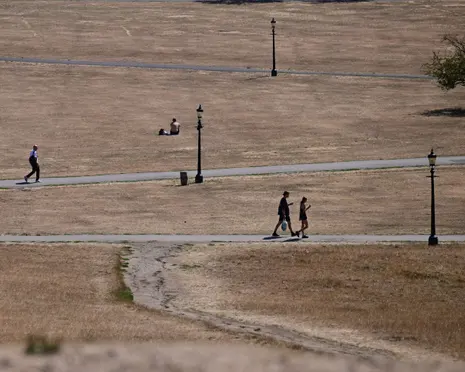
The storms arrived at the tail end of a summer in which most of England and the entirety of Wales had been formally declared in drought. Five distinct heatwaves were recorded across the UK during the season. Following a National Drought Group meeting on Thursday morning, the Environment Agency confirmed that 71.3 per cent of England remained under drought conditions. Only 34 per cent of the rainfall typically expected by that point in August had been received.
Philip Duffy, chief executive of the Environment Agency, drew attention to the paradox now playing out across the country.
“A few days or even weeks of wetter weather cannot reverse the impacts of several months of exceptionally dry conditions. Today’s yellow thunderstorm warnings show it’s possible to experience simultaneous drought and flood as heavy rain falls on compacted soils.”
Why This Pattern Is Becoming More Common
Climate scientists have issued repeated warnings that rising global temperatures are amplifying the volatility of British weather. The mechanism is straightforward: warmer air holds more moisture, so when convection finally triggers, rainfall intensities increase. At the same time, prolonged dry spells compact and desiccate soils, reducing infiltration capacity. The result is that when rain does arrive, a larger proportion runs off the surface rather than soaking in, producing flash-flood conditions even from moderate totals.
The sequence of five heatwaves followed by sudden, intense convective storms in late summer is precisely the compound event that modelling projects will grow more frequent under continued warming. For homeowners, insurers, and local authorities, the practical implication is that flood risk can spike abruptly in areas previously classified as low-risk, and that drainage infrastructure designed for historical rainfall patterns may prove inadequate under the new regime. The West Midlands fire service’s need to send seven engines to a single canal-side neighbourhood on a Wednesday evening illustrates how quickly operational assumptions can be invalidated when drought-primed landscapes meet a single violent storm cell.
Related Reading
Frequently Asked Questions
What is Homes damaged as storms follow heatwaves?
Homes damaged as storms follow heatwaves is the main topic of this guide. The article explains the context, practical details, and next steps readers should understand.
Why does Homes damaged as storms follow heatwaves matter?
Homes damaged as storms follow heatwaves matters because readers are looking for a useful answer, not just a short summary. Good content should match search intent and help them decide what to do next.