Germany’s firewall was meant to hold the far right at bay. It may have done the reverse

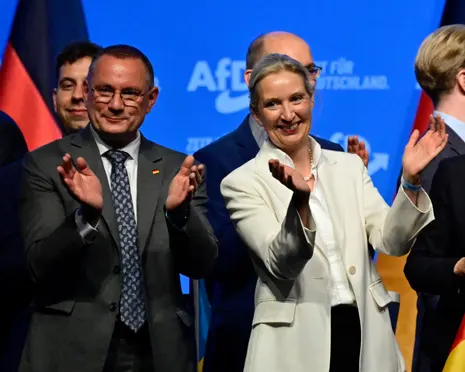
Table of Contents
A Vote That Could Redraw Germany’s Political Map
Wanderstayfinder.com – On 6 September, the state of Saxony-Anhalt — a region defined by its medieval timber-framed villages, the rugged peaks of the Harz range, and its deep association with the Reformation-era reformer Martin Luther — will go to the polls in what may become one of the most consequential state-level votes in the country’s postwar political history. For the first time since 1945, a party officially designated by Germany’s domestic intelligence agency as a “confirmed rightwing extremist” organisation could field a state premier and command a solo government. The Alternative für Deutschland (AfD), which has topped most national opinion polls since April of last year, is polling at up to 42 percent in Saxony-Anhalt. Under the country’s proportional-representation system, which bars any party below a five-percent threshold from entering parliament, a result in the low-to-mid forties could hand the AfD an outright majority in the state legislature.
The stakes extend well beyond one eastern state. A fortnight after the Saxony-Anhalt ballot, voters in Mecklenburg-Western Pomerania and Berlin will also choose their state parliaments. The AfD holds comfortable leads in both eastern territories and even sits in second place in Berlin, a city long regarded as a bastion of liberal politics. Should the party consolidate power across multiple states, the broad postwar consensus that kept far-right formations at the margins of German governance would effectively dissolve.
What an AfD State Government Would Mean on the Ground
Germany’s sixteen Länder exercise constitutional authority over education, policing, public broadcasting, and regional civil administration. An AfD-led state government would therefore have immediate levers of influence. Among the measures the party has outlined at state level: rewriting the school history curriculum to foreground what it calls Germany’s “achievements” rather than its wartime atrocities; stripping funding from anti-racism programmes; removing pride flags from public buildings; and rewriting the statutory mandates of public television and radio broadcasters.
Beyond policy content, an AfD administration could shape the composition of the state bureaucracy itself. By adjusting recruitment criteria and making political appointments that favour ideologically aligned candidates, the party could cultivate an environment in which civil servants default to silence rather than contest internal decisions. The Centre for Strategic and International Studies has noted that such a shift would carry an immediate domestic impact, altering the texture of daily governance in ways that ripple outward.
Federal and European Consequences
At the federal level, commanding a state government would entitle the AfD to seats in the Bundesrat, the upper house representing the Länder. While those seats would not permit the party to block legislation unilaterally, they would allow it to table new policy initiatives and disrupt the consensus-building that underpins German federalism.
On the European stage, the AfD’s influence would grow even though the party remains somewhat marginalised within the European Parliament, where it heads the ultra-nationalist ESN group alongside France’s Reconquest and Italy’s National Future. A more powerful AfD at home would weaken European unity in several concrete ways. Berlin’s role as an engine of integration would be undermined in areas such as environment policy — the AfD rejects the necessity of climate action — and in foreign affairs. The party’s hostility to further military aid for Ukraine and its eagerness to normalise relations with Moscow would play directly into Russian efforts to fracture western solidarity. More broadly, an AfD victory would send a potent signal that even the EU’s largest economy is susceptible to far-right capture, emboldening nativist parties ahead of national elections due in France, Italy, Spain, and Poland within the next eighteen months.
The Brandmauer: A Firewall That May Have Backfired
For decades, German political parties have maintained what they call a Brandmauer — literally a “firewall” — designed to prevent the normalisation of far-right extremism in mainstream politics. In practice, the firewall rules out any form of coalition or structural cooperation with the AfD. In 2018, the centre-right CDU, then led by Chancellor Friedrich Merz, went further and codified the Brandmauer into a formal “incompatibility resolution,” making the exclusion a matter of party-constitutional law rather than mere convention.
The stated objective was straightforward: by keeping the AfD permanently outside the tent of power, its support base would stagnate, its influence would shrink, and ultimately the party would fail to win government. By that measure, the strategy has failed. Analysts now identify at least three distinct structural flaws in the firewall approach.
Flaw One: Insulation from Compromise
As The Economist has argued, by rendering the AfD a permanent political pariah, the Brandmauer has effectively insulated the party from the compromises that discipline every other parliamentary actor. In normal coalition arithmetic, a junior partner must trade policy positions to hold office. The AfD, locked outside every governing arrangement, has been freed from that constraint. It can maintain maximalist rhetoric — distinguishing between “biological” and “passport” Germans, dabbling in iconography reminiscent of the Nazi era, and advancing positions often more extreme than those of other EU far-right formations — without ever having to dilute them for the sake of a working government. The result is a party that grows more radical with each election cycle rather than moderating toward the centre.
Flaw Two: The Vacuum Effect
When voters in eastern Germany perceive that their preferences are categorically excluded from governance, the firewall can function less as a barrier and more as a provocation. Disaffected constituents who feel no mainstream party will ever represent them are funneled toward the one formation that explicitly welcomes their grievances. The Brandmauer, intended to shrink the AfD’s electorate, may instead be consolidating it by making the party the sole available outlet for anti-establishment sentiment.
Flaw Three: Normalisation Through Proximity
Paradoxically, the very act of treating the AfD as a permanent, permanent fixture of every campaign — debating its positions, polling against it, building campaign strategy around its rise — grants the party a legitimacy that a smaller, ignored formation would never enjoy. The firewall’s visibility requirement means the AfD is discussed, covered, and taken seriously in every political conversation, even as it is formally excluded from every governing one. Over time, that sustained attention erodes the stigma the strategy was designed to preserve.
“The objective, of course, was to prevent support for the AfD increasing, its influence expanding, and, ultimately, the far-right party winning power. It hasn’t worked.”
The Saxony-Anhalt vote on 6 September will be the first real-world test of whether three decades of Brandmauer discipline can survive contact with a party that polls at 42 percent and has been granted, by its own domestic intelligence service, the formal label of confirmed extremism. If the AfD crosses the threshold into government, the question will no longer be whether the firewall held. It will be whether it ever existed at all — or whether it was, from the outset, a mechanism for entrenching the very force it was built to contain.
Related Reading
Frequently Asked Questions
What is Germany s firewall was meant to hold?
Germany s firewall was meant to hold is the main topic of this guide. The article explains the context, practical details, and next steps readers should understand.
Why does Germany s firewall was meant to hold matter?
Germany s firewall was meant to hold matters because readers are looking for a useful answer, not just a short summary. Good content should match search intent and help them decide what to do next.