Kim Jong-un’s sister casts doubt on Trump’s claims of secret US-North Korea talks

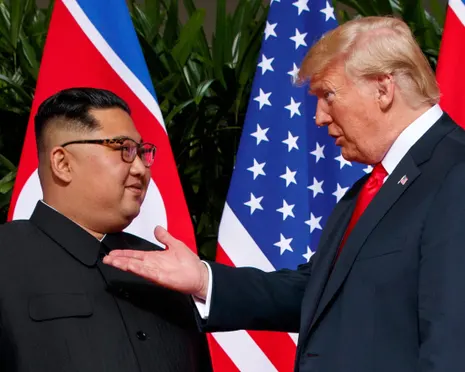
Table of Contents
Pyongyang’s Inner Circle Questions Whether Trump and Kim Ever Spoke at All
Wanderstayfinder.com – The diplomatic landscape between Washington and Pyongyang grew murkier this week after North Korea’s most visible foreign-policy voice publicly questioned whether her brother, Supreme Leader Kim Jong-un, had actually been in contact with President Donald Trump. Kim Yo-jong, the leader’s younger sister and a senior figure in the Workers’ Party of Korea, told state media she knew “absolutely nothing” about the supposed back-channel communications that Trump had described as ongoing. Her remarks landed the day after the American president told reporters aboard Marine One that he expected to sit down with Kim later in the year.
Who Is Kim Yo-jong, and Why Does Her Denial Matter?
Since stepping into the public eye around 2012, Kim Yo-jong has served as one of the DPRK’s principal spokespeople on inter-Korean and foreign affairs. She routinely issues statements through state-run outlets that function as quasi-official policy pronouncements. When she says she is unaware of a diplomatic development, the signal to both domestic audiences and foreign capitals is that no such development exists at the level of supreme leadership. Her intervention therefore does not merely add a note of skepticism; it directly challenges the premise that any secret dialogue has taken place.
In the statement carried by North Korean state media on Wednesday, she acknowledged that Kim harbored “personally good memories and feelings” toward the American president, a formulation that stopped short of confirming any exchange. Yet she immediately pivoted to a harder line: the United States remained an enemy of Pyongyang, and its hostile posture had not shifted.
“The United States’ hostile policy toward the DPRK has not changed, and the United States and its followers are vigorously carrying out hostile military activities against the DPRK even at this very moment.”
That language tracks a familiar DPRK rhetorical pattern, but its timing — issued within hours of Trump’s public claims — suggests the North wanted to control the narrative before Washington’s framing could harden.
Trump’s Marine One Exchange and the Nuclear-Weapons Disclosure
Journalists pressed the president on Wednesday as he departed Marine One, asking whether he was in direct contact with Kim. Trump declined to confirm or deny a live channel of communication. Asked whether he was planning an in-person meeting later this year, however, he answered without hesitation:
“Yeah, I will be.”
He went on to characterize his personal rapport with the North Korean leader in characteristically blunt terms:
“I know Kim Jong-un very well and he’s gonna be fine. As long as we have a smart president, he’s gonna be fine. If we have a dumb president, then he’s probably not going to be so fine.”
In the same exchange, Trump made an unusual intelligence disclosure, stating that North Korea possessed 57 “very powerful nuclear weapons.” The precise figure is notable because Washington has historically kept exact DPRK warhead counts out of public briefings, preferring ranges or qualitative descriptions. Revealing a specific number — and pairing it with the adjective “very powerful” — implies either a recent update in the intelligence picture or a deliberate signaling move aimed at both Pyongyang and other nuclear-armed states. In the same breath, Trump added that Iran should not be permitted to acquire a nuclear weapon, linking two separate proliferation concerns in a single remark.
The APEC Window and the Downgraded Exercise
The Wall Street Journal reported on Tuesday that Trump had been pressing aides to arrange a face-to-face meeting with Kim, potentially during a planned November trip to Asia for the Asia-Pacific Economic Cooperation summit in Shenzhen, China. APEC gatherings have historically served as convenient cover for bilateral side meetings, and Shenzhen’s location in southern China would place the two leaders within a short flight of Pyongyang. Whether that window will open depends, of course, on whether any genuine dialogue exists to build upon.
The backdrop to Trump’s remarks was his announcement that the United States would downgrade its participation in the large-scale military exercises conducted annually by South Korea and its American ally. Those drills, which have drawn sharp DPRK protests for decades, are among the most visible symbols of the US-South Korea alliance. Scaling back American involvement was framed as a conciliatory gesture, yet Kim Yo-jong’s statement made clear that Pyongyang read the move as insufficient to alter its strategic calculus.
Broader Implications
The episode underscores a recurring pattern in US-DPRK diplomacy: Washington signals openness, Pyongyang publicly denies any channel exists, and the gap between the two positions becomes itself a diplomatic variable. Kim Yo-jong’s phrasing — “Perhaps it is the only matter I do not know about in relation to our supreme leadership’s foreign policy” — was pointed enough to suggest that if such communications existed, they had been kept from even the sister who routinely speaks for the leadership on external affairs.
She also used the statement to push back against claims by Ukrainian President Volodymyr Zelenskyy that North Korea intended to deploy tens of thousands of troops to fight alongside Russia. Denying that deployment plan while simultaneously denying any secret US dialogue allowed Pyongyang to present a unified front: it was engaged with neither Washington’s overtures nor Kyiv’s battlefield calculus on its own terms.
For readers tracking the situation, the key question going forward is whether Trump’s November itinerary will include a stop that goes beyond the APEC agenda. If no meeting materializes, the Kim Yo-jong statement will be read in retrospect as the accurate account. If one does, the question shifts to what, precisely, was discussed — and whether the 57-warhead figure will become a benchmark against which future DPRK testing is measured.
Related Reading
Frequently Asked Questions
What is Kim Jong un s sister casts?
Kim Jong un s sister casts is the main topic of this guide. The article explains the context, practical details, and next steps readers should understand.
Why does Kim Jong un s sister casts matter?
Kim Jong un s sister casts matters because readers are looking for a useful answer, not just a short summary. Good content should match search intent and help them decide what to do next.