Moscow threat of ‘consequences’ will not alter UK support for Ukraine, says Burnham

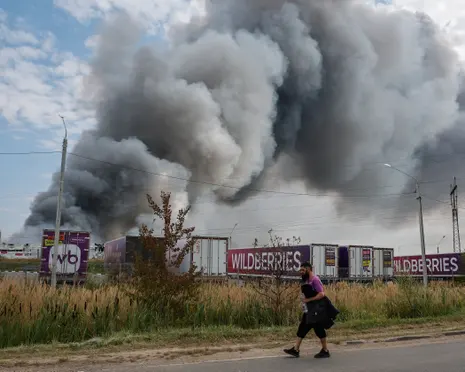
Table of Contents
UK PM Burnham Rejects Moscow’s Drone Threat, Vows Unwavering Backing for Ukraine
Wanderstayfinder.com – British Prime Minister Andy Burnham dismissed a sharp warning from Moscow on Tuesday, insisting that London’s commitment to Kyiv will not waver even as Russia threatens unspecified “consequences” over the use of British-manufactured drones in strikes deep inside Russian territory. Speaking during a visit to Wolverhampton, Burnham framed the UK’s role as a continuation of a policy thread stretching back through successive governments, and made clear he sees no room for retreat.
“This is the UK doing what it has long said it would do, which is to support Ukraine 100% against this illegal war led by Vladimir Putin.”
The confrontation came after the Russian embassy in London issued a pointed statement on Monday, accusing Britain of deliberately escalating the conflict and warning that the scale of its involvement would determine the cost it ultimately bears. The embassy’s language was unusually blunt for a diplomatic note, describing London as “deliberately opting for an escalation of the Ukraine crisis” and charging that the UK was “seeking to contain Russia and inflict maximum damage on it by proxy.”
“London’s actions will inevitably carry consequences for which it will have to answer. The deeper its involvement in the conflict and the greater its support for Kyiv’s terrorist machinery, the higher the price it will pay.”
Burnham’s Response: “Not Fair-Weather Friends”
Burnham’s reply, delivered while walking through Wolverhampton’s streets, was measured but firm. He positioned the drone supply not as a new escalation but as the fulfilment of a long-standing pledge, and invoked the continuity of British leadership across the conflict.
“We are providing support so that Ukraine can defend itself, and that’s been the British position all the way through this conflict by previous prime ministers. It remains the case with me. We are not fair-weather friends. We will be there in Ukraine’s hour of need, and that won’t change.”
A Ministry of Defence spokesperson reinforced the message in separate remarks, stating that Britain “stands shoulder to shoulder with Ukraine” and that Moscow should have “no doubt about the resolve of this government to stand against Russian aggression, in Ukraine and against the UK and our allies.”
The Deep-Strike Campaign in Context
The British-made drones at the centre of this diplomatic row form part of a broader Ukrainian “deep strike” programme that has intensified markedly over the past year. Kyiv has long employed British-supplied Storm Shadow cruise missiles against targets inside Russia, but the current wave of long-range drone operations marks a qualitative step-up in tempo and reach. Independent conflict-monitoring data from Acled indicates that Ukraine launched roughly three times as many such strikes in July as it did in January, a steep acceleration that has forced Moscow to disperse its air-defence assets across an ever-wider geographic footprint.
The targets have grown more consequential. Ukrainian long-range weapons have struck oil refineries, port installations, military depots, and warehouses belonging to Wildberries, Russia’s largest online retailer, incinerating merchandise valued in the billions of pounds. For a Russian public already more than four years into Moscow’s full-scale invasion of Ukraine, these strikes represent a tangible reminder that the war has crossed the front lines and reached home.
Capabilities and Limitations
Ukraine’s deep-strike reach now extends up to 1,500 miles (2,400 km) from its own border, enabled largely by domestically developed systems such as the Flamingo cruise missile and the FP-1 long-range fixed-wing drone produced by Fire Point. These homegrown platforms allow Kyiv to hit warehouses, refineries, ports, and military sites at ranges that were previously the exclusive domain of Russian long-range aviation and cruise-missile forces.
Nevertheless, Ukraine does not yet field the high-speed ballistic missiles that Moscow deploys regularly, meaning its deep-strike toolkit, while formidable, remains asymmetric in certain dimensions. Analysts note that the strategy is designed to erode Russia’s war-revenue streams and to make ordinary Russian citizens feel the economic and physical costs of the invasion, thereby chipping away at domestic support for the campaign.
Costs on Both Sides
The toll of the exchange continues to mount. Russia’s defence ministry announced on Saturday that it had shot down 598 Ukrainian drones over 19 Russian regions as well as over the Black Sea, the Azov Sea, and the annexed Crimean peninsula. On Monday, officials confirmed that seven people were killed overnight in Russia by Ukrainian long-range attacks, while five civilians died in Ukraine following strikes by Moscow’s forces.
On Tuesday, Russian missile strikes killed ten people and wounded eight more in a village in Ukraine’s north-eastern Kharkiv oblast, regional governor Oleh Syniehubov said on Telegram. The attack on the village of Pechenihy damaged ten private homes, a café, a post office, a shop, and at least seven vehicles.
Strategic Implications
The mutual stretching of air-defence systems on both sides has pushed them toward near-exhaustion, a condition that analysts warn will likely translate into rising civilian casualties as the conflict enters winter. For London, the embassy’s threat of “consequences” raises the question of what form any Russian response might take—whether diplomatic, economic, or otherwise—though Burnham’s rhetoric suggests the government intends to treat the warning as background noise rather than a reason to recalibrate its support. The episode nonetheless underscores how tightly coupled British industrial output has become to the operational tempo of the war, and how Moscow views that coupling as a direct act of belligerence rather than mere aid.
Related Reading
Frequently Asked Questions
What is Moscow threat of consequences will not alter?
Moscow threat of consequences will not alter is the main topic of this guide. The article explains the context, practical details, and next steps readers should understand.
Why does Moscow threat of consequences will not alter matter?
Moscow threat of consequences will not alter matters because readers are looking for a useful answer, not just a short summary. Good content should match search intent and help them decide what to do next.