Nearly 1,400 missing, mostly tourists, after Nepal-Tibet flash flood kills at least 356

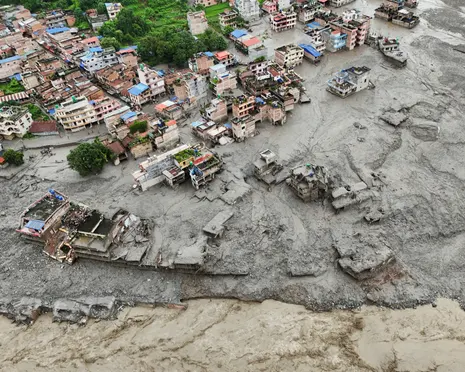
Table of Contents
Glacial Collapse Triggers Devastating Flood Along Nepal-Tibet Border, Leaving Nearly 1,400 Missing
Wanderstayfinder.com – A wall of ice, rock, and water tore through mountain valleys along the Nepal-China border on Wednesday, killing at least 356 people and leaving close to 1,400 unaccounted for — the vast majority of them foreign tourists and pilgrims. The disaster, triggered by the sudden collapse of a glacier’s lower section, sent a debris-laden torrent racing down the Lhende River basin and obliterated villages, infrastructure, and lives across both sides of the Himalayan divide.
Scale of Destruction
The force of the flood was unlike anything the region had experienced in living memory. Footage captured in the minutes after the event showed a towering column of water and sediment crashing over the border terrain. Trucks were flipped onto their sides, residential structures collapsed, paved roads vanished, and hydroelectric installations were swept clean. On the Tibetan side, officials confirmed a separate mudslide struck a border crossing, prompting fears of “major casualties” before the full toll became clear.
By Thursday afternoon, Nepali police had recovered 353 bodies, while Chinese state media confirmed three fatalities on the Tibet side. Rescue crews later located victims hundreds of miles downstream in Chitwan district, near the southern edge of the affected zone. Dozens of injured survivors were airlifted to Kathmandu for advanced treatment. The Nepali army, operating helicopters from a training centre in the hard-hit Nuwakot and Dhading districts, had pulled more than 100 people from flood-affected terrain by Thursday morning.
Missing Count and Nationalities
Police and tourism authorities in Nepal placed the number of missing persons at 826, of whom almost 600 were foreign nationals. The breakdown included 177 Indians, 63 Americans, 34 Australians, 33 British citizens, and 25 Canadians. Chinese state media separately reported at least 558 missing on the Tibet side, including no fewer than 260 foreign nationals. Many of those unaccounted for had been travelling the high-altitude pilgrimage route to Kailash Mansarovar, a sacred site revered by Hindus, Buddhists, and followers of other faiths.
The search has been hampered by the physical destruction of the landscape. Dozens of bridges have been destroyed, and roughly 25 miles (40 km) of road have been erased from the mountainous corridor long favoured by trekkers and pilgrims. In the immediate aftermath, residents of Nuwakot and Dhading gathered outside the army training centre — the staging point for helicopter operations — to learn whether relatives had survived. With hydroelectric infrastructure damaged and the grid down, mobile phone torches provided the only illumination as police recorded names of the missing just outside the barracks gate.
What Triggered the Flood
Early Nepali official statements pointed to an earthquake as the possible cause of the glacial failure. The US Geological Survey subsequently clarified that no seismic event had occurred. What was initially logged as a 4.4-magnitude tremor was, in fact, the seismic shock produced by the glacier’s rock and ice collapsing and by the subsequent flow of debris.
“No earthquake had occurred,” the agency stated.
An initial analysis of Planet Labs satellite imagery, cited by Nepal’s national disaster authority, indicated that a landslide of ice and rock had initiated the debris-laden flood in the Lhende River, approximately 12 miles (20 km) north-east of the Rasuwagadhi border crossing. Experts note that the extreme topography of the Himalayas — steep gradients, unstable moraine deposits, and accelerating glacial melt — compounds the likelihood of such catastrophic releases, particularly as warming temperatures weaken ice structures that have remained stable for centuries.
Voices from the Affected Areas
David Fisher, head of the Nepal delegation of the International Federation of the Red Cross, described scenes of total annihilation: entire villages and market areas wiped out, with houses, trees, and vehicles either submerged or buried beneath layers of mud and debris. Helicopters circled overhead throughout the day, ferrying survivors to safety.
In the village of Soley, Nuwakot district — a settlement of roughly 25 homes — the destruction was near-total, according to Nirajan Paudyal, a Kathmandu-based journalist whose parents and extended relatives reside there. He travelled to the area on Thursday seeking word of his family.
“There is no update till now,” he said. “I fear there won’t be any update.”
Bibek Kumal, a labourer working downstream from the worst-hit Rasuwa district near the Himalayan border, described the moment the torrent reached him.
“I started running. Then a wall of water came thundering down as if it was an earthquake.”
From a hospital bed, Kumal recounted how the current swept him downstream amid mud and debris. He survived by gripping a mango tree that stood in the path of the flow.
“Had there been no mango tree, I would have been washed away to death,” he said.
Keshav Prasad Baral, 68, treated at a small regional hospital, offered a more harrowing account of losing his wife in the seconds before the mud reached their home.
“It was a huge gush of mud coming straight towards us. As it got closer, it kept rising higher and higher. I tried to grab my wife’s hand and take her to the terrace. But she was swept away by the mud.”
Broader Implications
The disaster underscores a growing pattern in the Himalayan region: glacial lake outburst floods and ice-avalanche events, long catalogued by glaciologists as low-probability, high-consequence hazards, are becoming more frequent as climate-driven warming destabilises ice bodies that have persisted for millennia. The Rasuwagadhi corridor and the Kailash Mansarovar pilgrimage route attract tens of thousands of visitors annually, yet the mountain infrastructure — roads, bridges, communication lines — remains fragile and difficult to rebuild once the terrain itself has been reshaped. For the families now waiting outside army barracks with phone torches for light, the question is no longer how the flood happened, but whether their loved ones will ever be found.
Related Reading
Frequently Asked Questions
What is Nearly 1 400 missing mostly tourists?
Nearly 1 400 missing mostly tourists is the main topic of this guide. The article explains the context, practical details, and next steps readers should understand.
Why does Nearly 1 400 missing mostly tourists matter?
Nearly 1 400 missing mostly tourists matters because readers are looking for a useful answer, not just a short summary. Good content should match search intent and help them decide what to do next.