Far-right Mayor Sparks Controversy by Cancellation of Migrant-Themed Play
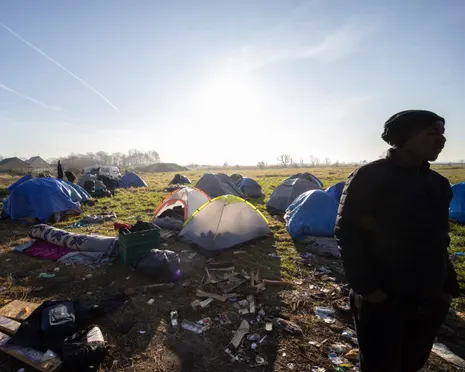
Far right French mayor causes outrage – A heated debate has ignited in southern France following the decision by the newly elected far-right mayor of Castres, Florian Azéma, to remove the play *Passeport* from the town’s cultural calendar. The drama, written by Anglo-French playwright Alexis Michalik, explores the lives of refugees in the infamous Calais refugee camp, known colloquially as “the Jungle.” The play centers on a young man who survives a brutal attack in the camp, only to awaken with no memory of his identity and a single blue Eritrean passport bearing the name Issa. With two other displaced individuals, he chooses to stay in France rather than attempt the perilous journey across the English Channel to the UK, aiming to integrate and secure legal status through a process of perseverance and self-discovery.
The Play’s Message
Michalik’s work delves into the complexities of exile, resilience, and personal identity, framing these themes within the context of contemporary migration challenges. The playwright argues that the narrative offers a human-centric perspective on displacement, countering the often-simplified media portrayals of migrants. Since its 2024 premiere in Paris, *Passeport* has toured across France, resonating with audiences and sparking conversations about the migrant experience. However, Castres has become the only town in the country to exclude the play from its 2027 national tour, a move that has drawn sharp criticism and underscored tensions between cultural expression and political ideology.
“Creative freedom and the independence of cultural programming are neither rightwing nor leftwing. They are one of the cornerstones of our democratic way of life,” Michalik said. “People have the right to like the play or not, but everyone should be able to see it.”
A Political Statement
Azéma, representing the far-right National Rally (RN), has defended his decision, claiming that *Passeport* promotes “illegal immigrants” and depicts the police in an unflattering light. Speaking to Agence France-Presse, he stated that the play “does not align with the values I championed during my election campaign.” His rationale highlights a broader ideological stance, suggesting that the RN prioritizes cultural control over artistic diversity. This reasoning has led to accusations of cultural censorship, with critics arguing that the move reflects an attempt to suppress narratives that challenge far-right rhetoric.
The cancellation of the play’s February 2027 performance at Castres’ town hall-run theatre has become a flashpoint for public discourse. Michalik described the abrupt removal as a “political and ideological decision,” contrasting it with the usual excuses given by authorities, such as budget constraints. “One minute it was in the programme, the next it had gone,” he noted, emphasizing the mayor’s clear intent to align the town’s cultural offerings with his political agenda.
Reactions and Broader Implications
Michalik’s decision to exclude *Passeport* from Castres has drawn criticism not only from local residents but also from national figures. French parliamentarians have raised questions about the role of cultural programming in a democracy, with the culture minister, Catherine Pégard, reaffirming that freedom of artistic expression is protected by law. “I would like to remind everyone that freedom of artistic expression is protected and enshrined at national level by the law,” she said, defending the play’s right to be performed.
The incident has been likened to the ideological battles seen in the United States, where similar approaches to limiting artistic expression have been criticized as “Trumpish.” Michalik’s comments underscore his concern about the potential consequences of the RN’s growing influence in French politics. “We can imagine what would happen on a wider scale,” he remarked, suggesting that the RN’s control over cultural narratives could threaten the country’s democratic principles.
“They [the RN] have been saying all along: ‘we respect the independence of culture and free speech, blah, blah, blah,’ then even on a local level they show they do not,” Michalik added. “So we can imagine what would happen on a wider scale. It’s quite similar actually to what’s happening in the US. It’s a very Trumpish approach.”
A Vision of Multicultural France
Michalik, 43, whose mother hails from the UK, has long championed multiculturalism as a defining feature of French identity. He is one of the nation’s most acclaimed contemporary playwrights, having won five Molière awards, the highest honor in French theatre. His work has consistently sought to humanize the migrant experience, offering a perspective that diverges from the media’s frequent focus on crisis and conflict. “I grew up in a part of north Paris that is multicultural,” he explained. “That is my vision of France: a place where diverse populations can coexist and thrive.”
Despite the cancellation, Michalik remains hopeful about the future of France’s cultural landscape. “I’m more saddened than worried by the increasing hostility towards migrants,” he said. “Throughout history, there have been migrants, and it’s always the same people who label them as the problem. They think if they didn’t exist, everything would be better.” He stressed that immigration is an inevitable part of societal evolution, and no government can entirely halt its progress. “Refugees and migrants bring new perspectives and opportunities to France,” he added. “It’s essential that their stories are told, not just through media, but through art.”
As the RN continues to lead in presidential election polls, the controversy surrounding *Passeport* serves as a microcosm of the broader ideological shift in French politics. Azéma’s actions have not only sparked protests but also raised questions about the role of local governments in shaping national cultural discourse. For Michalik, the cancellation is a stark reminder of the power dynamics at play in a democracy, where artistic expression can be both celebrated and constrained by political agendas. “This has touched a nerve,” he said, highlighting the emotional and symbolic weight of the decision. “It’s not just about a play—it’s about the right to tell our stories and the right to be heard.”
The incident has also prompted reflection on the state’s support for the arts. Michalik praised France’s commitment to cultural independence, noting that the state’s backing of the arts is a source of pride. “In France, the state supports the arts and we are very proud of this,” he said. “It’s crucial that our cultural programme remains a space for open dialogue, free from political bias.” As the 2027 national tour continues, the fate of *Passeport* in Castres stands as a symbol of the ongoing struggle to balance artistic freedom with political influence.