Vatican Excommunicates Ultra-Conservative Rebel Group SSPX
Vatican excommunicates all members of ultra – In a decisive move that has sent ripples through the Roman Catholic Church, the Vatican has formally excommunicated all members of the Society of Saint Pius X (SSPX), an ultra-conservative faction that has long resisted reforms. The announcement, made on July 2, 2026, by Cardinal Víctor Manuel Fernández, head of the Holy See’s Dicastery for the Doctrine of the Faith, cited the group’s recent ordination of bishops without the Pope’s approval as the catalyst for the schism. This act, according to the Vatican, constituted a “schismatic nature” violation under canon law, which can lead to automatic excommunication.
Break with Tradition Sparks Vatican Action
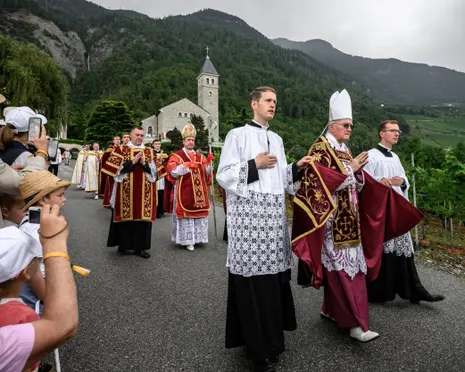
The SSPX, founded in 1970 in the Swiss village of Ecône, has been a persistent critic of modernizing changes within the Church. Its members, who adhere strictly to pre-Vatican II traditions, believe the ordination of bishops is a sacred duty that should not be compromised. The latest ceremony, held in a symbolic and ritualistic manner, drew an estimated 16,500 participants, including supporters from far-right political groups like Forza Nuova in Italy and Futuro Nazionale, a movement that challenges the leadership of Prime Minister Giorgia Meloni. These alliances highlight the group’s growing influence beyond religious circles.
Cardinal Fernández emphasized that the excommunication was not merely a punishment but a means to reaffirm the Church’s authority. “The society’s actions have created a formal rupture with the Roman Catholic Church, which is considered a grave offense,” he stated. The Vatican’s response was sharper than anticipated, extending excommunication to all priests of the SSPX and any Catholics who formally align with the group. This measure underscores the severity of the schism, which is defined as a complete and public break from the Church’s unity.
Leo’s Efforts to Mend Divides
Pope Leo, who has prioritized church unity since his election in May 2025, sought to reconcile with traditionalists after the papacy of Francis. However, the SSPX’s defiance marked a significant challenge to his leadership. Despite Leo’s attempts to persuade the group to halt the ordinations, the society remained steadfast. “They believed the bishops they ordained were entirely faithful to the church’s tradition,” said Andrea Vreede, Vatican correspondent for NOS. “Even though they were short of bishops, they saw this as a sacred obligation.”
The ordination ceremony, held on Wednesday, was a carefully orchestrated event that symbolized the group’s rejection of papal authority. While the Pope had previously shown openness to traditionalist practices—wearing classic vestments and reviving the summer retreat at Castel Gandolfo—the SSPX felt this was insufficient. “They hoped Leo would be more accommodating than his predecessor, Francis, but they were disappointed,” Vreede explained. “He followed the same path, which left them with no choice but to act.”
SSPX’s Theological Stance and Global Reach
The SSPX’s rejection of Vatican II reforms has been a defining feature of its identity. Key among these is the use of local languages in Mass, a change that was controversial for decades. Until the 1960s, the Mass was celebrated in Latin, and the SSPX insists that the traditional form is essential to preserving the faith. Similarly, the group maintains a strict stance against dialogue with other Christian denominations, including the Eastern Orthodox and Anglican churches, and views the Catholic Church as the sole true expression of Christianity.
Despite its conservative principles, the SSPX has managed to attract a substantial following. With nearly 1,500 priests, seminarians, and vocational members, the group has grown to an estimated 150,000 to 200,000 adherents worldwide. Its presence is particularly strong in the United States, France, and Argentina, where its message resonates with those who feel the Church has become too progressive. This growth has made the SSPX a formidable force, even as a splinter group.
Yet, the excommunication has not been without precedent. The conflict between the Vatican and the SSPX dates back to 1988, when its founder, Archbishop Marcel Lefebvre, and four bishops he had ordained without the Pope’s permission were excommunicated. At the time, the excommunications sparked outrage, especially after British bishop Richard Williamson was accused of Holocaust denial. Pope Benedict XVI later lifted these excommunications in 2009, but the SSPX’s defiance has once again led to a rupture.
Political and Social Implications
The SSPX’s alliance with far-right political movements has amplified its impact beyond religious matters. Its presence at the ordination ceremony, alongside members of Forza Nuova and Futuro Nazionale, suggests a strategic effort to link traditionalist Catholicism with conservative politics. Analysts note that this connection could help the SSPX gain visibility in regions where anti-establishment sentiment is rising, particularly in Italy, where Futuro Nazionale aims to challenge Giorgia Meloni’s upcoming re-election prospects.
Andrea Vreede described the SSPX as “a very minor group but very loud and very ultra-right.” She highlighted the group’s ability to mobilize large crowds, even as it remains a fraction of the Church’s overall size. The excommunication, she argued, is a necessary step for the Vatican to maintain doctrinal coherence. “Leo’s focus on unity has been a priority, and this move reinforces his commitment to a unified Church,” she said. “While it may cause discomfort, it demonstrates his resolve.”
The crisis also reflects broader tensions within Catholicism. Traditionalists argue that the Church has lost its spiritual essence by embracing modernity, while reformers see the SSPX as a reminder of the need for consistency. For Pope Leo, the excommunication is a calculated response to a challenge that threatens his vision of a cohesive global Catholic community. “This was inevitable,” Vreede added. “The schism has happened before, and it might happen again. But it won’t damage his reputation.”
As the Vatican moves to excommunicate the SSPX, the Church faces a critical moment. The decision not only targets the group’s leadership but also signals a renewed emphasis on orthodoxy. Yet, the movement’s grassroots appeal and political ties suggest it will not disappear easily. For many followers, the SSPX represents a return to the “pure” faith, and its continued existence may serve as a test of Leo’s ability to balance tradition with contemporary needs. Whether this excommunication strengthens or divides the Church remains to be seen, but one thing is clear: the fight over doctrine is far from over.
Legacy of the SSPX and Future Outlook
The excommunication marks the first major crisis under Pope Leo’s leadership. While he has made strides in fostering unity, the SSPX’s actions have exposed lingering divisions. The group’s history of resistance, including its role in the 1988 excommunications, shows it is willing to challenge papal authority. However, the Vatican’s decisive stance may push the SSPX further into the margins, unless it finds new allies or adapts its approach.
For Andrea Vreede, the situation highlights the Vatican’s strategic use of excommunication. “It’s not just about punishing the SSPX,” she said. “It’s about sending a message to the wider Catholic community that the Church will not waver on key doctrines.” The Pope’s decision to excommunicate the entire group, rather than just its leadership, reflects a broader effort to consolidate control. This approach could deter other factions from following suit, even as it intensifies the divide between traditionalists and reformists.
Despite the excommunication, the SSPX’s influence persists. Its ability to draw crowds and align with political movements indicates that its message still holds power. As the global far-right gains momentum, the group may see an opportunity to expand its reach. Yet, the Vatican’s response, though harsh, is also pragmatic. “The schism is not very important, but it’s a sign of Leo’s coherence,” Vreede noted. “He is not willing to compromise, even when the stakes are high.”
The excommunication of the SSPX is a defining moment for Pope Leo, who has positioned himself as a leader of unity and tradition. While the move has drawn criticism from some quarters, it reinforces the Church’s commitment to maintaining its doctrinal integrity. As the SSPX continues to resist, the Vatican’s actions will be closely watched, not only for their religious implications but also for their political and social consequences. The battle between the two factions is a microcosm of a larger struggle within the Church, one that will shape its future for years to come.