Archbishop of Canterbury Calls for End to Israeli Occupation of Palestine
Archbishop of Canterbury calls for end – During a recent pilgrimage to the Holy Land, the Archbishop of Canterbury, Sarah Mullally, has intensified her advocacy for an end to the Israeli occupation of Palestine. The visit, which spanned five days, included meetings with Palestinians who have endured attacks by settlers and faced detention without formal charges. Mullally, who leads the Church of England, and Hosam Naoum, the Anglican Archbishop of Jerusalem, jointly issued a statement urging Anglicans globally to push for political action to create a path toward resolving the occupation.
Shared Vision for Peace and Justice
The pair emphasized the need for a “viable two-state solution” to ensure Israelis and Palestinians can coexist in peace, dignity, and security. They highlighted that Jerusalem’s status should be negotiated as a shared capital, a stance reflecting their concern over the erosion of Palestinian rights. Mullally and Naoum also expressed fears about the declining presence of indigenous Christian communities in the Holy Land, whose roots trace back to the time of Jesus’ ministry. They warned that ongoing conflict threatens not only political stability but also the cultural and religious legacy of these groups.
“This must lead to a viable two-state solution enabling Israelis and Palestinians to live in peace, dignity and security. Jerusalem’s status should be determined through negotiation as a shared capital,” the letter read.
Their statement underscored the catastrophic state of Gaza’s health system, which has been overwhelmed by years of blockade and bombardment. Mullally described the region as experiencing “catastrophic collapse,” urging the international community to take responsibility for alleviating the suffering there. During the pilgrimage, she witnessed firsthand the daily challenges faced by Palestinians in the West Bank, Gaza, and East Jerusalem, including the pervasive network of checkpoints that restrict movement and freedom.
Symbolism of Olive Trees and Resistance
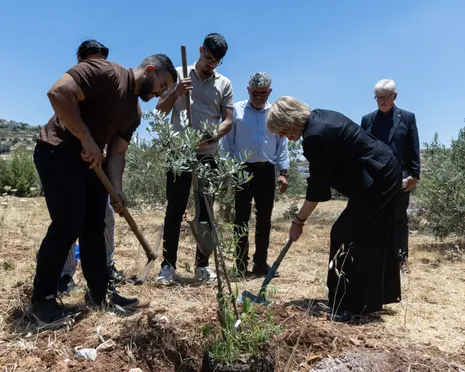
In a poignant moment, Mullally planted an olive tree alongside the family of Daoud Nassar, a Palestinian Christian whose land has been targeted by Israeli settlers since 1991. The act symbolized the deep historical ties of Palestinian Christians to the region, as she explained that olive trees represent their enduring connection to the land. “When many Palestinian Christians are leaving, olive trees are a symbol of their deep roots in this land,” Mullally remarked, praising the Nassars as an example of “Christian resistance to injustice.”
The visit also included meetings with individuals directly impacted by the occupation. Mullally met Layan Nasir, 26, a Palestinian Anglican community worker who was recently released after being imprisoned by Israeli forces. She also visited the parents of Natalie Abu Dayeh, a Christian student held without charge, highlighting the personal toll of the conflict. These encounters reinforced the archbishop’s call for accountability and justice, as she described the experiences of Palestinians as a reflection of broader systemic issues.
Refugees and the Fragile Future
Mullally and Naoum’s letter emphasized the plight of Palestinians living under occupation, noting that “unchecked settler violence, forced displacement, systemic discrimination, and expanding checkpoints” have left communities impoverished and powerless. They warned that annexation policies are already in effect, with settlements growing rapidly across the West Bank. In Israel, the ongoing tension from the 7 October atrocities has heightened sensitivity to potential threats, altering both social dynamics and political strategies.
“In Israel, the simultaneous fighting of many conflicts at one time, and the deep-seated aftermath of the horrifying atrocities of 7 October, have created a state of intense sensitivity to potential danger that has transformed society and politics,” they wrote.
The archbishop’s visit aimed to inspire Palestinian Christians during a period of escalating displacement and conflict. She noted that communities are being “violently forced from their land,” a reality that has driven many to seek refuge elsewhere. During her sermon at St Peter’s Church in Birzeit, Mullally drew parallels between the struggles of modern Palestinians and the biblical account of Jesus speaking to a people living under foreign rule. “In the Gospel of Matthew, Jesus is speaking to a community living in fear: his own people living in an occupied land and under foreign rule,” she said. “I can only imagine how these words may sound to you today.”
Mullally’s remarks reflect a broader critique of the occupation’s impact on both political and spiritual dimensions. She argued that the Middle East conflicts are symptoms of a deeper crisis, rooted in the abandonment of international law and the reliance on military force to resolve disputes. This perspective aligns with the Church of England’s upcoming General Synod, where a motion to reassess investment policies in the region will be debated. The synod’s focus on “justice and human dignity for everyone” underscores a growing commitment to addressing the occupation’s consequences.
Global Solidarity and Next Steps
The joint letter from Mullally and Naoum serves as a call to action for Anglicans worldwide, urging them to support efforts for a just resolution. They stressed that the international community cannot remain passive, emphasizing a moral duty to assist in Gaza’s reconstruction. The archbishop’s visit, which included conversations with families feeling “unmoored and traumatised by endless conflict,” aims to amplify voices often overshadowed by geopolitical tensions.
As the Church of England continues its engagement with the region, the debate over investment policies is expected to spark renewed discussions on the role of faith institutions in addressing human rights concerns. Mullally’s advocacy, rooted in personal encounters and historical symbolism, highlights the intersection of faith and politics in the quest for lasting peace. Her emphasis on olive trees as a metaphor for resilience resonates with the enduring spirit of Palestinian Christians, who have fought to preserve their heritage despite relentless challenges.
The archbishop’s visit to the Holy Land has drawn attention to the humanitarian and spiritual dimensions of the occupation, framing it as a global issue that demands collective action. By intertwining biblical narratives with contemporary realities, Mullally and Naoum aim to galvanize support for a future where both Israelis and Palestinians can thrive without the shadow of conflict. Their message reinforces the idea that the occupation is not just a political matter but a profound disruption of the region’s shared history and identity.