Supreme Court Upholds Border Policy Allowing Asylum Seekers to Be Turned Away
Supreme court lets Trump turn back – The U.S. Supreme Court has ruled in favor of the Trump administration’s plan to intercept asylum seekers at the U.S.-Mexico border, effectively permitting the revival of a policy that enables officials to deny entry to migrants before they physically step onto American soil. This decision marks a pivotal shift in how asylum claims are processed, raising concerns among legal experts and human rights advocates about the potential consequences for vulnerable populations. The 6-3 ruling, which drew sharp criticism from the dissenting justices, hinges on the interpretation of a key phrase in immigration law: “arrive in.”
Legal Debate Centers on Definition of ‘Arrive In’
The crux of the case revolved around the precise meaning of the term “arrive in,” which determines when a migrant becomes eligible to request asylum under U.S. law. The majority opinion, authored by Justice Samuel Alito, argued that the phrase refers to a person entering a country, not simply arriving at its border. This interpretation, Alito claimed, aligns with common usage, as no one would typically say someone “arrives in” a place before crossing into it. The ruling allows federal agents to block asylum seekers from entering the United States, even if they are already at a designated port of entry.
“The court’s illogical interpretation is driven almost entirely by a fixation on a single word: ‘in.’ Words, however, must be read in context and with attention to how they fit into the statute as a whole,” wrote Justice Sonia Sotomayor in her dissent.
Sotomayor, joined by Justices Elena Kagan and Ketanji Brown Jackson, contended that the policy’s implementation could undermine the core principles of asylum law. They emphasized that the term “arrive in” should not be confined to a strict definition, but rather understood within the broader context of the legal framework. The dissenting justices warned that the decision would enable the government to bypass protections for asylum seekers, even if those individuals are near the threshold of a port of entry or have a clear path to safety.
Policy’s Origins and Legal Battle Across Administrations
The turn-back policy, also known as “metering,” was first introduced during the Trump administration and has since become a focal point of legal contention. The policy allows border officials to return migrants to Mexico before they enter the U.S., effectively sidestepping the right to claim asylum under federal law. The case that led to the current ruling was initiated in 2017 by Al Otro Lado, a nonprofit organization based in California and Mexico, and several asylum seekers who experienced the policy firsthand.
Throughout the years, the policy has faced repeated challenges in lower courts, which largely upheld its legality until the Supreme Court’s intervention. The Biden administration temporarily suspended the practice in 2021, but the Trump campaign quickly moved to reinstate it. The high court’s decision to endorse the policy came after lower courts had already ruled against it, creating a legal stalemate that the justices now resolved in favor of the administration.
Humanitarian Impact and Advocacy Concerns
Human rights groups have expressed alarm over the ruling, warning that it could lead to a new wave of migrant deaths and suffering. Erika Pinheiro, executive director of Al Otro Lado, described the policy as a “border hardening” measure that risks displacing thousands of people into perilous conditions. “In a world of increasing conflict and climate disaster, this hardening of borders to keep out the most vulnerable is sure to result in many more lives lost,” she said.
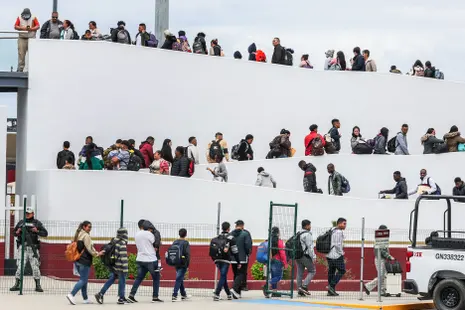
Under the revived policy, asylum seekers would be stranded at border checkpoints, where they could be physically turned back before entering the U.S. This would mean that even those with valid claims for protection might be forced to wait in overcrowded camps or face dangerous crossings across deserts or rivers. Advocates also pointed out that the policy could be used to reject migrants who are certain to face persecution or death if sent back, further straining the asylum process.
“Cruelty is not a substitute for real solutions. Blocking people from seeking asylum at official ports of entry will do nothing to fix our broken immigration system; it only makes things more chaotic and dangerous for vulnerable families,” said Rebecca Cassler, a senior litigation attorney at the American Immigration Council.
The policy’s implementation has been inconsistent, with officials sometimes applying it selectively. Some migrants are turned away at the border line, while others are allowed to wait in Mexico until they can apply for asylum. This inconsistency has already created confusion, with some asylum seekers attempting dangerous crossings after being denied entry at official ports. Critics argue that the policy’s ambiguity makes it easy to exploit, allowing the government to prioritize speed over due process.
Broader Implications for U.S. Immigration Law
Legal experts have noted that the ruling could set a precedent for future immigration policies. By interpreting “arrive in” narrowly, the court has given the administration flexibility to enforce border controls more aggressively. This could lead to a situation where asylum seekers are denied access to legal protections simply because they are not processed at designated entry points. The decision also raises questions about the role of federal law in safeguarding migrant rights, particularly in the context of growing global displacement.
While the administration claims the policy helps manage the flow of migrants, opponents argue that it undermines the fundamental purpose of asylum: to provide refuge to those fleeing persecution. The Supreme Court’s approval of the turn-back policy represents a shift in how the U.S. approaches immigration, prioritizing administrative efficiency over humanitarian considerations. For now, the policy is not in full effect, but its reimplementation could trigger a new wave of challenges for asylum seekers and the legal community.
The ruling underscores the ongoing ideological divide within the court, with the majority favoring a strict textual interpretation of the law and the dissenters emphasizing the need for contextual analysis. Justice Sotomayor’s dissent, which spans nearly 35 pages, highlights the tension between legal precision and practical consequences. Her critique of the majority’s approach has drawn attention to the potential long-term impact on the U.S. asylum system and its alignment with international standards.
As the policy moves closer to being fully implemented, its effects on both migrants and the legal framework will be closely monitored. The decision has already sparked debate about the balance between national security and the rights of asylum seekers, with advocates warning of the humanitarian toll if the administration continues to use the policy to expedite deportations. For now, the Supreme Court’s ruling stands as a landmark moment in the evolving landscape of U.S. immigration law.