White House construction played part in Trump helicopter incident, safety officials say

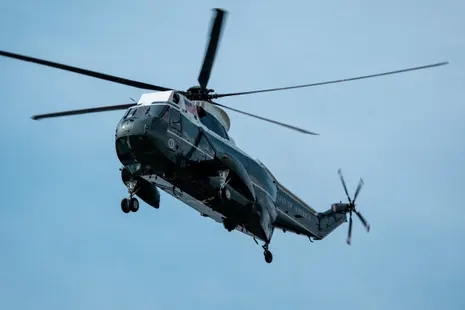
Table of Contents
White House Construction Played Part in Helicopter Near-Miss
Wanderstayfinder.com – White House construction played part in a close encounter between Marine One and a commercial jet, the National Transportation Safety Board confirmed in a preliminary report released Thursday. The agency traced the root cause to a temporary relocation of the presidential helicopter’s departure point — a shift driven by the sprawling renovation of the executive mansion grounds — which disrupted radio links to air-traffic control and left controllers unaware of the helicopter’s launch. The finding lands in the middle of an already tense debate over aviation safety around Washington’s busiest airspace corridor, less than eight months after a fatal midair collision killed 67 people.
What Happened on 4 August
At 2:33 p.m. on 4 August, a Marine One helicopter carrying President Donald Trump lifted off from the Ellipse, a small lawn south of the White House. Sixty seconds later, an Embraer E170 operated by an American Airlines subsidiary climbed out of Ronald Reagan Washington National Airport on a scheduled flight to Florida. Because the helicopter crew never transmitted the required three-minute pre-liftoff notification, commercial departures were not held, and the two aircraft converged on nearly the same airspace. The NTSB classified the event as a “loss of separation.”
At closest approach the two aircraft sat 0.82 nautical miles — roughly 1.5 kilometers — apart laterally and 700 feet (213 meters) apart vertically. FAA rules in the airport vicinity mandate at least 1.5 miles (2.4 kilometers) of horizontal spacing and a 500-foot (152-meter) vertical buffer. The Embraer was vectored away from the helicopter’s path in what the board described as a precautionary reroute.
How the Helipad Shift Broke the Radio Link
For decades Marine One has departed from the South Lawn. Beginning in May, that practice was suspended when construction crews broke ground on a new ballroom intended to replace the east wing. Helicopter operations were pushed south to the Ellipse in the interim. A purpose-built pad for a larger next-generation Marine One is also taking shape on the South Lawn, though reports this month indicated the design was being reworked after Trump voiced displeasure with its visual profile and what looked like an unintended slope.
The geographic shift changed the angle and distance between the helicopter and the tower, degrading signal quality. The NTSB’s preliminary report names “communication issues” as the proximate cause of the missed notice. The crew tried at least twice to reach controllers before wheels-up and got no answer. A backup path routed through a helicopter facility at Joint Base Anacostia-Bolling in southwest Washington, D.C., also went dark, leaving the crew with no working channel at the moment of departure.
“Communication issues” — NTSB preliminary report, identifying the failure to deliver the mandatory liftoff notice.
Warnings Issued and Overlooked
The breakdown had been flagged weeks earlier. On 30 July, air-traffic controllers sat down with Marine One personnel to discuss a pattern of missed “three minute to liftoff” calls. The helicopter crew conceded that communications “had been spotty” and agreed to fall back on alternative contact methods whenever the primary channel faltered. That contingency plan failed on 4 August when both paths went silent at the same instant.
Bryan Bedford, who heads the FAA, said the agency moved an antenna and updated operating procedures immediately after the 4 August event. Post-relocation checks, the NTSB noted, showed the communication problem had not recurred. Yet the Associated Press reported on Friday that controllers again lost brief contact with Marine One on Thursday while the president traveled to an event in Texas. The link was restored within seconds and no safety concern was identified in that second episode.
At the time of the original incident, an FAA statement called the event non-critical, stating “it didn’t appear to be a dangerous close call and the aircraft weren’t apparently converging.” That characterization sits uneasily alongside the numerical separation data and the broader pattern of risk in Washington-area airspace.
Context: The January 2025 Collision
The August near-miss arrived in the shadow of a January 2025 midair collision over the capital between a commercial airliner and an Army Black Hawk helicopter that killed 67 people. In the months since, proximity rules governing helicopter and fixed-wing traffic around Reagan National Airport and the White House corridor were tightened. The NTSB’s finding that White House construction played part in the August event underscores how ground-level decisions — a moved helipad, a degraded antenna line — can ripple outward into the shared airspace above the nation’s most heavily trafficked flight corridor.
Frequently Asked Questions
Why was Marine One launched from the Ellipse instead of the South Lawn? Construction on a new ballroom replacing the east wing, along with work on a next-generation helipad, made the South Lawn unavailable. Operations were temporarily shifted south to the Ellipse beginning in May.
What is the “three-minute notice” and why does it matter? Helicopter crews must inform air-traffic controllers at least three minutes before liftoff so controllers can hold or reroute commercial departures. Missing that notice means a jet and a helicopter can occupy the same airspace simultaneously.
Did anyone get hurt in the 4 August event? No injuries were reported. The Embraer was rerouted as a precaution, and the NTSB classified the event as a loss of separation rather than a collision.
What steps has the FAA taken since the incident? The agency relocated an antenna and revised operating procedures. Post-relocation checks showed no recurrence of the communication failure, though a brief second contact loss was logged during a Texas trip later that week.