Burnham accuses Russia of ‘outrageous threats’ against UK as he visits Kyiv

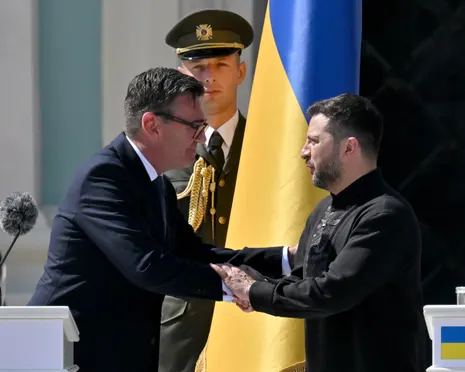
Table of Contents
- UK Hands Ukraine Missile Secrets as Moscow Pulls Ambassador and Warns of Retaliation
- A Speech at St Sophia Cathedral Marks Independence Day
- Moscow Escalates Rhetoric
- The Coalition of the Willing and Broader Security Context
- Diplomatic Fallout: Ambassador Withdrawn, No Replacement Named
- Related Reading
- Frequently Asked Questions
UK Hands Ukraine Missile Secrets as Moscow Pulls Ambassador and Warns of Retaliation
Wanderstayfinder.com – The diplomatic rift between London and Moscow deepened sharply this week after Britain decided to share previously classified engineering blueprints with Kyiv, enabling Ukraine to develop its own production line for long-range cruise missiles. The move, announced by Prime Minister Andy Burnham during his first overseas trip since taking office, drew an immediate and blistering response from the Kremlin, which accused the UK of deliberately sabotaging any prospect of a negotiated settlement. Russia simultaneously confirmed that its ambassador in London had departed without a successor, a step that underscores how far bilateral relations have slid since the full-scale invasion began in February 2022.
What the Blueprint Handover Means in Practice
The documents released to Ukraine cover British-manufactured components used in the Storm Shadow/Scalp family of long-range cruise missiles. By declassifying these specifications, London is giving Kyiv the technical foundation to eventually design and build a domestically produced variant of the weapon. Officials acknowledge that a fully independent Ukrainian production capability could take years to materialise, but the strategic logic is clear: reducing dependence on Western-supplied munitions would make Ukraine’s defence posture more resilient against supply-chain disruptions and political shifts in allied capitals.
Burnham also confirmed that the UK will assist France in establishing assembly lines inside Ukraine for long-range missiles, a commitment French President Emmanuel Macron had outlined the previous month. Separately, Britain has authorised Ukraine to employ British-made drones in offensive strikes, a step that prompted Moscow to warn London would pay a “high price” for its involvement.
A Speech at St Sophia Cathedral Marks Independence Day
Burnham delivered his remarks inside St Sophia cathedral in Kyiv on Monday, the date Ukraine marks its independence from the Soviet Union. The ceremony coincided with the 35th anniversary of that independence, a milestone that carries particular weight given the ongoing war. Details of the commemorative programme were kept deliberately low-key amid fears of another Russian missile barrage targeting the capital.
In his address, Burnham drew a direct parallel between Britain’s wartime role and Ukraine’s current struggle. He told the assembled audience:
“My nation kept the flame of European freedom alive in the 20th century, you hold that flame in the 21st.”
He went on to describe Ukraine’s ordeal in stark terms, noting that the country had “endured 12 years of naked aggression, the occupation of Crimea, and now four and a half years of Russia’s full-scale invasion, all aimed at crushing the independence that we are here to celebrate.”
“Russia’s actions have not changed the path this nation is on. It’s confirmed it. You have stood tall and defiant in the face of everything Russia has thrown at you. And you have taken your place as a proud, sovereign European nation, a vibrant democracy with a bright future ahead.”
Burnham closed with a personal note of gratitude directed at the Ukrainian people:
“I want to tell you something you probably don’t hear enough: thank you. Thank you all. Thank you. Thank you for the incredible stand you have taken because we are all stronger for it.”
He added, addressing the Kremlin’s latest threats directly: “Despite Russia’s outrageous threats to my country, we will continue our support for Ukraine.”
Moscow Escalates Rhetoric
Creamlin spokesperson Dmitry Peskov dismissed the blueprint exchange as an act of deliberate provocation. He told reporters that Britain was “involved in this war on the side of the Kyiv regime” and accused London of systematically undermining diplomacy:
“Britain methodically and regularly adds fuel to the fire, and methodically and regularly hatches schemes to prevent even the slightest progress in the peaceful settlement process.”
Peskov further stated that Moscow would identify and destroy the locations where Ukrainian missile production takes place, a warning that effectively places any future Ukrainian manufacturing sites on a targeting list.
Burnham responded within hours of his cathedral speech, turning the Kremlin’s own metaphor back on itself in a brief interview:
“Who started the fire? That’s the question, isn’t it?”
The Coalition of the Willing and Broader Security Context
While in Kyiv, Burnham joined a conference call with 34 leaders belonging to what has been termed the “coalition of the willing” — a grouping of nations that have pledged to help guarantee Ukraine’s security in the event a truce is reached with Russia. French President Macron and German Chancellor Friedrich Merz participated in that meeting by video link rather than travelling to the capital in person.
Burnham’s entourage in Kyiv included António Costa, president of the European Council, and Luc Frieden, prime minister of Luxembourg. The visit was Burnham’s first trip abroad since assuming the premiership, making its timing and messaging a deliberate signal of continuity in British support.
Kyiv has indicated that Russia is accumulating additional ballistic missiles and weighing whether to mobilise a further 300,000 soldiers. Those missiles have been employed against Ukrainian infrastructure, logistics warehouses, and the capital itself, producing rising civilian casualties. A persistent shortage of US-made Patriot interceptor systems — widely regarded as the only weapon capable of reliably countering such ballistic threats — compounds the defensive strain.
Diplomatic Fallout: Ambassador Withdrawn, No Replacement Named
Russia’s decision to recall its ambassador to the UK represents a concrete escalation beyond rhetorical posturing. Andrey Kelin, who had served in London for seven years, departed last month. According to the Russian embassy in the British capital, no successor has been appointed. A spokesperson for the mission characterised the state of relations as having “deteriorated to an unprecedentedly low level entirely on London’s initiative.”
A UK government spokesperson confirmed that Britain’s ambassador in Moscow would remain in post, a decision that leaves an asymmetry in diplomatic representation between the two capitals. The absence of a Russian ambassador in London means that formal channels of communication between the two governments are now thinner than at any point since the post-war period, raising questions about how crises will be managed in the months ahead.
For Ukrainian President Volodymyr Zelenskyy, the convergence of Independence Day commemorations, the blueprint handover, and the continued missile threat places him at what appears to be the most consequential juncture of his presidency — a moment where symbolic solidarity, material capability, and the risk of renewed large-scale strikes all intersect in a single week.
Related Reading
Frequently Asked Questions
What is Burnham accuses Russia of outrageous threats?
Burnham accuses Russia of outrageous threats is the main topic of this guide. The article explains the context, practical details, and next steps readers should understand.
Why does Burnham accuses Russia of outrageous threats matter?
Burnham accuses Russia of outrageous threats matters because readers are looking for a useful answer, not just a short summary. Good content should match search intent and help them decide what to do next.