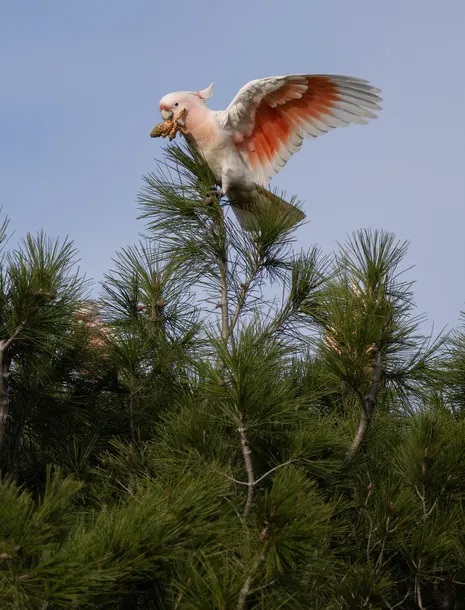
‘Flamin’ cockatoos’ have lost much of their habitat to bushfires. Can the species survive?
Wanderstayfinder.com – In the heart of north-west Victoria, Wyperfeld National Park has become a battleground for the survival of the pink cockatoo, an endangered species whose future now hangs in the balance. Two consecutive wildfires in the span of twelve years have reduced the population of mature native pines—critical to the birds’ survival—to a mere handful. These trees, once abundant, now stand as sparse remnants of a once-thriving ecosystem, with the majority of the park’s core habitat for the cockatoos reduced to ash. The recent blazes, which scorched 440,000 hectares of land across Victoria, including 59,000 hectares within Wyperfeld, have intensified the crisis. This area, home to the largest breeding site for pink cockatoos in the state, is now a stark reminder of the relentless impact of climate change on wildlife.
The Last Stand in a Burnt Landscape
At the park’s entrance, a small cluster of pink cockatoos perches on a row of Aleppo pines, their vibrant plumage contrasting against the charred surroundings. Though these trees are not native to the region, they have become a temporary refuge for the birds, who rely on the slender cypress pines, or Callitris gracilis, for nesting. The Aleppo pines, however, are not the ideal habitat. The birds’ true reliance is on the ancient, towering native pines that take decades to mature and provide the essential hollows for breeding. Dr. Victor Hurley, an ecologist who has studied the species for over three decades, describes them as “flame-crested,” a nickname that reflects both their striking appearance and the fiery devastation that has engulfed their habitat.
“The flame-cresteds seem to be the wimpier kid in the school yard,” Hurley says, illustrating the birds’ struggle for limited nesting sites. In a world where competition for hollows is fierce, the pink cockatoos often lose to more aggressive species like galahs or feral European honeybees, which claim the remaining cavities. The problem is compounded by the fact that very large, old pines are now vanishingly rare. Years of land clearing and the 2014 wildfires, which scorched 60% of the pine plains, have already decimated 97% of the known cavity-bearing trees in the region. Now, the 2025-26 fires have pushed the species closer to the brink.
A Refuge Amidst the Ashes
Despite the widespread destruction, a small, unburnt grove at the park’s eastern edge offers a glimpse of what the cockatoos once called home. This semi-arid woodland, though sparse in trees, is a lifeline for the species. It is dotted with resilient casuarina and slender cypress pines, their gnarled branches forming a natural canopy. The forest floor is covered in small lichens and mosses, a testament to the ecosystem’s enduring fragility. Here, a makeshift artificial hollow—a log carved into a bird-sized door—straps to a power pole serves as an early prototype for conservation efforts. Hurley, who pioneered this method in 2009, explains that the birds will excavate their own nesting sites in sufficiently large trees, but the scarcity of such trees has left them with few options.
“The cockatoos have always been resourceful,” Hurley says, “but when there’s not enough habitat, their resilience is tested.” His work with the Mallee Woodpeckers, a group of volunteers dedicated to the species’ survival, has focused on creating artificial hollows to弥补 the loss. By cutting into the trunks of dead but standing trees, they carve out spaces at least 20cm wide and reinforce the outer bark to ensure durability. These structures, often hidden from view, provide a temporary solution to the ongoing habitat crisis. To date, Parks Victoria and Hurley’s team have installed approximately 150 such hollows in the park, a modest but vital contribution to the birds’ chances of thriving.
Broader Impacts on Endangered Species
The devastation in Wyperfeld is part of a larger pattern affecting Victoria’s biodiversity. The 2025-26 fires, which burned more land than the catastrophic Black Saturday blazes of 2009, have left countless species struggling. For instance, the eastern bristlebird lost 82% of its habitat at Howe Flat, a crucial stronghold for the species, resulting in a 30% drop in population. Similarly, in South Australia, fires in Deep Creek National Park have impacted half of the available habitat for the western beautiful firetail and the Mt Lofty Ranges southern emu-wren. These losses underscore the interconnectedness of ecosystems and the cascading effects of habitat destruction.
While the cockatoos face a unique challenge due to their reliance on ancient trees, their plight mirrors that of other species. The pine plains, a region critical to their survival, have been reduced to 70% destruction in January’s fires. The remaining trees are not just remnants; they are the last hope for a species that depends on them for reproduction and sustenance. Hurley emphasizes that the cockatoos’ survival hinges on the availability of these large, mature trees, which are increasingly scarce due to both natural and human-induced pressures.
Hope in the Ashes
Though the fires have left scars on Wyperfeld, the conservation efforts of Hurley and his team offer a sliver of hope. The artificial hollows, while not a perfect substitute for natural trees, provide a critical alternative in the short term. “These structures are a stopgap measure,” Hurley explains, “but they give the birds a chance to nest and raise their young in an environment where they might otherwise be forced to compete with more aggressive species.” The team’s work has also involved monitoring the cockatoos’ behavior, tracking their foraging patterns and breeding cycles, to better understand how to support their recovery.
As the climate continues to shift, the question remains: can the pink cockatoos adapt to the changing landscape? Their ability to find new nesting sites and access food sources will determine their survival. For now, the unburnt grove and the artificial hollows stand as symbols of human intervention in the face of ecological collapse. The survival of these birds, with their fiery crests and delicate pink wings, may depend on the ingenuity of conservationists and the resilience of nature itself. The path forward is uncertain, but the efforts to protect them are a reminder of the importance of preserving biodiversity in the face of growing threats.
“The flame-cresteds seem to be the wimpier kid in the school yard,” Hurley says, illustrating the birds’ struggle for limited nesting sites.
With each passing year, the pressure on the cockatoos intensifies. The repeated fires have not only reduced their habitat but also fragmented it, making it harder for populations to recover. Yet, the determination of researchers and volunteers offers a glimmer of optimism. By combining scientific knowledge with hands-on conservation, they are working to ensure that the pink cockatoos, once a symbol of Australia’s natural beauty, do not vanish into history. The story of Wyperfeld National Park is one of loss and resilience, a microcosm of the broader challenges facing wildlife in a warming world.