‘The river has taken everything’: people return to remains of their homes in Nepal

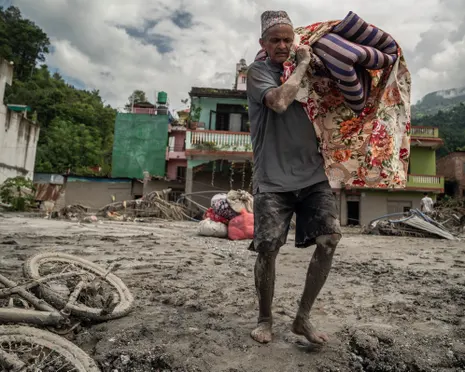
Table of Contents
The River Has Taken Everything: Nepal Flood Survivors
Wanderstayfinder.com – In Devighat, a centuries-old pilgrimage settlement clinging to the banks of the Trishuli River, residents walked back into their neighborhoods on Sunday to find nothing but shattered concrete, twisted rebar, and a thick, tar-like layer of sediment where their kitchens, bedrooms, and shrines had stood. The river has taken everything — every structure, every possession, every trace of daily life — and those who returned faced a landscape of total erasure. Days earlier the Trishuli had surged to apocalyptic height, sweeping entire villages off the map, and the receding waters left behind only a grey, congealed residue that still hides what lies beneath.
A Death Toll That Will Keep Rising
Confirmed fatalities across Nepal and Tibet stood at 797 by Sunday, though officials cautioned the number will climb. More than 3,000 residents in the hardest-hit districts remain unaccounted for. With roads and bridges wiped out, army helicopters are the only means of reaching isolated communities, and every flight carries the grim expectation of more bodies to recover.
Cold-storage facilities nationwide have run out of space. Corpses continue to surface in their hundreds from the solidified mud, often miles from where the victims last lived and frequently mangled beyond visual recognition. In the district of Bharatpur, authorities have opened mass graves. Before each body is lowered into a shallow trench, police draw a DNA sample, attach a tag bearing a location number, seal the remains in a plastic bag, and log the plot. The stated hope is that genetic matching will eventually let families claim their loved ones for traditional funeral rites.
Downstream in Chitwan, roughly 100 miles from the worst-affected zone, more than 250 corpses have been pulled from the riverbanks. Their condition is so degraded that only nine have been positively identified. The remainder will be interred, at least temporarily, in a stretch of forest on the city’s outskirts.
Identifying the Dead: Slideshows, Websites, and Silent Lines
To compress what would otherwise be an interminable identification process, local officials have adopted an approach many find grimly pragmatic. Photographs of recovered bodies have been compiled into PowerPoint slide decks. Relatives are asked to sit through the sequences and scan each frame for a distinguishing mark — a necklace, a wedding band, a tattoo, an old scar. The same images appear on the Nepal police website and are printed and taped to the walls outside the capital’s morgue in Kathmandu, where families gather in long, silent lines.
Voices from the Mud
Devighat was among the communities obliterated by the flash flood and accompanying mudslides. On Sunday afternoon, police search-and-rescue crews were preparing to extract yet another body from the muddy shell of a collapsed dwelling. Through the dense sediment, only the rescuers’ boots were visible.
“It is very tough work. We have retrieved 10 bodies from here so far, maybe there will be more,” said Amabadutta Bhatta, a police superintendent assigned to the city’s search-and-rescue operation. “The floods destroyed the first and second storey of most homes here. When we finally clear all the mud, which may be many months, who knows what we might find.”
The Trishuli’s danger was not confined to the past. On the very afternoon survivors were sorting through debris, the river swelled again to a threatening level, and rescuers urged anyone still at ground level to move to higher terrain immediately. Many residents packed the handful of belongings they could locate, knowing they would not be returning.
Usha Nepali, 49, stood beside the few remaining concrete fragments of the house where she had raised four children and, more recently, three grandchildren. She wept openly.
“I invested everything to build this house, so now I don’t know where to go and what to do,” she said. “Nothing is left except this cloth on my back. I haven’t even been able to change clothes since the floods. How can we rebuild this house? This land is no longer safe but it’s the only land we have. The river has taken everything.”
Her words capture a dilemma facing thousands: the very ground that sustained their families for decades is now recognized as unstable, yet no alternative plot exists within reach. Rebuilding on a riverbank that has just demonstrated its capacity to swallow an entire settlement raises questions about engineering, zoning, and the limits of state assistance that will take years to answer.
Jamuna Magar, 36, described her husband’s family as having lived in Devighat for generations. She had married into the community and called it “such a beautiful place.” In the minutes between rescue operations, she moved through the debris with a quiet, exhausted determination, searching for anything — a photograph, a document, a single object — that might anchor her to the life she had known.
Frequently Asked Questions
Where did the worst flooding occur? The most severe damage struck communities along the Trishuli River in central Nepal, including the pilgrimage town of Devighat, as well as downstream areas in Chitwan roughly 100 miles away.
How many people have died? As of Sunday, confirmed fatalities in Nepal and Tibet reached 797. Authorities expect the figure to rise, and more than 3,000 people remain unaccounted for in the worst-affected districts.
How are families identifying recovered bodies? Officials use DNA sampling at mass graves, PowerPoint slide presentations of body photographs for visual matching, images posted on the Nepal police website, and printed copies displayed outside the Kathmandu morgue.
Can survivors rebuild in Devighat? Residents report that the riverbank land is now considered unstable. No alternative plots are available within reach, so questions of engineering, zoning, and state assistance remain unresolved.
Is the river still dangerous? Yes. On the same Sunday survivors returned to their neighborhoods, the Trishuli swelled again to a threatening level, and rescuers urged anyone at ground level to move to higher terrain immediately.