Artist defends Ronnie O’Sullivan mural in Sheffield saying it isn’t finished

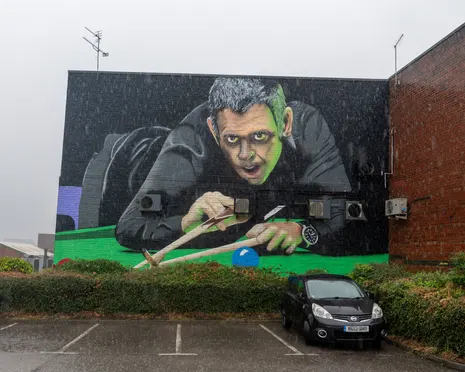
Table of Contents
Sheffield’s Ronnie O’Sullivan Mural Sparks Debate Over Public Art and Its Limits
Wanderstayfinder.com – Sheffield’s growing reputation as a canvas for large-scale street art took an unexpected turn this month when a commissioned portrait of snooker legend Ronnie O’Sullivan drew a wave of online criticism comparing the seven-time world champion to a figure straight out of a horror film. The mural, painted on the rear wall of the Spot On snooker club, has divided local opinion almost overnight, with supporters praising its boldness and detractors calling the likeness grotesque.
The artwork was created by Chris Ashmore, a street artist who received the commission to produce a life-sized depiction of O’Sullivan for the venue’s exterior. Spot On, a well-known snooker bar in the city, sought the piece as a permanent feature celebrating one of the sport’s most decorated players. O’Sullivan, who has claimed seven world titles and remains one of the most technically accomplished players in the game’s history, has long been associated with Sheffield’s sporting culture, making the mural a natural fit for a venue that caters to fans of the cue sport.
The Artist’s Side of the Story
Ashmore pushed back firmly against the negative commentary, explaining that the piece was nowhere near completion when photographs began circulating online. He told interviewers that only two weeks of the five-week timeline allocated for the project had elapsed at the point the images went viral.
“I usually use a scissor lift, where you can stand back and see things as a whole, but I couldn’t use it as the land is too uneven.”
The artist added that the scaffolding had been removed before the final stages of work were complete, meaning the mural was exposed to public view in a partially finished state.
“When the scaffolding came down, I came away and boom – it’s gone viral. I saw people saying it looks like Michael Jackson or a zombie. I’ve got thick skin, I’ll be OK, but it didn’t want feel fair.”
Ashmore confirmed that corrective work — what he termed “touch-ups” — would follow once access to the wall was restored. The uneven terrain surrounding the building, which prevented the use of a scissor lift, complicated the logistics of returning to the piece at height.
A Divided Street
Reactions from Sheffield residents proved sharply split. Gillian Jones, who lives in the immediate vicinity of the mural, told interviewers that the painting “brightened her day” and that she welcomed the addition to her neighbourhood’s visual landscape. For her, the work represented the kind of civic creativity that makes a city feel alive and engaged.
Others were far less charitable. Frank Short, a passerby who stopped to examine the portrait, offered a measured critique:
“The artwork is OK, but the eyes are all wrong. It looks like he’s taken something.”
Shaun Spalding was more blunt, describing the mural as “shocking” and pointing to specific anatomical details that struck him as off.
“His eyes are all wrong, his teeth are wrong, it just don’t look like Ronnie. It looks like somebody who’s got a skeletal face.”
These comments, shared widely on social media, amplified the controversy well beyond the immediate street where the mural sits. The comparison to a zombie — and, in some posts, to Michael Jackson’s later-life appearance — became a recurring motif in the online discourse, with screenshots of the partially completed work circulating alongside snooker fan accounts and local news pages.
The Venue Stands Behind Its Artist
Dan Kirkland, manager of Spot On, addressed the backlash directly, acknowledging that certain facial features required adjustment while pushing back against what he described as personal attacks on Ashmore.
“Yes, we’ve seen what you’ve seen. There are parts of the face that need tweaking, particularly around the eyes and mouth. Some relatively small changes will make a huge difference, so we’ll arrange whatever access Chris needs.”
Kirkland drew a clear line between aesthetic disagreement and personal hostility toward the creator.
“What has upset us is seeing some of the reactions becoming personal towards Chris. People are absolutely entitled to like or dislike a mural. But having an opinion about a piece of artwork is one thing. Slagging off the person who created it is another.”
Public Art, Public Scrutiny
The episode sits within a broader conversation about how cities commission, display, and police large-scale public artwork. Sheffield has invested heavily in its street-art identity over the past decade, with murals appearing across the city centre, the Attercliffe district, and industrial heritage sites. When a council or private venue commissions a portrait of a local figure, the work enters a space where every passerby becomes a critic — and where a single photograph, taken at an awkward angle or at an incomplete stage, can reshape the narrative before the final coat of paint dries.
The timing issue at the centre of this particular dispute — scaffolding removed before the artist finished his work — raises practical questions about how commissioned pieces should be staged, concealed, or protected during production. Ashmore’s reliance on scaffolding rather than a scissor lift, dictated by the uneven ground behind the club, meant that the mural was visible from the street at every stage of its creation. Had the scaffolding remained in place until completion, the viral moment may never have occurred.
For now, the mural remains on the wall, awaiting the corrective pass that Ashmore and Spot On say will follow. Whether the final version satisfies the neighbourhood’s divided audience remains to be seen. What is certain is that the episode has made the Spot On mural one of the most discussed pieces of public art in Sheffield in recent memory — a fact that, for a city proud of its creative identity, is itself a form of validation.
Related Reading
Frequently Asked Questions
What is Artist defends Ronnie O Sullivan mural?
Artist defends Ronnie O Sullivan mural is the main topic of this guide. The article explains the context, practical details, and next steps readers should understand.
Why does Artist defends Ronnie O Sullivan mural matter?
Artist defends Ronnie O Sullivan mural matters because readers are looking for a useful answer, not just a short summary. Good content should match search intent and help them decide what to do next.