Greek Orthodox priest and cult musician clarifies views on homosexuality

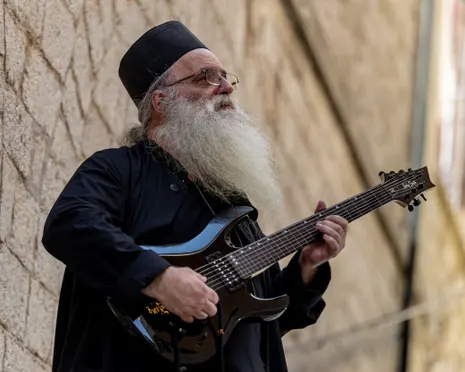
Table of Contents
Greek Priest-Musician Clarifies Position on Homosexuality and Radical Right After Years of Speculation
Wanderstayfinder.com – Greece made history in 2024 when it became the first nation with a majority Orthodox Christian population to enact same-sex marriage legislation. That landmark shift in social policy has, in the months since, drawn renewed attention to one unlikely figure at the intersection of liturgical tradition and avant-garde sound: Father Dionysios Tabakis, a serving Greek Orthodox priest whose self-recorded albums of drone metal and religious dubstep have carved him a niche in experimental music communities worldwide. On Tuesday, Tabakis published a public statement laying out his personal position on homosexuality, his relationship to Greek radical-right politics, and the circumstances behind a long-dormant controversy involving a neo-Nazi party.
A Voice Between the Altar and the Amplifier
Tabakis first entered the broader cultural conversation through his debut album Paradise Metal, issued by the Greek independent label Heat Crimes. The record earned a 7.6 rating from Pitchfork, the influential experimental-music publication, and prompted profile pieces in outlets ranging from the New York Times to the Guardian. His sonic palette — layered drones, processed liturgical chant, and sub-bass pulses — made him a fixture of underground music discourse long before his theological and political remarks became newsworthy.
In the new statement, Tabakis framed his outlook in broadly pastoral terms:
“As can be seen from my musical expression, I am in favour of unity, love, empathy and help for every needy, wronged and suffering person in life. Whoever they are, whatever they believe, whether they are a saint or a sinner.”
The 2024 Blog Posts and the Marriage Bill
The scrutiny that prompted the clarification traces back to two entries Tabakis authored in 2024 on The Doors, an Orthodox Christian WordPress blog. Written around the period when Greece’s parliament was debating the same-sex marriage bill, the posts used language that struck many readers as sharply condemnatory. Gay people were labelled “Sodomites”; the proposed legislation was called a “blasphemous” measure; and the concept of gay marriage itself was described with the Greek phrase σοδομικὸ τερατούργημα, translating roughly as “sodomitic monstrosity.”
Those words landed with particular force because they appeared in the same year the country moved to legalise the very institution the posts denounced. Tabakis’s statement directly addresses the tension:
“My view on homosexuality is the same as that of the Orthodox church for 2,000 years, nothing more, nothing less.”
He went on to emphasise pastoral care over doctrinal rigidity in practice:
“We owe homosexual people love and acceptance because many have at times experienced great rejection from their environment, especially from their families. Over the years, homosexual people have also come to me for confession, and I have always received them with acceptance and love.”
Still, the statement stops short of departing from traditional Orthodox teaching. Tabakis acknowledged that he continues to regard homosexuality as a sin, while insisting on the primacy of personal liberty:
“I also always respect the freedom of my fellow man. After all, with freedom we sin, and with freedom we repent. It is better to sin with freedom than to be virtuous with oppression.”
The Golden Dawn Question
A second thread of controversy resurfaced on Greek social media in recent weeks, centred on a 2013 YouTube clip showing Tabakis performing a sanctification — a formal blessing of a newly opened premises — at an office building belonging to Golden Dawn. The neo-Nazi party held parliamentary seats from 2015 to 2019 before being formally criminalised in 2020; its leadership subsequently received prison sentences for murder, assault, and weapons possession.
In the statement, Tabakis explained that he carried out the consecration as an official duty at the request of his superior ecclesiastical authority, and noted that he had likewise attended blessing ceremonies connected with other political and municipal organisations. Heat Crimes, the label behind his debut record, offered additional context to Pitchfork, explaining that in Greek Orthodox practice priests routinely perform agiasmos — blessing ceremonies for homes, shops, schools, public institutions, military facilities, and other premises. The label stressed that a politician or political organisation inviting a local priest to bless new premises does not, by itself, constitute an endorsement of that organisation by either the priest or the Church. The distinction, in their framing, lies between performing a religious rite and issuing a political statement.
Against Nationalism, in the Spirit of His Grandparents
Tabakis also used the statement to articulate a broader political position, declaring himself opposed to nationalism:
“The only ones who have interests in nationalism and borders are the weapons factories that spread death. Besides, my grandparents from Crete fought Hitler and nazism, so I follow their spirit. In fact, one reason I have removed the frets from my guitar is my mental need not to be confined to borders.”
The remark about fretless guitar — an instrument choice that allows continuous pitch slides and eliminates the fixed intervals of standard fretting — ties his musical practice to a stated philosophical commitment to openness and the rejection of rigid boundaries, whether geographic, doctrinal, or social.
For readers unfamiliar with the Greek context, the episode illustrates a wider tension now playing out across Orthodox-majority societies: how clergy navigate between centuries-old canonical teaching on sexuality and the pastoral reality of a congregation that increasingly includes LGBTQ members, while simultaneously managing public perception in a political landscape where religious figures are expected to take visible stances on issues from migration to national identity. Tabakis’s attempt to hold both positions — doctrinal continuity and personal compassion, liturgical duty and political distance — has made his statement one of the more closely watched pronouncements from a Greek cleric in recent years.
Related Reading
Frequently Asked Questions
What is Greek Orthodox priest and cult musician?
Greek Orthodox priest and cult musician is the main topic of this guide. The article explains the context, practical details, and next steps readers should understand.
Why does Greek Orthodox priest and cult musician matter?
Greek Orthodox priest and cult musician matters because readers are looking for a useful answer, not just a short summary. Good content should match search intent and help them decide what to do next.