Holding election in wartime would risk destroying Ukraine, says Zelenskyy

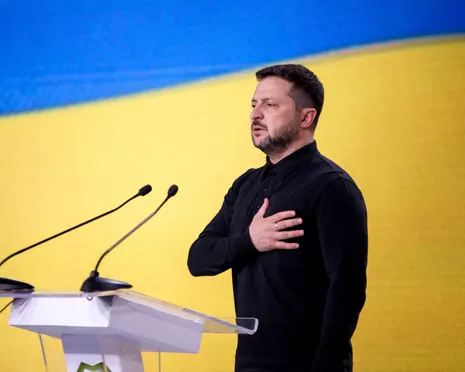
Table of Contents
Zelenskyy Warns Wartime Vote Could “Split Ukraine” as Missile Threats Mount
Wanderstayfinder.com – Ukraine’s president has poured cold water on calls for a snap parliamentary or presidential election, arguing that staging a national vote amid active full-scale war would amount to handing Russia a tool of internal fracture. Speaking to a small group of journalists on Saturday in a briefing whose details surfaced publicly on Sunday, Volodymyr Zelenskyy framed the question in stark terms: a ballot box under bombardment is not democracy, it is a vector for division.
“I believe that if we want to destroy the country, then during such a war we can move in the selection of elections. I believe that during such a war, elections in general are big risks. Elections right now are a tsunami for the state that will split Ukraine.”
The remarks marked the president’s first direct public response to a challenge that had been building inside Kyiv’s own government. Mykhailo Fedorov, the former defence minister who had been dismissed roughly a month before the briefing, had publicly urged a fresh contest. For a sitting leader whose five-year constitutional term lapsed in May 2024, the demand represented the most visible intra-governmental test of his authority since Moscow launched its full-scale invasion in February 2022.
The Martial-Law Freeze and Its Political Cost
Ukraine has operated without scheduled elections since martial law was declared at the outset of the invasion. In peacetime, a five-year presidential cycle would have produced a successor long before the current conflict ended. The suspension, while legally grounded in wartime emergency powers, has nonetheless created a growing question among Western partners and domestic commentators about the durability of democratic legitimacy under prolonged crisis governance. Zelenskyy’s answer, delivered with characteristic bluntness, was that his priority sequence is simple: end the war first, preserve statehood second, and let electoral mechanics follow once conditions permit.
He did, however, leave a narrow door open. If Ukraine’s allies could engineer “specific conditions” guaranteeing that a vote would be conducted safely, legitimately, and democratically, he said he would back the exercise. That would entail organising polling in frontline districts, among displaced populations abroad where millions of Ukrainians now live, and under a guarantee of no strikes or shelling on voting days. The logistical and security architecture required is, by his own framing, far beyond what the current battlefield permits.
The Fedorov Rift
Zelenskyy used the briefing to explain the circumstances of Fedorov’s departure. The former minister, he said, had overstepped his portfolio by attempting to absorb functions that properly belong to the military command structure. Four alternative government posts were offered; Fedorov turned down all of them. The president’s tone was measured rather than bitter.
“I really had and still have a very positive attitude toward Mykhailo. We have been through a lot together. But I believe that he himself goes, or is pushed, into the wrong things.”
The episode nonetheless signals a widening circle of voices inside Ukraine willing to press for political normalisation even while shells fall. Whether that pressure will intensify as the war drags on remains an open question for Kyiv’s domestic politics.
Ballistic Missiles and the Winter Calculus
The backdrop to Zelenskyy’s election remarks was a detailed accounting of Russia’s missile posture. He placed Moscow’s stockpile of high-speed ballistic missiles at between 600 and 630 units, with production running at just over 100 per month in the run-up to winter and a maximum annual capacity of roughly 1,300. Those weapons have been used to strike Ukrainian infrastructure, logistics warehouses, and the capital itself, producing a rising toll of civilian casualties.
The countermeasure gap is acute. US-made Patriot interceptors remain the only system capable of reliably engaging ballistic missiles at range, and supply is thin. Zelenskyy stated that his target for the winter defence package was 300 Patriot missiles, while the air force’s own request stood at 360. He acknowledged the difficulty: global annual output of the most capable PAC-3 interceptor hovers around 600 units.
“I wanted to secure 300 Patriot missiles for the winter package. The request from our air force is 360.”
On the diplomatic front, he announced an agreement with France covering at least one SAMP/T air-defence system to be delivered within the current year, and a separate understanding with Germany for approximately 600 PAC-2 and PAC-3 interceptors slated for delivery across 2027 and 2028. He also floated the possibility that Washington might release a “small percentage” of its own stockpiles – in the range of five to ten per cent – noting that Ukraine was prepared to pay and that such a transfer would let the country “get through the winter” while making, in his words, “a very significant difference both in protecting lives and diplomatically.”
Coalition Pressure and the Donetsk Question
Following a Saturday conversation with Zelenskyy, French president Emmanuel Macron confirmed he had agreed to strengthen Paris’s support for Kyiv, including through interceptor-missile deliveries, though he offered no further specifics. The so-called coalition of the willing – a France- and Britain-led grouping of European partners – was set to convene on Monday to discuss how to escalate pressure on Moscow to halt its invasion.
On the ground, Russian forces are reportedly massing for a renewed push to seize the remainder of eastern Donetsk province that Ukraine still holds, with the objective of completing the capture by year’s end. The territory in question centres on the cities of Kramatorsk and Sloviansk. Zelenskyy expressed confidence that Moscow would fail to take the area, though the missile build-up and the reported consideration of mobilising an additional 300,000 soldiers suggest Kremlin planners are preparing for a sustained winter offensive rather than a brief probing action.
For Ukrainian citizens watching from displacement centres across Europe or from basements in cities under nightly bombardment, the election question is not abstract. It is a question about whether the state that shelters them will remain whole, or whether the very act of choosing leaders under fire could become the instrument of its unraveling. Zelenskyy’s answer, for now, is that survival precedes the ballot.
Related Reading
Frequently Asked Questions
What is Holding election in wartime would risk?
Holding election in wartime would risk is the main topic of this guide. The article explains the context, practical details, and next steps readers should understand.
Why does Holding election in wartime would risk matter?
Holding election in wartime would risk matters because readers are looking for a useful answer, not just a short summary. Good content should match search intent and help them decide what to do next.