The faces behind the feeds: Gen Z’s private lives and public posts – in pictures

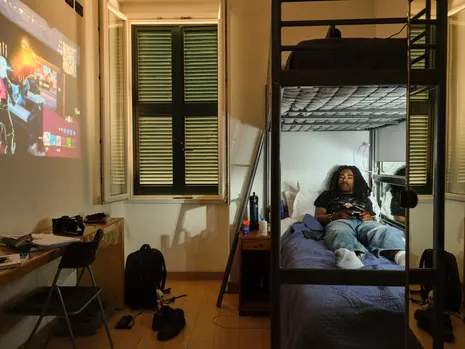
Table of Contents
When the Bedroom Becomes a Stage: A Photographer Documents How Gen Z Builds Identity Online and Offline
Wanderstayfinder.com – The generation currently aged roughly 14 to 27 has never known a world without a smartphone in constant reach. For them, scrolling through feeds, crafting stories, and curating digital personas is not a hobby layered atop daily life — it is woven into the fabric of daily life itself. Understanding how this cohort negotiates the boundary between private self and public performance has become one of the most pressing questions in contemporary visual culture. Italian photographer Niccolò Rastrelli, born in 1977 and squarely of generation X, set out to answer that question through a project he calls IRL, the familiar internet shorthand for “in real life.”
A Photographer’s Motivation
Rastrelli has long gravitated toward subjects who construct identity through self-presentation. Earlier in his career he documented the global surge of cosplay, the youth subculture in which fans embody fictional characters through elaborate costume and makeup. That work sharpened his interest in how young people perform versions of themselves. But he sensed a more universal phenomenon waiting to be examined: the daily act of being “on the socials,” as he puts it.
“In the last few years, I’ve also worked a lot with younger people. I’m older and don’t have children, so I want to understand their point of view.”
That generational gap — between a photographer who remembers dial-up internet and a subject who has never typed a letter by hand — became the creative engine of the project. Rastrelli recruited participants spanning the full age range of Gen Z, from teenagers just turning 14 to adults in their late twenties. While most sessions took place in Italy, he traveled to the United Kingdom, Morocco, and France to capture a geographically diverse cross-section of the generation.
The Two-Part Portrait
The project’s formal structure is deceptively simple. Each subject contributes two paired images. The first is a posed portrait taken in their bedroom — whether that space is a room in a family house, a corner of a flatshare, or a university hall of residence. The young person looks directly into the lens, often holding a phone or seated beside a laptop. Extension cables snaking across the floor, tangled plugs, and the clutter of adolescent life frame the scene. Rastrelli chose the bedroom deliberately.
“I decided to shoot in the bedroom because when you’re young it’s such an important place. It’s really your first solo home. Before social media, it was also the main place where you could build your identity.”
Posters, stacked books, an electric guitar leaning against the wall, a barbell, or a massive stuffed unicorn — these objects function as a visual autobiography. They signal who the occupant is and who they aspire to become. The second component of each pair is a set of screenshots pulled from the subject’s phone, representing their typical online activity. The overwhelming majority come from Instagram, one of the dominant platforms for this age group, and many are ephemeral “stories” rather than permanent feed posts. Selfies warped by novelty filters, casual shots of friends mid-meal, and black-and-white frames captured on disposable film cameras all appear in the collection.
Co-Curation and the Questionnaire
Rastrelli insisted that each participant select their own screenshots, mirroring the way they arranged and posed in their bedrooms. This “co-curation” meant the final image was a collaboration rather than an imposition. Alongside the visual material, he administered a written questionnaire probing each subject’s relationship with social media. The answers unsettled him in several ways.
One recurring surprise: many young people maintain multiple accounts on a single platform, each with a different privacy setting. Lana, 16, runs several Instagram profiles calibrated to varying degrees of openness.
“Only on my most private account do I feel free to really be myself.”
Another finding struck Rastrelli more deeply. A significant number of his subjects described social media not as a space for personal expression but as a professional instrument. The starkest illustration was Francesco, a 23-year-old web developer and social media manager who does not post on his own account at all.
“It’s like when you meet chefs. They all say they don’t cook at home because they’re cooking all day in the restaurant.”
Regulation, Perception, and What Comes Next
The project lands amid intensifying public debate over social media’s effects on young minds. In the United Kingdom, a legislative ban on social media use for under-16s is scheduled to take effect next spring. Italy, by contrast, has no comparable plans on the table. Yet Rastrelli’s conversations suggest the young people he photographed do not experience the platforms as uniquely corrosive compared with their elders.
“Many of them use social media less than people from my generation.”
The principal divergence, he notes, is one of platform choice rather than volume of use. Facebook, now culturally coded as a boomer app, barely surfaced in his subjects’ screens. TikTok, Instagram, and Snapchat dominated instead. This generational migration of preferred platforms has led Rastrelli to consider extending the project’s scope, repeating its methodology to capture how the next wave of digital-native behavior will reshape identity, privacy, and self-presentation in ways that remain, for now, invisible to older observers still learning the language.
Related Reading
Frequently Asked Questions
What is The faces behind the feeds?
The faces behind the feeds is the main topic of this guide. The article explains the context, practical details, and next steps readers should understand.
Why does The faces behind the feeds matter?
The faces behind the feeds matters because readers are looking for a useful answer, not just a short summary. Good content should match search intent and help them decide what to do next.