Skeptical Republicans Demand Details of U.S.-Iran Peace Deal
Wanderstayfinder.com – Following the announcement of a new agreement between the United States and Iran to conclude the ongoing conflict, Republican lawmakers have raised questions about its terms. The agreement, unveiled on Sunday and scheduled for a formal signing in Geneva on Friday, outlines a framework for ending hostilities but has yet to provide comprehensive clarity. Senators returning to Washington on Monday expressed their concerns, emphasizing the need for detailed briefings before finalizing the deal. Among them, Senator John Thune highlighted the lack of understanding, stating, “Even the people who follow this stuff closely up here don’t know that much about it.”
The Memorandum of Understanding
The memorandum of understanding (MOU) centers on key provisions, including the reopening of the strategic strait of Hormuz and the removal of the U.S. naval blockade in the region. These measures aim to restore economic flow and reduce tensions in the area. Additionally, the agreement includes financial incentives for Iran, contingent on meeting specific benchmarks. However, the document remains vague, prompting criticism from Republican officials who argue that more transparency is essential. The MOU was digitally signed by President Donald Trump and Vice President JD Vance, with Iran’s parliamentary speaker Mohammad-Bagher Ghalibaf representing the country.
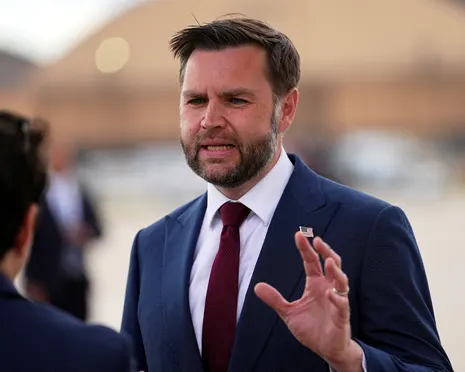
During a Monday interview with CNN, Vance described the MOU as “a very general document,” noting that “on a number of issues, we are going to have to figure this stuff out during the technical negotiation phase.” He estimated the agreement to be “about a page” in length, though later clarified it as “about a page and a half” when speaking to NBC News. This slight adjustment in the document’s size underscores the evolving nature of the talks. Vance also confirmed that international nuclear inspectors from the International Atomic Energy Agency (IAEA) would be granted access to Iran’s nuclear facilities under the terms of the agreement, a critical component for ensuring compliance.
Despite these assurances, many Senate Republicans remain unconvinced. Thune, the Senate majority leader, admitted he had not been personally briefed on the deal, stating, “I think the issues are going to be compliance, and how are you going to enforce that.” His concerns reflect a broader sentiment among the party’s leadership, who feel the agreement lacks sufficient specifics. Thom Tillis of North Carolina echoed this sentiment, asking, “If it’s a secret deal then how can I take it seriously?” Such questions highlight the growing demand for transparency from the U.S. Senate, which has historically received higher-level intelligence briefings before making public statements.
Democratic Support and Public Calls for Action
The push for more information has not been limited to Republicans. Democratic leaders, including Senate Minority Leader Chuck Schumer, have also urged Trump to release the details of the agreement publicly and brief Congress immediately. Schumer emphasized the importance of ending the war “for good,” stating, “We need the details publicly, brief Congress immediately, and end this war for good.” This call for action aligns with the party’s broader strategy of ensuring accountability and oversight in foreign policy decisions.
The MOU, while not yet fully disclosed, is said to include provisions for Iran’s frozen funds to be released, sanctions relief, and a $300 billion fund to aid Iran’s reconstruction efforts if Tehran meets certain conditions. However, the absence of a complete document has fueled speculation. Vance, who has been a vocal advocate for the agreement, stated that the specifics would be addressed during a 60-day technical negotiation phase. He added that IAEA access to Iran’s nuclear sites would occur “very quickly,” given the “broad agreement” on the issue. Yet, the timeline and conditions for enforcement remain unclear, leaving room for skepticism.
Trump’s agreement with Iran marks a departure from the 2015 accord signed under the Obama administration. That deal, which allowed Iran to resume nuclear activities in exchange for sanctions relief, was withdrawn by Trump during his first presidential term. Critics argue that the previous agreement sent “pallets of cash” to Iran, enabling its nuclear program to expand. The current MOU seeks to rectify this by incorporating stricter conditions, but its success depends on how effectively these are implemented. Vance noted that the deal’s goal is to help Iran “destroy the highly enriched stockpile,” a step toward limiting its nuclear capabilities.
Republican Concerns Over Enforcement
As the agreement moves forward, concerns about its enforcement mechanisms have intensified. Thune emphasized the need for clear guidelines on compliance, stating, “I think the issues are going to be compliance, and how are you going to enforce that.” His remarks were shared by several other Republican senators, who believe the agreement’s effectiveness hinges on its ability to monitor Iran’s adherence to the terms. Tillis questioned the deal’s legitimacy, stating, “If it’s a secret deal then how can I take it seriously?”
Senator Lindsey Graham, a close ally of Trump and a longtime critic of Iran, also expressed reservations. He called for a thorough examination of the memorandum, saying, “The way Iran describes it, it’s awful. The way we describe it, it makes sense to me.” Graham stressed the importance of congressional review, suggesting that the agreement must be scrutinized before it is ratified. This sentiment is shared by many Republicans who worry that the deal could inadvertently empower Iran’s nuclear ambitions.
The MOU’s ambiguity has sparked debates about its long-term implications. While the document outlines a framework for cooperation, its lack of detail raises questions about the binding nature of its provisions. Vance’s assertion that the agreement is “a very general document” has led to speculation about its enforceability. Some lawmakers fear that the MOU could serve as a temporary truce, allowing Iran to reassert its nuclear capabilities without significant oversight. Others, however, view it as a necessary step toward stabilizing the region and reducing the threat of military conflict.
Historical Context and Future Implications
The current agreement builds on the 2015 nuclear deal, which Iran agreed to sharply limit its nuclear program in exchange for sanctions relief. Trump’s decision to withdraw from that accord during his first term in office was met with widespread criticism, as it was seen as weakening U.S. leverage over Iran. The new MOU, while similar in some respects, aims to address these shortcomings by incorporating stricter conditions and greater monitoring. However, the absence of a publicly released document has left many unanswered questions, particularly regarding the financial incentives and their conditions.
As the MOU prepares for its formal signing, the political landscape in Washington remains divided. While some lawmakers, including Vance, support the agreement as a step toward peace, others, like Thune and Tillis, demand more transparency. The challenge now lies in translating the agreement’s broad principles into actionable policies that can be enforced effectively. With the U.S. and Iran set to sign the document, the coming weeks will be critical in determining whether this deal will be seen as a breakthrough or a compromise that leaves room for future conflict.
Republicans continue to stress the importance of securing Iran’s commitment to its nuclear program. Thune reiterated that the deal would be “a good one” if the incentives are tied to Iran’s efforts to reduce its nuclear arsenal and eliminate the enriched uranium buried under sites damaged by U.S. strikes last summer. This emphasis on conditional rewards reflects a broader strategy to ensure that Iran’s nuclear ambitions are curtailed rather than encouraged. Yet, the lack of a detailed document has made it difficult to assess the full scope of these conditions, leaving the agreement in a state of uncertainty.