‘Shameful’: UK, Australia and Canada criticise Israel over Gaza aid convoy killings decision

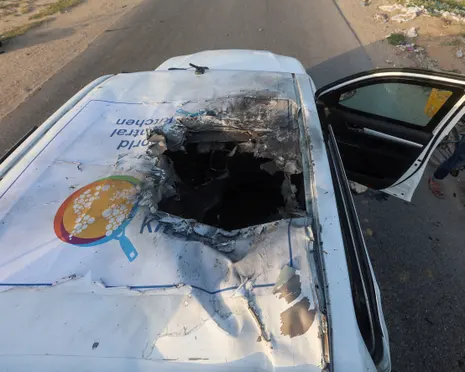
Table of Contents
Three Nations Condemn Israel’s Refusal to Prosecute Gaza Convoy Killings
Wanderstayfinder.com – The question of who answers for the deaths of aid workers in Gaza has long haunted international diplomacy. On Thursday, that question sharpened into open condemnation when Britain, Australia, and Canada jointly labelled the Israeli military’s decision to forgo a criminal probe into the April 2024 airstrike on a humanitarian convoy as “shameful.” Seven staff members of the American-based World Central Kitchen (WCK) organisation were killed in that strike, and the absence of any formal prosecution has now drawn coordinated criticism from three of the organisation’s home governments.
A Joint Statement Demands Justice
The three governments issued a unified communique stating plainly that the outcome falls short of what victims and their families are owed.
“This decision is both too little, and too late. The victims of this incident and their families deserve justice and accountability, and we will continue to seek answers on their behalf. The World Central Kitchen attack is one of countless incidents in Gaza where there has been no accountability.”
The statement went on to underscore the ongoing danger facing aid personnel operating inside Gaza, noting that despite the fragile ceasefire in place, the territory remains the most lethal environment in which to deliver humanitarian supplies. A total of 186 humanitarian workers were killed across Gaza during 2025, a figure that underscores how routine the risk has become for those attempting to reach civilians in desperate need.
National Reactions Sharpen the Criticism
In Canberra, the Australian government voiced its “outrage” at the military’s conclusion. Families of the Australian victim, Zomi Frankcom, pushed back against what they described as an internal, opaque process that terminates with a brief military statement clearing the soldiers of criminal wrongdoing. Israel’s ambassador to Australia, Hillel Newman, publicly defended the decision, arguing that the review had been thorough and proportionate.
In London, the Foreign Office declared that the UK was “appalled and angry” on behalf of the families of three British citizens killed in the same strike: John Chapman, James Henderson, and James Kirby. Their deaths, alongside those of colleagues from other nations, had triggered a wave of global outrage in the weeks following the April 2024 attack.
Poland, which also lost a volunteer in the convoy, voiced its own displeasure. The Polish government said it was “very disappointed” and urged Israeli authorities to cooperate with Polish investigative proceedings into the incident. Damian Soból, a volunteer from the eastern Polish town of Przemyśl, was among those killed.
WCK’s Account and the IDF’s Explanation
World Central Kitchen, which distributed food across Gaza throughout the conflict, had stated immediately after the strike that it had coordinated the movement of its vehicles with the military. The convoy’s cars bore the organisation’s logo on their roofs, visible from the air, a detail WCK emphasised to underscore the clarity of their civilian status.
“There has never been any excuse or justification for the attacks, and there is nothing in this account that does so. The decision is inconsistent with the full truth and deeply offensive.”
The IDF, speaking on Wednesday, offered its own narrative: several individuals inside the vehicles had been mistaken for armed Hamas operatives, and the convoy had strayed from the previously agreed route. Nevertheless, the military concluded that “the decisions of the commanders did not raise reasonable suspicion of criminal misconduct.” Two officers were removed from their posts at the time of the finding, and three others received formal reprimands. One of the dismissed officers had reportedly signed an open letter earlier that year calling for Gaza to be deprived of aid, a detail that added a layer of bitterness to the families’ grief.
A Pattern of Unanswered Questions
The convoy killings do not exist in isolation. Israel imposed strict restrictions on the entry of humanitarian assistance throughout the conflict, and experts declared a famine in Gaza in August 2025. Against that backdrop, the military’s handling of other deadly incidents has drawn parallel scrutiny.
On Wednesday, the IDF acknowledged that its troops had opened fire on a Kia Picanto carrying five-year-old Hind Rajab and six family members in 2024. The child had spent roughly three hours on a desperate phone call to the Palestinian Red Crescent on 29 January 2024, pleading for rescue as the family attempted to flee a new Israeli offensive into Gaza City. All other passengers in the vehicle were also killed. The military said it had ordered a criminal investigation into that killing, as well as into the fatal shooting of 15 paramedics in 2025. The IDF had previously and repeatedly denied that its troops were present near the incident, though investigations by media outlets and independent observers uncovered evidence strongly suggesting nearby Israeli tanks were responsible.
The military framed its reviews as part of its obligations under international law and Israeli domestic law, stating that it examined “exceptional incidents that occurred during combat.” Yet legal experts note that criminal misconduct investigations into Israeli troops over the killing of Palestinians very rarely culminate in convictions, a pattern that lends weight to the criticism now voiced by London, Canberra, and Ottawa. For the families of those killed in the April 2024 strike, the absence of a prosecution is not merely a procedural shortcoming; it is, in their words, a denial of the truth they have sought since the day the convoy was hit.
Related Reading
Frequently Asked Questions
What is Shameful?
Shameful is the main topic of this guide. The article explains the context, practical details, and next steps readers should understand.
Why does Shameful matter?
Shameful matters because readers are looking for a useful answer, not just a short summary. Good content should match search intent and help them decide what to do next.