Search is on for at least 33 Britons missing after flash floods in Nepal and Tibet

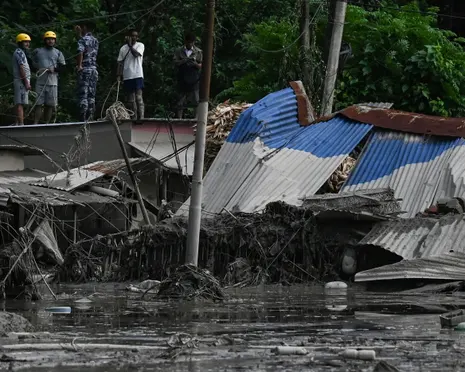
Table of Contents
Glacier Collapse Triggers Catastrophic Floods Along Nepal–Tibet Border, Leaving Hundreds Dead and Thousands Missing
Wanderstayfinder.com – A catastrophic glacier collapse along the high-altitude border between Nepal and China’s Tibet Autonomous Region unleashed torrents of meltwater that swept through mountain valleys, destroying entire settlements and killing at least 353 people. Nearly 1,400 individuals remain unaccounted for in the aftermath, the majority of them foreign tourists who had been travelling through one of the world’s most sacred pilgrimage corridors. Among the missing are at least 33 British nationals, prompting an urgent diplomatic and rescue response from London.
The Rasuwa district, a rugged stretch of Himalayan terrain long favoured by trekkers and religious pilgrims, bore the brunt of the flooding. The sudden release of glacial ice sent a wall of water and debris cascading down river valleys for an estimated 40 to 50 kilometres, obliterating villages in its path. Power infrastructure was destroyed across the affected zone, severing communications and complicating every attempt to locate survivors or the dead.
British Nationals Spread Across Multiple Tour Groups
The missing Britons were travelling with several different operators, complicating the search and accounting effort. Kailash Journeys confirmed that seven of its UK clients – five women and two men, aged between 18 and 55 – could not be reached after the floods struck. The Trekkers’ Society, which runs guided itineraries to Mount Kailash, identified nine British citizens on its manifest: four men aged 14, 50, 50 and 54, alongside five women aged 40, 46, 50, 50 and 53.
Alpine Eco Trek reported that a 13-year-old girl was among its missing British travellers, together with two Irish citizens. The group had been undertaking a nine-day circuit to Mount Kailash and was crossing from Nepal into Tibet when the floods cut them off at the border. Travel logs also place three men aged 65, 64 and 52, and seven women aged 44, 47, 51, 60, 63, 63 and 65, with the same operator.
Himalayan Glacier US stated it had lost all contact with a party of 47 guests, including two British citizens, who were en route to the sacred peak. Nepali agency Fishtail Tours confirmed one additional British traveller missing. The Nepal tourism board verified on Wednesday that 33 UK citizens were among the foreign nationals unaccounted for in the disaster zone.
Scale of Destruction Described as Unprecedented
Bishal Nath Upreti, president of the Nepal Centre for Disaster Management, characterised the event in stark terms when speaking on BBC Radio 4’s Today programme:
“It’s a huge debris, and in fact, after the 2015 earthquake, this is one of the largest disasters that we have [had] in Nepal.”
He described the volume of water released as extraordinary, estimating roughly 20 cubic metres of excess flow added to the river system over the affected stretch. Villages spaced along the valley floor were, in his words, “completely wiped out.” The comparison to the 2015 Gorkha earthquake – which killed nearly 9,000 people and reshaped Nepal’s disaster-preparedness landscape – underscores how rare a single-event catastrophe of this magnitude is for the country.
On the Tibetan side, China’s state broadcaster CCTV confirmed at least three fatalities, while the Xinhua news agency placed the number of unaccounted-for persons in that region at 558. Rescuers on both sides of the border are working to locate survivors in the mountainous terrain, though the scale of debris and the absence of road access make progress slow.
UK Government Mobilises Consular and Rescue Support
Andy Burnham, the UK’s foreign secretary, pledged an initial £5 million in government assistance and offered to dispatch emergency responders to bolster Nepal’s own disaster operations. Speaking to journalists during a visit to south Wales, he described the emerging picture as devastating:
“It’s a devastating picture that is emerging from what has happened in Nepal. Scenes that we’ve never seen the like before, I don’t think, certainly the scale of the devastation.”
Burnham confirmed that consular support staff were being deployed to the region so that British nationals could access assistance around the clock. He added that families of the missing would receive “all the support we can” during what he called “a very distressing and devastating situation.” In a separate written statement, he invoked the long friendship between the two nations:
“In the past, Nepal has been there for Britain in our hour of need, and we will be there for Nepal in its hour of need right now.”
UK minister Pat McFadden told Times Radio that the full picture was “not completely clear yet,” noting that many more people were understood to be missing than the figures initially released by Nepalese authorities, and that no definitive casualty numbers had yet emerged from China.
Royal Family Expresses Deep Sorrow
King Charles and Queen Camilla said they were “heartbroken” by the disaster and extended their “most profound sympathy” to those affected. The King noted that many people in the United Kingdom maintain “strong, deep and personal ties to this part of the world,” reflecting decades of pilgrimage, trekking, and cultural exchange centred on sites such as Mount Kailash. The Prince and Princess of Wales separately expressed their shock, saying they were “thinking of everyone caught up in this terrible disaster.”
Personal Toll: A Family Waiting for News
For Pramod Poudel, a resident of Uckfield in East Sussex, the disaster struck far closer to home than most readers can imagine. His wife, parents, brother and uncle were all caught in the flooding. He told the BBC he would fly to Nepal that Thursday night in a desperate bid to make contact with them.
“I guess there is no power so they can’t charge their phones – to be honest, it’s a very hard and difficult time at the moment.”
In an emotional account, Poudel described seeing photographs of the area where his family’s home had stood:
“I have seen pictures of where my home town used to be … and there is nothing there now.”
Why Mount Kailash Draws Pilgrims and the Risks of the Route
Mount Kailash, rising to 6,638 metres in the Ngari Prefecture of Tibet, is revered simultaneously by Hinduism, Buddhism, Jainism and Bon as a cosmic axis and site of supreme spiritual significance. The traditional circumambulation (parikrama) of the peak, combined with visits to nearby Manasarovar Lake, forms the backbone of multi-day tours that typically cross from Nepal through the Rasuwa corridor. The route passes through some of the most remote and infrastructure-poor terrain in the Himalaya, where a single weather event or glacial failure can isolate entire groups for days. The 2015 earthquake already demonstrated how quickly seismic activity can destabilise glaciers in this range, and climate-driven warming of high-altitude ice has raised concerns among disaster-management agencies about the frequency of sudden outburst floods in the region. For the families now waiting in Britain, Ireland and elsewhere, each passing hour without news deepens the fear that their loved ones may never be found.
Related Reading
Frequently Asked Questions
What is Search is on for at least 33?
Search is on for at least 33 is the main topic of this guide. The article explains the context, practical details, and next steps readers should understand.
Why does Search is on for at least 33 matter?
Search is on for at least 33 matters because readers are looking for a useful answer, not just a short summary. Good content should match search intent and help them decide what to do next.