Russian Artist and Putin Critic Shot Dead in Poland
Wanderstayfinder.com – A Russian artist who was openly critical of Vladimir Putin and the Chechen leader Ramzan Kadyrov was fatally shot in the eastern Polish town of Biała Podlaska, according to a prosecutor’s statement. The incident occurred on Monday, June 16, 2026, and the victim was identified as Robert Kuzovkov, also known by his artistic name Semyon Skrepetsky. Marcin Kozak, a spokesperson for the Lublin district prosecutor, confirmed that five rounds were fired at the man, with one striking him in the head. Two Belarusians were detained in connection with the case but not yet charged.
Context of the Incident
Local media reported that the victim was a well-known Russian artist and performer who had gained attention for his sharp critiques of the Russian government. Kozak emphasized that the attack targeted the individual for his public opposition to Russian authorities. The Belarusian opposition Telegram channel DzikMedia cited unnamed sources, claiming that an unidentified man had tried to scale the fence of Russia’s consulate in Biała Podlaska while escaping police. He was later caught, though the connection between the suspect and the shooting remains under investigation.
Victim’s Background
Skrepetsky, born in the Altai region of Russia, had lived there until 2021, when he moved to Poland to escape political persecution. His work often featured satirical caricatures of prominent figures, including Vladimir Putin, the late opposition leader Alexei Navalny, and even Ukraine’s president, Volodymyr Zelenskyy. He was also known for his scathing portrayals of Ramzan Kadyrov and his son Adam, as well as the Akhmat special forces commander Apti Alaudinov. Just two days before his death, Skrepetsky had shared a painting depicting Ramzan and Adam Kadyrov as pigs, a recurring motif in his art.
Kozak noted that the victim had been actively involved in artistic projects that challenged the policies of Russian authorities. His work, which combined visual satire with political commentary, had made him a prominent voice in the Russian diaspora. The prosecutor added that the victim’s identity would be crucial to understanding the motive behind the attack, as it could reveal whether the act was part of a broader campaign targeting critics abroad.
Poland’s Role as a Target
Poland has positioned itself as a key logistics hub for military and other supplies sent to Ukraine, which has drawn the attention of Russian intelligence operatives. Jacek Dobrzyński, a spokesperson for the special services minister, explained that the country’s strategic role has made it a target for spies seeking to gather information on Ukraine’s efforts to resist Russia’s invasion. The Internal Security Agency, Poland’s domestic intelligence body, has been working closely with local police and prosecutors to investigate the case. However, the Russian embassy in Warsaw has not commented on the incident, leaving the matter to be addressed by Polish authorities.
Skrepetsky’s death has sparked discussions about the risks faced by Russian dissidents in Poland. His artistic work, which mocked both Putin and Kadyrov, had made him a symbol of defiance. The prosecutor’s statement highlighted that the attack was likely motivated by his public criticism of Russian leadership, though the exact perpetrator remains unclear. The two detained Belarusians are under scrutiny as potential suspects, with authorities exploring their ties to the incident.
Kadyrov’s Alleged Involvement
Some Russian artists and commentators in exile believe the killing was orchestrated by Kadyrov, who has been accused of targeting critics both within and outside Russia. Kadyrov’s regime in Chechnya is known for its highly personalized and repressive system, which has led to the detention and assassination of dissenters. Investigators and human rights organizations have linked his associates to several attacks and plots in Europe, including the targeting of journalists and activists. The use of the term “Don” by Kadyrov—a Chechen title meaning “lord” or “master”—has become a symbol of his authoritarian influence, and Marat Gelman, a prominent Russian art collector, suggested that the murder reflected this power.
“The murder of an artist is a terrible event. I hope there will be an investigation, although I’m almost certain it was one Chechen ‘Don,’” wrote Gelman in a post referencing Kadyrov’s trademark use of the word.
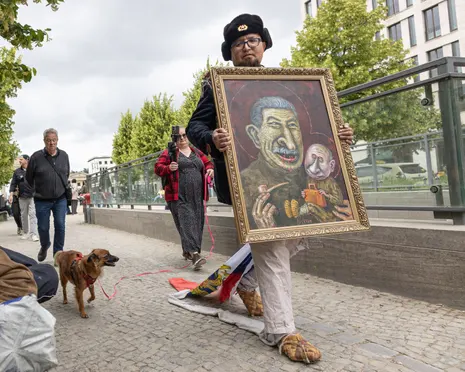
Skrepetsky’s protest in Berlin on June 12, 2026, marked a significant moment in his activism. The event took place on Russia Day, a holiday commemorating the Soviet Union’s dissolution and Russia’s declaration of sovereignty. During the demonstration, he displayed a caricature that juxtaposed Stalin and Putin, drawing attention to their shared legacy of authoritarian control. This act of defiance, combined with his ongoing critiques of Russian policies, may have placed him in the crosshairs of those seeking to silence dissent.
International Reactions and Implications
The killing has raised concerns about the reach of Russian influence beyond its borders. While the Polish government has not yet confirmed a link to Moscow, the incident underscores the growing tensions between Russia and its critics in the West. Skrepetsky’s death has also highlighted the dangers faced by Russian émigrés who continue to challenge their homeland’s policies. His work, which often blended humor with sharp political commentary, had earned him a following among those who opposed the Russian government’s actions in Ukraine and Chechnya.
Reuters contributed to this report, providing additional context on the broader geopolitical situation. As the investigation continues, questions remain about whether the attack was a targeted operation or a random act of violence. Skrepetsky’s family and colleagues in the art community have called for transparency, stressing the importance of uncovering the truth behind the killing. His legacy, however, continues to inspire others who use creative expression to challenge power, even in the face of danger.
Legacy of Defiance
Skrepetsky’s art had become a platform for voicing dissent, often using surreal imagery to critique the Russian regime. His caricatures, which portrayed leaders as pigs or other symbolic figures, were both humorous and provocative, capturing the public’s frustration with authoritarianism. The attack in Biała Podlaska not only marked a tragic loss but also reinforced the idea that criticism of Russia’s policies could come at a high cost. His work, which had been shared online and in galleries, had already drawn the ire of Russian authorities, suggesting that the incident may have been a culmination of his outspoken stance.
As the Polish investigation progresses, the case has drawn comparisons to past targeted killings of Russian critics in other countries. The presence of Belarusians in the suspect list adds another layer of complexity, given the close ties between Belarus and Russia. While no definitive link to Kadyrov has been established, the pattern of attacks on dissenters points to a coordinated effort to suppress voices opposing the Kremlin. Skrepetsky’s death serves as a reminder of the global reach of Russian influence and the risks faced by those who challenge it,