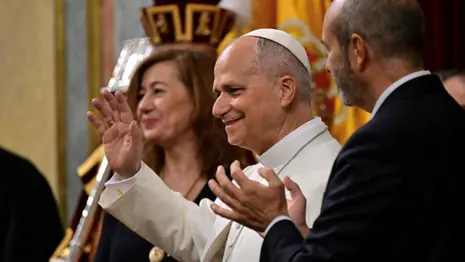
Pope Leo XIV Warns of Global Spiritual and Cultural Crisis During Address to Spanish Parliament
Wanderstayfinder.com – In a pivotal moment of global discourse, Pope Leo XIV delivered a speech to the Spanish parliament in Madrid, addressing a profound spiritual and cultural upheaval affecting societies worldwide. The pontiff emphasized the urgent need for international cooperation to address the root causes and consequences of the “tragic narrative of migration,” which he described as a central challenge to modern humanity. His remarks, which received a seven-minute standing ovation, underscored the interconnectedness of peace, justice, and the ethical treatment of migrants, reflecting his broader concerns about the fragility of global stability.
Global Challenges and Moral Imperatives
The pope’s address spanned multiple critical issues, from geopolitical conflicts to the rapid evolution of artificial intelligence. He argued that the current state of the world is marked by a deep spiritual and cultural crisis, manifesting in escalating violence, ideological division, and a pervasive sense of distrust. “Peace is not merely a political goal but a fundamental moral requirement in this age of turmoil,” he stated, urging nations to prioritize diplomatic resolve and ethical responsibility over militaristic solutions.
“The world is facing a profound spiritual and cultural upheaval, which materializes through diverse forms of conflict, polarization, and a growing disconnect among communities.”
Leo XIV highlighted how this crisis is exacerbated by the global reliance on weapons to achieve temporary calm. He criticized the trend of rearmament in regions like Europe, suggesting it is often presented as an inevitable response to international instability. “True security arises from justice, patient dialogue, and a commitment to respecting the laws that safeguard human lives,” he asserted, emphasizing that policies should focus on people’s well-being rather than the interests of those profiting from war.
Migration: A Moral and Humanitarian Priority
A significant portion of the speech centered on migration, a topic the Pope aims to elevate during his week-long visit to Spain. He called for the creation of “secure and lawful routes” for displaced individuals, advocating for integration opportunities that honor their dignity. “Migrants are often compelled to abandon their homes due to lack of peace, security, or adequate living conditions,” he explained, stressing that these individuals are not just refugees but symbols of the broader ethical dilemmas facing the international order.
“The tragic drama of migration challenges the conscience of nations and threatens the foundations of our shared humanity.”
Leo XIV’s remarks came as Spain’s socialist-led government pursued a progressive policy, regularizing the status of over 500,000 undocumented migrants and asylum seekers. This move contrasts with the country’s far-right Vox party, which has campaigned for a “national priority” policy favoring Spaniards in housing and benefits. Santiago Abascal, leader of Vox, condemned the regularization scheme as an effort to facilitate an immigrant “invasion,” a stance that reflects growing tensions over migration in Europe.
Root Causes of Migration and Global Responsibility
The Pope urged the international community to address the root causes of displacement, including economic inequality, climate-induced disasters, and the erosion of peaceful coexistence. “We must ensure that no one is forced to leave their home because of injustice, hardship, or environmental degradation,” he said, calling for a unified approach to tackle these issues. His vision includes policies that protect vulnerable populations, particularly those most affected by instability and conflict.
Leo XIV also reaffirmed the Church’s teachings on the sanctity of human life, emphasizing that every individual should be respected from birth to natural death. “When this principle is compromised, the most defenseless become the first casualties, and the law loses its core purpose: to serve and protect all people,” he declared. This statement resonated with his call for nations to demonstrate moral greatness by supporting the lives of the most fragile, whether through social programs, legal frameworks, or compassionate care.
Spain’s Progressive Stance and the Pope’s Influence
Spain’s recent decisions on migration policies provide a striking backdrop to the Pope’s address. The country has become a rare example of a European nation embracing a more inclusive approach, contrasting with the stricter measures seen in other regions. This shift has sparked debates about the role of the Church in shaping national policies, particularly in areas like abortion and euthanasia, which have already seen significant legislative changes.
Abortion was decriminalized in Spain in 1985, and subsequent reforms in 2010 expanded women’s rights to terminate pregnancies up to 14 weeks. In 2021, the nation introduced a euthanasia law, reflecting its progressive stance on personal freedoms. Leo XIV’s comments on these issues, though brief, signaled his intent to engage with Spain’s evolving social landscape. He stressed that the protection of human life should be a universal standard, regardless of individual circumstances or political trends.
International Law and the Path to Peace
Throughout his speech, the Pope underscored the importance of international law as a tool for fostering stability and fairness. He criticized the tendency to prioritize military solutions over diplomatic efforts, arguing that such approaches often mask deeper moral failures. “A just and enduring peace requires a steadfast commitment to international law, not the fleeting silence of bullets,” he said, highlighting the need for nations to address the causes of conflict rather than merely its symptoms.
Leo XIV’s visit to Spain, the first time a Pope has addressed the parliament, marks a significant milestone in the Church’s engagement with European politics. As the first U.S. pope, his remarks carry particular weight, especially in light of his past disagreements with the Trump administration over its military actions in Iran and its treatment of migrants. His presence in Madrid is timely, given the country’s socialist government’s efforts to counteract the far-right’s influence on migration and social policies.
A Call for Global Unity and Ethical Leadership
Amid the Pope’s critique of current global trends, he also offered hope. “By uniting our efforts and recognizing the shared dignity of all people, we can overcome this crisis and build a more just and harmonious world,” he said. His speech serves as both a warning and a blueprint for action, urging leaders to adopt policies that reflect the values of compassion, equity, and solidarity. As the globe grapples with these challenges, Leo XIV’s words resonate as a reminder of the moral responsibilities that accompany leadership in an increasingly complex world.