Armenia’s pro-Europe party wins election and cements shift away from Russia
Wanderstayfinder.com – Armenia’s parliamentary elections have delivered a decisive victory to its pro-European party, signaling a broader realignment of the nation’s foreign policy and its long-standing ties with Russia. The results, announced after a tense campaign, reflect the electorate’s preference for a more Western-oriented approach, as Prime Minister Nikol Pashinyan’s Civil Contract party secured a narrow majority. This outcome underscores a growing public sentiment to move beyond Russia’s influence, which has historically shaped Armenia’s political and economic landscape.
European Union and Russian Opposition
The election outcome was celebrated in Brussels, where European leaders saw it as a step toward greater integration with the EU. In contrast, Moscow expressed disappointment, viewing the results as a setback to its geopolitical interests in the South Caucasus. The Russian-backed Strong Armenia alliance, led by billionaire Samvel Karapetyan, managed to secure 25% of the parliamentary seats, a significant but not dominant share. This division highlights the ongoing struggle between pro-European aspirations and pro-Russian factions within the country.
Pashinyan, a former journalist and leader of the 2018 Velvet Revolution, has consistently framed his administration’s goals around peace and economic progress. His platform emphasizes reducing Armenia’s reliance on Russia, a priority that has become more urgent since the 2023 loss of Nagorno-Karabakh to Azerbaijan. The defeat marked the end of a decades-long territorial dispute and left many Armenians questioning the effectiveness of their traditional ally. Pashinyan’s government now faces the challenge of transforming this setback into a catalyst for regional cooperation.
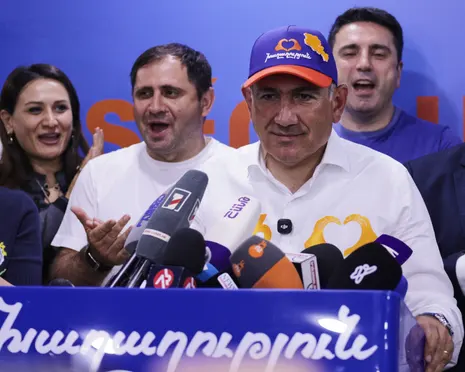
“The people of Armenia voted for peace, regional prosperity and regional cooperation, and I hope this will be met with a positive response from Turkey and Azerbaijan,” Pashinyan stated at his campaign headquarters as early results began to emerge. His remarks underscored the belief that a shift toward Europe could unlock new opportunities for Armenia, fostering stability and economic growth in the region.
Strategic Moves and EU Aspirations
Despite his pro-European stance, Pashinyan has pledged to maintain Armenia’s membership in the Russia-led Eurasian Economic Union. This decision balances the need for economic ties with the west against the reality of continued alignment with Moscow. The prime minister has also positioned himself as a bridge between Armenia and Turkey, advocating for normalization of relations and a peace agreement with Azerbaijan. His vision of a united South Caucasus, free from historical tensions, remains a cornerstone of his political strategy.
European leaders have swiftly acknowledged Pashinyan’s success, with the European Commission president, Ursula von der Leyen, calling the result a “testament to a democratic Armenia” steadily advancing toward Europe. She emphasized that the EU would continue to support the nation’s aspirations. Pashinyan’s alignment with Western powers has also drawn praise from U.S. President Donald Trump, who described him as “a great friend and leader.” This endorsement highlights the growing role of the United States in mediating the Armenia-Azerbaijan conflict.
The election, held just months after Armenia’s defeat in Nagorno-Karabakh, has become a pivotal moment in the country’s history. For many Armenians, the loss of the disputed region symbolized a turning point. Pashinyan has framed this as a necessary sacrifice, arguing that clinging to the territory prolonged conflict and dependence on Russia. His narrative has resonated with voters, particularly in urban centers where the economic impact of the war has been most pronounced.
Challenges Ahead
However, Pashinyan’s path to European integration is not without obstacles. The prime minister failed to achieve the supermajority required to push forward with constitutional reforms, a critical step in finalizing peace with Azerbaijan. This shortcoming has sparked frustration among reformists, who view it as a missed opportunity to solidify Armenia’s sovereignty and territorial boundaries. The absence of a constitutional amendment could delay the peace process, leaving unresolved tensions with Azerbaijan.
Armenian officials and analysts have accused Moscow of actively working to influence the election in favor of pro-Russian candidates. Reports suggest that disinformation campaigns targeted voters, while efforts were made to encourage Armenians living in Russia to return home and cast ballots against Pashinyan. These actions reflect Russia’s enduring influence over Armenian politics, even as the nation seeks to chart a more independent course.
“Armenians are tired of war. We want to be an open, European country that develops and prospers, where I don’t have to worry that my son will be called up to fight,” said Lilit Mkrtchyan, a shopkeeper from Yerevan. Her words encapsulate the hopes of many citizens who see the election as a chance to break free from the cycle of conflict and align with Western values.
The recent election has also exposed deepening divisions within Armenian society. While urban populations largely support Pashinyan’s pro-Europe agenda, rural areas and pro-Russian supporters remain skeptical. This split has been exacerbated by the ongoing conflict in Nagorno-Karabakh, which has created a sense of urgency for change among the populace. The prime minister’s ability to unify these factions will be crucial in implementing his vision for the future.
Pashinyan’s government has already taken steps to distance itself from Moscow, including suspending Armenia’s participation in the Collective Security Treaty Organization. This move marks the most significant break in relations with Russia since the country’s independence, signaling a strategic shift toward the EU. The decision has been met with both admiration and concern, as Armenia navigates the delicate balance between maintaining economic ties with Russia and pursuing European integration.
The 2023 loss of Nagorno-Karabakh to Azerbaijan has reshaped the political discourse in Armenia. It has forced the nation to confront the limitations of its traditional ally, which failed to prevent the territorial loss despite having peacekeepers stationed in the region. This has led to a wave of public disillusionment with Russia, particularly among younger voters who see the conflict as a symbol of outdated geopolitical ties.
As the new parliamentary term begins, Pashinyan’s government will face the challenge of translating electoral success into tangible progress. The prime minister’s emphasis on peace and prosperity has galvanized support, but his push for EU membership and constitutional reforms will require careful diplomacy. The outcome of this election is a clear indication of Armenia’s desire to redefine its place in the world, moving closer to Europe while maintaining strategic ties with Russia.
With the European Union and the United States now more closely aligned with Armenia’s goals, the nation is positioned to leverage this support in its pursuit of regional stability. Yet, the road to full European integration remains long, and Pashinyan’s leadership will be tested by the need to reconcile past allegiances with present aspirations. The election has not only confirmed a shift in Armenian politics but also set the stage for a new era of diplomatic engagement and economic reform.