Passenger jet billed as China’s answer to Boeing and Airbus prepares to make first international flight

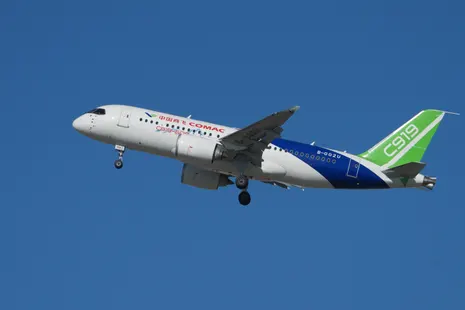
Table of Contents
China’s C919 Takes Its First Steps Beyond Domestic Skies
Wanderstayfinder.com – Wednesday marks a significant milestone for Chinese aviation as the Comac C919 embarks on its maiden international commercial journey. The state-backed aircraft will depart from Beijing Capital International Airport at 3pm local time, heading toward Ulaanbaatar, Mongolia’s capital city. The relatively short hop of just over two hours represents more than a simple route addition—it signals China’s ambition to position itself within the global commercial aviation arena.
While the flight distance may seem modest, the occasion carries considerable symbolic weight. The C919 has been marketed as Beijing’s counterweight to the Boeing-Airbus duopoly that has controlled commercial aviation for decades. This dominance is particularly pronounced across Asian markets, where both American and European manufacturers have maintained strong footholds. Nevertheless, industry observers caution that meaningful competition may require multiple generations of development and refinement.
A Decade in the Making
The C919, manufactured by the Commercial Aircraft Corporation of China (Comac), shares dimensional similarities with the Boeing 737 family. Since entering service on domestic Chinese routes in 2023, the narrow-body aircraft has accumulated flight hours under the watchful eyes of Chinese carriers. However, Wednesday’s Air China service to Ulaanbaatar represents the first commercial deployment of the aircraft on an international corridor.
Scott Kennedy, senior adviser at the Centre for Strategic and International Studies, characterized the flight as primarily a public relations initiative. “Ulaanbaatar was likely chosen because of how close it is to Beijing,” Kennedy noted. “It doesn’t change the fact that the plane was years overdue, is composed of western components, and is less efficient than its Boeing and Airbus cousins.”
The aircraft’s development timeline reflects broader challenges in Chinese aerospace manufacturing. When first unveiled in 2015, Li Jiaxiang, then-head of China’s civil aviation authority, declared: “A great nation must have its own large commercial aircraft.” Yet progress has proceeded at a measured pace, even as China has surged ahead in sectors like robotics and electric vehicle production.
Complexity of Commercial Aviation
The aviation sector demands integration of diverse scientific disciplines and engineering expertise, alongside reliance on international supply networks. A 2020 CSIS analysis revealed that over half of the C919’s component suppliers operated from the United States. This dependency extends beyond individual parts to encompass critical knowledge transfer regarding system integration and software compatibility.
Kyle Chan, a Brookings Institution fellow specializing in China’s industrial policy, emphasized the manufacturing challenges inherent in commercial aircraft production. “Large passenger aircraft and jet engines are extremely complex and challenging to manufacture,” Chan explained. “They require precision components, complex electro-mechanical control systems, and the ability to coordinate a vast global supply chain.”
Chan further noted that commercial aviation presents fundamentally different challenges compared to other high-tech sectors. “There’s a reason there are basically only two major commercial aircraft makers in the world. Building large passenger jets that are safe and reliable is an order of magnitude more difficult than making EVs.”
Production and Market Realities
Comac’s production figures illustrate the gap between ambition and current capability. Last year, the manufacturer delivered merely 15 C919 units to customers, falling significantly short of its annual target of 75 aircraft. The company did not provide public comment when approached for clarification regarding these figures.
Domestic airlines remain Comac’s primary customer base, though international interest exists. In 2023, Brunei-based GallopAir committed $2 billion toward acquiring 30 Comac aircraft, including 15 C919 models. However, the carrier has not yet commenced commercial operations, leaving the aircraft’s international service potential untested.
Regulatory approval remains another hurdle. The C919 has yet to receive certification from either European or American aviation authorities. Complicating matters further, the United States reportedly suspended certain exports to Comac last year, citing reciprocal restrictions implemented during the broader US-China trade conflict. Both nations subsequently negotiated a truce, currently scheduled to expire in November.
Geopolitical Dimensions
Recent diplomatic developments have added layers to China’s aviation strategy. During President Donald Trump’s state visit to Beijing in May, one notable outcome was China’s commitment to purchase 200 Boeing aircraft. In exchange, Washington offered supply guarantees for engine components and related parts destined for Chinese manufacturing operations.
National security considerations underpin China’s aviation ambitions. Zhang Yanzhong, a Chinese Academy of Engineering academic and C919 project expert, told state media that dependence on foreign nations for large aircraft technology “would threaten national strategic security.” Nevertheless, Zhang acknowledged that “a long way to go before achieving commercial success” remained.
Kennedy cautioned against oversimplifying the C919’s identity. Describing it as a purely Chinese aircraft, he argued, proves misleading given the substantial volume of imported components. He expressed skepticism regarding Comac’s prospects as a serious competitor to established manufacturers, stating it remains “very unlikely” for the company to challenge Boeing and Airbus “even a generation from now.”
The C919’s international debut represents neither triumph nor failure in isolation. Rather, it marks one chapter in China’s ongoing effort to establish itself within an industry characterized by centuries of accumulated expertise, stringent safety requirements, and deeply entrenched global supply relationships. Whether this aircraft can evolve from symbolic achievement to commercial reality will depend on sustained investment, regulatory progress, and the patience of both domestic and international stakeholders willing to give Chinese aviation time to mature.
Related Reading
Frequently Asked Questions
What is Passenger jet billed as China s answer?
Passenger jet billed as China s answer is the main topic of this guide. The article explains the context, practical details, and next steps readers should understand.
Why does Passenger jet billed as China s answer matter?
Passenger jet billed as China s answer matters because readers are looking for a useful answer, not just a short summary. Good content should match search intent and help them decide what to do next.