Kyiv Monastery Set on Fire in Night of Russian Attacks Across Ukraine
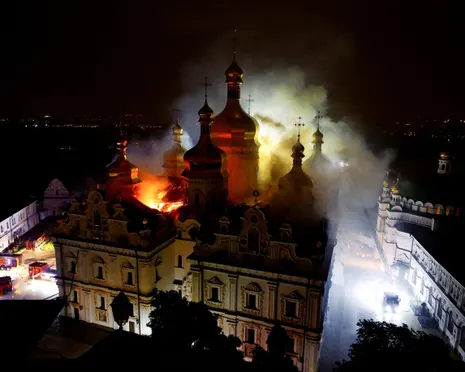
Wanderstayfinder.com – In the early hours of Monday, a fierce assault by Russian forces struck Kyiv, leaving a trail of destruction across the city and beyond. Among the most poignant casualties was the Pechersk Lavra monastery complex, home to the Dormition Cathedral—a UNESCO World Heritage Site and a cornerstone of Ukraine’s religious and cultural identity. The attack, which involved a combination of missiles and drones, ignited flames that consumed parts of the historic structure, drawing international condemnation for its symbolic and physical toll.
A Symbolic Blow to Christian Heritage
Volodymyr Zelenskyy, Ukraine’s president, condemned the assault as “one of Russia’s most serious crimes against Christian culture to date.” Speaking during a tense meeting of G7 leaders in France, he emphasized the need for a decisive response from the alliance. “It is very important that there be a response from the G7 countries, which are now gathering for their summit—this response must be decisive and substantive: more pressure on the aggressor and more support for Ukraine’s air defence, especially anti-ballistic capabilities,” he said, underscoring the gravity of the attack.
“What more must the Kremlin Antichrist do for the world to realise that decisive action must be taken so that the Russian terror against Ukraine and the very principles of peace come to an end?”
The cathedral, a revered site for millions, was not the only target. The Oleksandr Dovzhenko national film studio, which safeguards Ukraine’s largest and oldest costume collection, also bore the brunt of the attack. This dual assault highlighted the breadth of Russia’s campaign, which seeks to dismantle both Ukraine’s cultural legacy and its military infrastructure.
Russian officials quickly dismissed the targeting of the cathedral, asserting that it had been hit by a US-made Patriot air-defence missile. However, this claim was met with skepticism as evidence of the attack mounted. At the Pechersk-Lavra complex, state security officers were seen inspecting the wreckage of two Shahed drones, contradicting Moscow’s narrative. Meanwhile, a tumbled gilded dome from the Art Arsenal museum space lay crumpled in the street, a stark reminder of the devastation wrought by the strikes.
Residents in Peril
The attack unfolded with relentless intensity, forcing citizens into underground shelters as waves of drones and missiles rained down. In Kyiv, the violence left four dead and 23 injured, with heavy explosions shaking the city center. A young priest, who serves as an army chaplain, described the chaos from the monastery grounds. “I only heard one of the two strikes at 4.55am in the morning,” he said, his voice trembling as he gestured toward the scorched copper roofing. “The explosion was massive and blew open one of our windows. Everything was shaking.”
“Everything was shaking. I’m from Bakhmut [the Donbas city levelled during Russia’s devastating siege and capture]. This site is important to everyone. But for the Russians, nothing is sacred—there is no sanctuary. They will claim there was a military object here because they have no values.”
Residents across Ukraine braced for the onslaught, with damage reported at 16 locations in the capital. Tymur Tkachenko, head of Kyiv’s military administration, urged people to remain in shelters as new launches targeting the city continued. “New launches targeting the capital keep being recorded,” he stated, highlighting the ongoing threat.
Ukraine’s foreign minister, Andrii Sybiha, vowed to escalate efforts within UNESCO and other international bodies to address the “state barbarism” inflicted on the monastery. “Ukraine would be urgently initiating procedures to ensure immediate and adequate responses to this destruction,” he said on X, framing the attack as an assault on the nation’s heritage. The French foreign ministry echoed this sentiment, comparing the strike to an attack on Notre Dame cathedral. Jean-Noël Barrot, France’s foreign minister, called it a demonstration of Russia’s “cruelty” and its disregard for cultural landmarks.
As the sun rose over Kyiv, the monastery’s flames still flickered, a testament to the night’s fury. Staff members rang bells in a defiant act, signaling resilience amid the destruction. The attack occurred against the backdrop of global attention on the Trump administration’s peace talks with Iran, as well as Trump’s birthday celebrations featuring a cage-fighting event on the White House lawn. This juxtaposition underscored the complexity of the conflict, where political maneuvers and military strikes coexist.
Legacy in Flames
The Dormition Cathedral, a masterpiece of Byzantine architecture, holds immense historical and spiritual value. Metropolitan Epiphanius, head of the Orthodox Church of Ukraine, lamented its destruction on X. “[The] roof of one of the holiest places in the Christian world—Dormition Cathedral of the Kyiv Pechersk Lavra—is burning,” he wrote, framing the attack as a profound blow to Christianity itself.
The attack’s timing added to its symbolic weight, with Ukraine’s military reporting 70 missiles and 611 drones launched overnight. Of these, 50 missiles and 582 drones were intercepted, showcasing the nation’s air-defence capabilities. Despite this, the damage was extensive, with six individuals reported injured and the cultural fabric of Kyiv fraying.
Zelenskyy’s recent discussions with Donald Trump during the conflict underscored the diplomatic efforts to end the war. However, the monastery’s destruction raised questions about the pace and effectiveness of these negotiations. For many Ukrainians, the attack was a stark reminder of the stakes involved, as their heritage and lives are increasingly under threat.
As the fires subsided, the scene at Pechersk-Lavra remained a focal point of sorrow and solidarity. The cathedral, once a beacon of faith and history, now stood as a symbol of resilience and the ongoing struggle for Ukraine’s sovereignty. The attack not only marked a military victory for Russia but also intensified the call for global support, with leaders urged to act decisively against the aggressor.
With the battle for Kyiv intensifying, the world watched as the monastery’s iconic domes, once a testament to centuries of devotion, faced the flames. The destruction was a calculated move, aimed at eroding Ukraine’s cultural identity and sending a message of dominance. Yet, the reaction from the Ukrainian people and their international allies suggested that the fight for their heritage is far from over.