China Surpasses Competitors in Asia Amid Hormuz Crisis, Report Highlights
Strategic Reserves and Renewable Investments Shield China from Global Energy Turmoil
China is a clear winner – The Asia Group, a geopolitical consulting firm, has released a report asserting that China is the only Asian nation to emerge as a clear beneficiary of the Strait of Hormuz crisis. This conclusion follows a comprehensive analysis of the economic and political ripples caused by the closure of the critical waterway, which has become a focal point of international trade tensions. The report underscores how China’s strategic positioning, bolstered by its vast energy reserves and aggressive renewable energy initiatives, allowed it to navigate the crisis with relative ease compared to other regional powers.
The crisis began when Iran effectively sealed the strait, a vital artery for global oil and gas transportation, after a coordinated strike by the United States and Israel on February 28. The attack targeted Iranian government and military installations, resulting in the death of Supreme Leader Ali Khamenei. This event triggered a surge in energy prices worldwide, with Asian markets facing disproportionate exposure due to their reliance on the waterway. Before the closure, approximately 80% of the oil and nearly 90% of liquefied natural gas passing through the strait was destined for Asia, alongside a significant portion of other essential goods.
Asia Group’s researchers examined the impacts on China, India, Japan, and South Korea, as well as emerging economies in Southeast Asia. They mapped the cascading effects of the conflict across sectors such as manufacturing, energy, and agriculture. The findings reveal that while many nations struggled with supply chain disruptions and rising costs, China’s pre-existing infrastructure and foresight enabled it to capitalize on the crisis. According to Erica Downs, a senior research scholar at the Centre on Global Energy Policy, China’s proactive stockpiling of oil and its substantial investment in renewables have positioned it as a key player in global energy stability.
China’s strategic oil reserves played a crucial role in mitigating the crisis’s effects. The country had built up significant stockpiles, taking advantage of low prices during the previous year. By 2025, its crude oil imports had increased from 11.1 million barrels a day to 11.6 million, with over 80% of the growth allocated to reserves. As of January, China’s stockpiles were sufficient to cover 104 days of imports at the 2025 rate, providing a buffer against price volatility. This preparedness is part of a broader trend, as Beijing continues to expand its renewable energy capacity, aiming to diversify its energy sources and reduce dependency on fossil fuels.
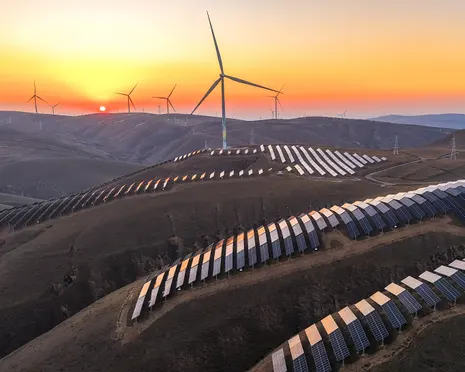
The report highlights China’s remarkable progress in renewable energy infrastructure. In 2025 alone, the nation installed 315 gigawatts of new solar power, accounting for more than half of the world’s additions. The preceding year saw a similar surge, with 277 gigawatts added. These efforts align with Beijing’s goal to have 50% of its energy supply come from non-fossil sources by 2030, a target that includes expanding wind and solar capacity to 30% of the total, up from 22% in 2025. While coal remains the dominant energy source, accounting for over 50% of the mix, the rapid growth of renewables demonstrates a strategic shift toward sustainability.
“With 1.4 terawatts of renewable energy already operational and a reserve of 90-110 days of crude imports, China managed the initial shock more effectively than any of its regional counterparts,” the Asia Group noted in its analysis.
China’s economic resilience also extends to its dominance in the global supply chain for solar and clean technology industries. By expanding production and exporting these goods at competitive prices, Beijing has not only strengthened its position in the international market but also prompted concern among Western leaders. The crisis accelerated this trend, with electric vehicle exports rising over 110% in May compared to the previous year, and solar shipments in April increasing by 60%. These figures underscore China’s ability to leverage geopolitical instability for economic gain.
While the crisis has been a boon for China, it has not been without risks. Drew Thompson, a senior fellow at the S Rajaratnam School of International Studies in Singapore, pointed out that the loss of US credibility in the region could have unintended consequences. “It’s tempting to view any US decline as an advantage for China, but Beijing is cautious about becoming the dominant force in the Middle East,” Thompson said. The report suggests that China’s strategic interests in the region are not solely tied to economic benefits but also to its broader geopolitical aspirations.
Moreover, the crisis has influenced Beijing’s perspective on regional security. Wen-Ti Sung, a non-resident fellow with the Atlantic Council’s Global China Hub based in Taiwan, observed that the challenges of navigating through hostile territory during the conflict may have made China reconsider a potential military move against Taiwan. “The difficulty of securing supply lines in the Hormuz crisis could serve as a cautionary tale for Beijing, highlighting the complexities of military intervention,” Sung remarked.
Despite these considerations, the Asia Group report maintains that China views the challenges posed by the crisis as manageable and even advantageous. “Ultimately, Beijing perceives the pain points as opportunities to enhance its influence and secure long-term stability,” the report stated. This mindset reflects a broader strategy to position itself as a reliable alternative to the US in global affairs, leveraging the instability to strengthen its economic and political standing in Asia and beyond.