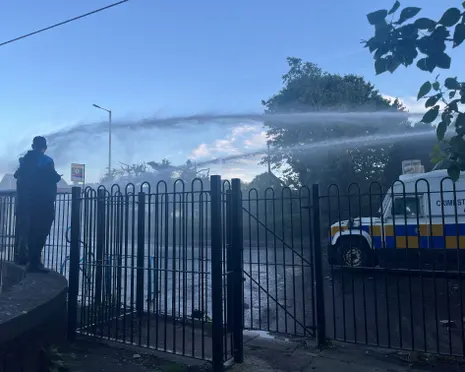
French Police Authorized to Use Water Cannon on Asylum Seekers in £660m Deal with UK
Wanderstayfinder.com – The UK and France have entered into a £660 million agreement that grants French riot police the right to deploy water cannons against asylum seekers in northern France. This arrangement, confirmed to the Guardian, allows specialist units, including a 50-officer riot squad, to operate in collaboration with British authorities to deter migrants and smugglers from launching small boats. The initiative is set to intensify during the summer season, aiming to preempt large-scale crossings into the UK.
Under the terms of the deal, French officers from the Compagnies Républicaines de Sécurité (CRS) are permitted to use water cannons, CS gas, and batons as part of their public order powers. These tools, which can eject individuals from a distance and cause physical harm, are restricted in Great Britain due to concerns about their potential to undermine “policing by consent.” However, the use of water cannons is allowed in Northern Ireland, where they were recently deployed to quell anti-immigration demonstrations.
A refugee advocacy group condemned the agreement, calling it a “sickening escalation” in state violence against asylum seekers. Steve Smith, chief executive of Care4Calais, stated in a
“This would be a sickening escalation in the state violence being waged against refugees here in Calais. The UK government treats refugees as second-class citizens, and funding these types of indiscriminate, violent tactics against refugees in France would underline that. If the use of water cannon is prohibited in Great Britain, then we shouldn’t have a government backing its use against communities in another country. It’s inhumane and the UK government should be ashamed.”
The charity highlighted the disparity between the UK’s domestic policies and its support for aggressive measures in France.
The deployment of elite French riot units was announced by Prime Minister Keir Starmer during the G7 summit in Évian-les-Bains. “These units are just one element of the landmark deal between our countries that is taking our collaboration to the next level,” Starmer remarked, underscoring the significance of the partnership. A permanent CRS team, trained in riot and crowd control tactics, has been stationed on French beaches to maintain public order, according to a government statement. The Home Office emphasized that this unit is better equipped to handle hostile crowds and evolving smuggling strategies, aiming to intercept illegal migrants before they reach the UK.
French riot police have previously used water cannons in various scenarios, including quelling unrest following Paris Saint-Germain’s Champions League victory. In July 2023, officers were captured on camera administering CS gas and batons to asylum seekers and gang members in Calais and Dunkirk as they attempted to board small boats in shallow waters. The CRS has faced allegations of brutality and racial bias, with notable incidents dating back to 2018. During the “gilets jaunes” protests, nine officers were found guilty of assaulting peaceful demonstrators who were seeking refuge from tear gas.
Additionally, leaked WhatsApp messages from two years ago revealed CRS officers sharing an image of a small boat filled with migrants that had capsized. This incident sparked debates about the force’s role in migration control. The UK’s previous home secretary, Theresa May, had ruled out water cannon use on the British mainland in 2015, citing the risk of causing harm. Despite this, Northern Ireland’s police retain access to six water cannons, which were deployed last week to disperse a crowd of around 300 people who had set fire to a truck and hurled petrol bombs near Newtownabbey.
Shabana Mahmood, the current home secretary, first outlined the plan to station French riot police permanently on Channel beaches last month. This initiative is part of broader efforts to enhance security in northern France, which include building a detention center, expanding maritime operations to intercept boats in shallow waters, and increasing the number of officers by 40% on the beaches. Downing Street reported that joint law enforcement actions led to a reduction in attempted crossings, with 40% of attempts halted in May. However, 2,726 individuals still managed to cross into Britain, a figure slightly lower than the 2,826 recorded in May 2023.
Home Office officials confirmed that the funding for the French riot squad will come from French government resources, although the deployment was authorized under the £660 million deal. A source noted, “Policing tactics are a matter for the French authorities,” leaving the UK’s role as a supportive partner rather than a direct operator. While the Home Office has yet to issue a formal comment, the CRS has not responded to requests for a statement. This silence has raised questions about the transparency of the agreement and its implications for asylum seekers in France.
As the summer season approaches, the collaboration between the UK and France continues to evolve, with both nations prioritizing border control measures. The use of water cannons, however, remains a contentious issue, as it symbolizes a shift toward more forceful tactics in the fight against migration. Critics argue that such methods, while effective in dispersing crowds, risk tarnishing the UK’s reputation as a nation committed to humane treatment of refugees. Meanwhile, supporters of the deal see it as a necessary step to address the growing challenges at the Channel borders, with the hope that it will deter more people from attempting the perilous journey to Britain.